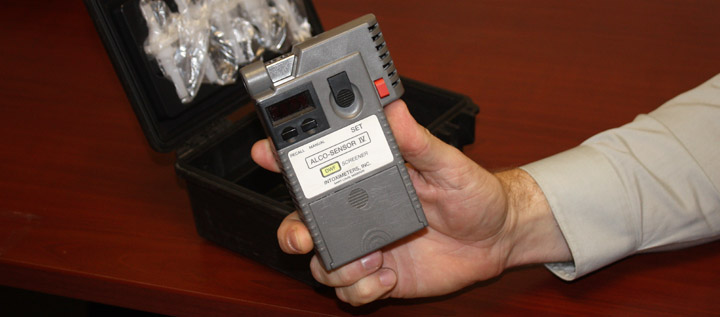
Police in British Columbia have decided to adjust the Approved Screening Devices they use to check a person’s blood-alcohol content in order to address the risk that a driver with a blood-alcohol content of less than 0.05 could potentially be penalized. Roughly 2,200 of these devices are being sent to a police facility in Langley to be readjusted to register a “warn” when a driver has a blood-alcohol content of 0.06 instead of the current threshold of 0.05. Photo by Paul Everest - Click on picture for larger image
OSOYOOS TIMES-November 24, 2010
By Paul Everest – Osoyoos Times
Because of the possibility of a discrepancy in their precision, police across the province will be adjusting the devices they use to conduct roadside driver impairment checks.
Chief Constable Jamie Graham, the chair of the British Columbia Association of Chiefs of Police’s traffic safety committee, announced on Nov. 19 that police are being asked to immediately adjust their Approved Screening Devices (ASDs)to issue a “warn” reading for 60 milligrams of alcohol in 100 millilitres of blood, or a 0.06 blood-alcohol content level.
Until now, a 0.05 blood-alcohol content level would register a warn when police used the devices, which are often referred to as roadside breathalysers by the public, during roadside stops.
New driving penalties brought in on Sept. 20 meant that any motorists who were found to have a blood-alcohol content within the “warn” range of between 0.05 and 0.08 faced a driving ban of between three and 30 days as well as hundreds of dollars in fees and penalties depending on how many “warn” offences the motorist had racked up in a five-year period.
In his announcement, Graham said because the ASDs are being used more and there is “a greater emphasis put on the evidence they produce for provincial law enforcement, we believe they merited closer scrutiny.
“There is a very small margin of error where a WARN reading could potentially be lower than .05 mgs.,” Graham said, adding that the margin of error has not been a “significant problem in the past.”
“We now believe that out of an abundance of caution and to ensure they provide accuracy and any doubt is resolved in favour of the public, the devices should be adjusted.”
Police in British Columbia will send roughly 2,200 of the devices to a police facility in Langley for the adjustment.
The recalibration is expected to be complete by the beginning of December.
Graham said while the devices are being adjusted, police will still issue 24-hour driving prohibitions and will carry out investigations into cases of impaired driving where criminal charges might be warranted.
“However, three, seven and 30-day roadside prohibitions will not be issued unless the sample was obtained by a readjusted ASD or using the current ASD when there is a FAIL reading,” he said.
An ASD will register a fail if a person has a blood-alcohol content of 0.08 or above.
Being found with 80 milligrams of alcohol per 100 millilitres of blood could bring about criminal charges.
The levels for the “fail” range will not be changed.
Part of the reason the province decided to get tougher on motorists caught with a blood-alcohol content between 0.05 and 0.08 — the so-called warn range — was because police were issuing between 30,000 and 40,000 24-hour suspensions in British Columbia every year.
Under pressure from the province’s hospitality industry, which claimed the new drinking and driving penalties were hurting business since people were afraid to drink any alcohol before driving, Rich Coleman, B.C.’s minister of public safety and solicitor general, said on Nov. 9 that the province would be examining the new penalties “to ensure they are working effectively.”
Coleman said one consequence of the new penalties is that responsible drivers have been forced “to err on the side of extreme caution.”
The province will therefore look at “how more public education can continue to support responsible drivers in making safe decisions when they go out for a meal or to celebrate with friends,” he said.
Coleman added that he had talked with provincial law enforcement leaders about encouraging police to use discretion when it comes to towing or impounding a vehicle.
Such discretions, he said, include the option of “parking a vehicle, if it is safe to do so, or allowing a sober passenger or friend to get a vehicle home” if the driver has only been caught once or twice in the warn range.
The province is now facing questions about what happens to people who have received driving suspensions for registering a warn within the “margin of error” range of an ASD.
In a statement released to media following Graham’s announcement, the Ministry of Public Safety and Solicitor General stated that “The provincial government is reviewing the implications, if any, for motorists who have received fines or suspensions in the ‘warn’ range. Government continues to consult with affected groups and individuals to determine whether any legislative changes are needed.”
Local police were not available for comment.
[email protected]