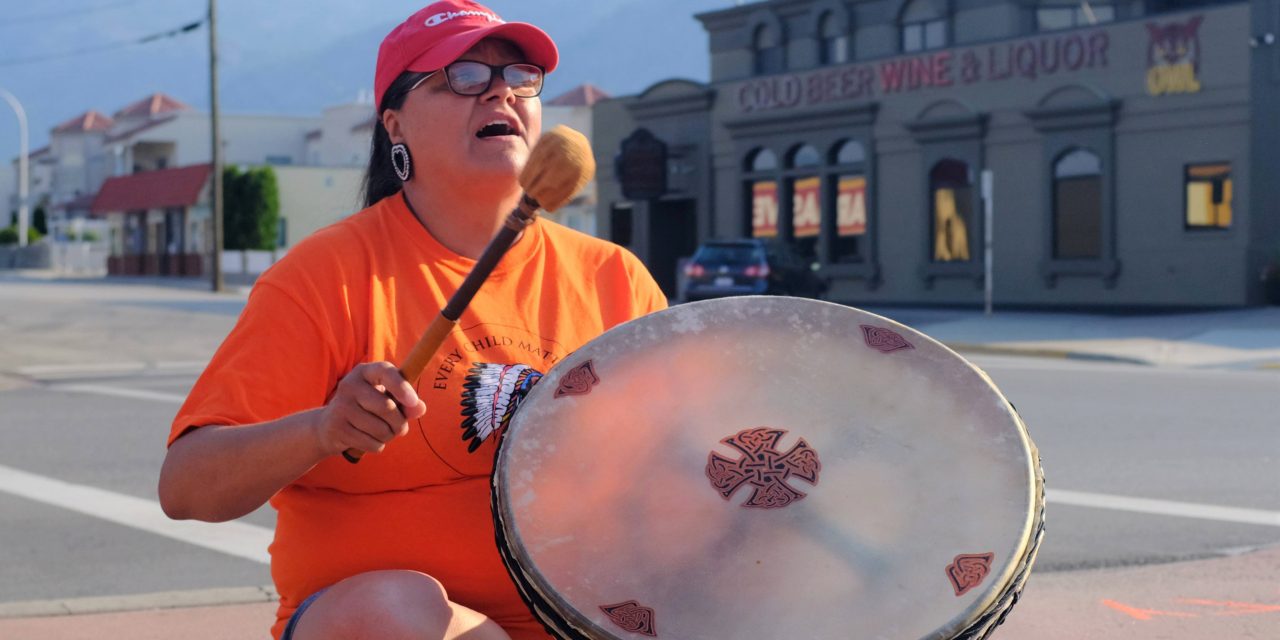
Tammy Watson was by the water at Gyro Park early morning on July 1 when she heard the drums beating. She followed the sound and found herself at the main intersection on Main Street, Osoyoos where she saw a group of locals drumming.
“I thought at first what’s going on? Some construction happening or something? And it just went boom, right in my heart. And then I knew someone’s drumming,” said Watson. “I’m just drawn to it, drawn to the drum.”
Watson, who is part of the Saulteau First Nations, was visiting Osoyoos last week to bring water from Spotted Lake to her healer who was feeling sick. She and two Elders from the community were in town for two days.
When Watson spotted the drumming on Main Street, she phoned the Elders, Judy Belcourt and Judy Desjarlais to come meet her there and bring their drum.
At the intersection across from the Owl Pub sat locals Wina Poliquin, Ashley Walter, and Raina Dawn Lutz who planned to do the solidarity sit-in the night before to show their support for the Indigenous community after the recent findings of unmarked burials across the country in former residential schools. They called their sit-in a “global mourning.”
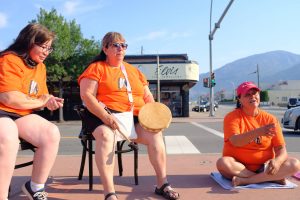
(Left to right) Judy Belcourt, Judy Desjarlais and Tammy Watson on Main Street Osoyoos. Neha Chollangi photo.
The three started drumming at 7 a.m. on July 1. They hoped to create some visibility in the community about the importance of the issue and spend Canada Day to reflect on these tragedies.
When Watson unexpectedly dropped by and joined their circle to drum, sing and share her knowledge, Walter said it felt “divine.”
Honks, cheers, and waves filled the streets as people walked and drove by the sit-in, expressing their support for the cause.
“It was so wonderful to meet local people on Canada Day, or what we call Turtle Island Day, and see locals drumming and recognizing residential schools and the suffering that we share across Canada for Indigenous people,” said Watson.
When Watson, Belcourt and Desjarlais joined the circle, they sang the Cree morning song Waniska with the drums. The song gets louder and louder as it goes on.
Waniska means to wake up, explained Watson.
“In the song our words mean ‘wake up, the sun is shining, the birds are singing. It’s a beautiful day.’ And that song was sung in the villages back in the day, and they had a person that would go around and wake everybody up and get everybody going in the morning.”
She added that it brings her so much hope that Canada is finally waking up. Though Watson said it’s a very sad time of mourning for the country, she feels hope that people are recognizing the fact that there is a lot of work to be done.
A number of cities and towns across Canada held solidarity walks on Canada Day, where streets flooded with orange.
With a large push to hold off Canada Day celebrations this year in respect for the Indigenous children who suffered in residential schools, these solidarity walks were a way for people to come together and give space for First Nations.
Since the discovery of the mass burial of 215 Indigenous children at the former Kamloops Indian Residential School just over a month ago, many more residential school sites across the country are being investigated for remains.
The tally has been growing for the past month.
Cowessess First Nation in Saskatchewan announced the finding of 751 remains in the cemetery near the former Marieval Indian Residential School. Most recently, 182 unmarked grave sites were found at St. Eugene’s Mission School near Cranbrook, B.C. last week.
Just over a few weeks, the number of children found at the former sites has climbed to over 1,000. And the search continues.
Walter, a meditation teacher in town, said she stopped celebrating the holiday a few years ago.
“I use this time of the year to reflect on reconciliation, as I do all year long, but I place special emphasis at this time,” she explained.
Walter had a meditation session the night before on June 30th, and spoke to Poliquin after about wanting to do something on Canada Day to show support and solidarity for the First Nations community.
Later that evening, they decided to meet early in the morning the next day to drum.
“I thought what else can be better than if we actually do this in town so that we can have visibility and make people see that there’s support,” said Poliquin. “Overall I find there are more people in the community who want to see solidarity, but there’s not many people taking the initiative to get it going.”
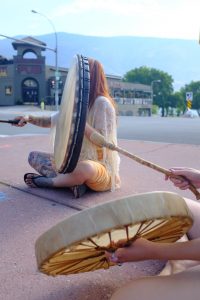
Wina Poliquin and Raina Dawn Lutz drumming on Main Street in Osoyoos. Neha Chollangi photo
Although nearly everyone who passed by the group showed vocal support, Walter mentioned that one man who drove by just the three of them earlier in the morning shouted “go get jobs.”
“We all looked at each other and we said, ‘this is our job.’ It’s our job to be present, supportive, be an ally and stand in solidarity,” said Walter. “To me, this man speaks out in that way, because he has a level of fear and ignorance from not being educated on on what’s happened in our history.”