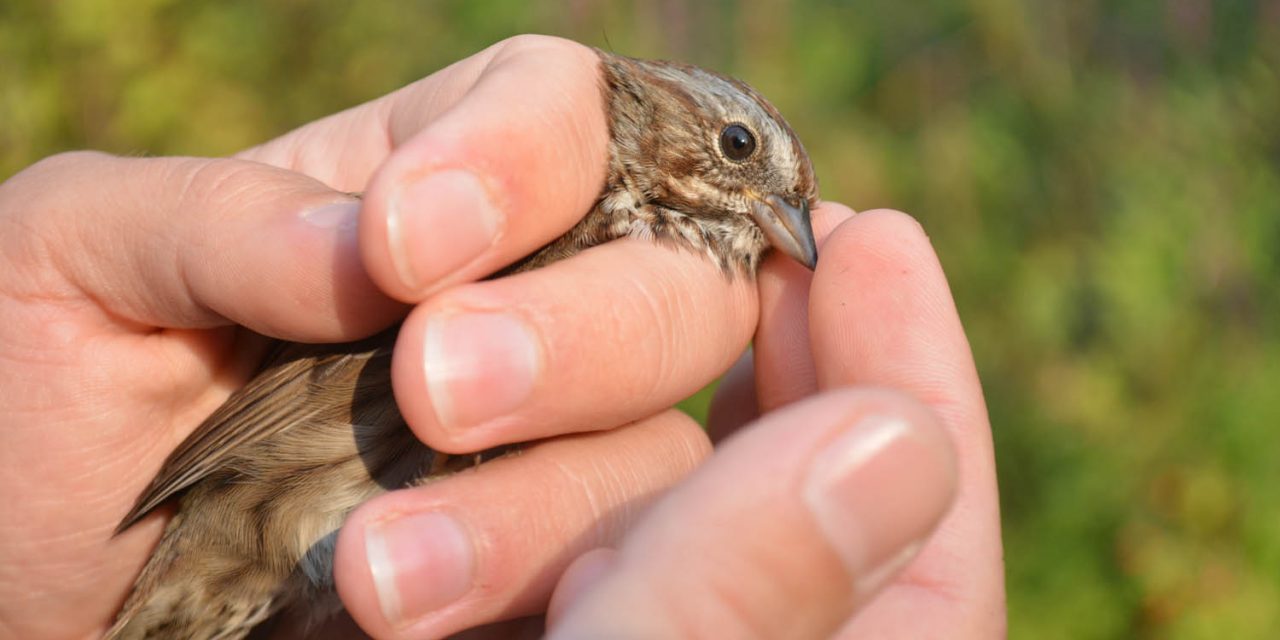

A song sparrow is carefully held in the hands of bander in charge Matthias Bieber at the Vaseux Lake Bird Observatory. (Lyonel Doherty photo)
Nature lovers keen on getting up close and personal with wild birds will be in for a real treat on Sunday, Sept. 23.
That’s when the Vaseux Lake Bird Observatory will host its annual open house from 9 a.m. to noon.
Bander in charge Matthias Bieber said the open house will give people of all ages a unique opportunity to view their operation and learn how their research impacts migratory song birds.
The public will see firsthand how volunteers collect the birds from 14 nets on the property and record their data before releasing them back in the wild.
Joining Matthias will be assistant bander Jason Bieber, who has extracted 3,000 birds during his 1,000 hours of volunteer banding. For those interested, he can explain how to become a volunteer and obtain a permit to handle the birds.
The mist nets they use are made of a fine nylon mesh that you can barely feel when your hand comes into contact with them. The birds fly into the nets and become trapped, which allows volunteers to collect them.
“Oftentimes they are just lying there and they’re not even aware that they’re trapped,” Matthias said.
Extracting the birds is a very delicate process and requires a lot of training; it takes hundreds of hours of experience and not everyone can do it.
While getting caught in a net isn’t fun, it’s relatively low-stress for the birds, he pointed out. The birds are handled very quickly and released immediately after the data is collected.
During the open house the public will see the extraction and banding process up close.
The event will also have exhibits, artifacts and guided tours.
The observatory, one of 25 stations across Canada, is located one kilometre north of the Vaseux Lake wildlife centre and boardwalk on Highway 97.
Matthias said their focus is to collect data on bird population trends over time as part of the Canadian Migration Monitoring Network.
“By collecting all the data from these different stations and combining it they are able to analyze the trends … to see over time if bird populations are declining or not.”
In addition to the banding data, they also do daily observations and census of everything they see in the bird world, not only in B.C., but also across Canada.
“Most of the birds that breed in the boreal forest pass through one of our stations in Canada. It’s kind of a good indicator for how well they are doing,” Matthias said.
He noted that the past three years have shown good numbers, but it depends on the species.
“It’s hard to say overall if birds are increasing or not, but if you look at specific species, the ones that we monitor really well, you can definitely see differences in how their numbers are doing.”
Matthias said there are a lot of species that have declined over the last 10 years, while others have thrived. He noted it’s really dependent on local changes to climate and how that affects bird habitat.
“We have a few species here this year that are actually doing super well, based on what we found from our last month of data collection.”
He stated this has more to do with how local conditions are affecting the site. For example, there are a few species that breed on site and they are doing really well.
“It probably has to do with the wet spring that we had and the water levels. We had really good dense vegetation, a lot of mosquitoes and that kind of thing.”
He noted this might be different for birds coming from up north due to fires and habitat loss.
Overall, many birds are declining, Matthias said, especially those that feed on insects, a food source that is facing population declines due to pesticides, he pointed out.
He stated that the rufous hummingbird is experiencing a big drop in numbers too.
Matthias suspects that the wildfires in B.C. have had a negative effect on some species, particularly those that breed here.
Some of the more common species that banders catch at the observatory include the gray catbird (more than 200 caught this year), willow flycatcher, yellow warblers, song sparrows and American goldfinch.
Rare species they have caught include the gray flycatcher (threatened and only found in the Okanagan). The yellow-breasted chat is another obscure species that is endangered, Matthias mentioned.
He was asked what the world would be like if there were no birds on the planet.
There would probably be all sorts of chaos, he said.
“They play a vital link in the food network as a whole. Without them our insect population would probably be out of control.”
Birds also help disperse seeds to help spread native plants, while others help pollinate flowers. And obviously they are a food source for a lot of higher predators, Matthias pointed out.
Yes, so if we didn’t have any birds, there would likely be a lot of crazy stuff going on in the world, he admitted.
The ultimate goal of the monitoring program is to learn what can be done to protect the birds and prevent their decline, Matthias said.
“Some of the main threats to birds right now are outdoor cats; that’s probably the biggest one, in addition to habitat loss. Outdoor cats are a major issue; they kill hundreds of millions of birds every year in North America.”
Matthias said the big initiative right now is to spread that awareness with the hope that people will work towards having indoor cats only.
Jason suggested having cats on a leash outdoors.
“My mom is, I think, a good example of this. She has her cat on a leash attached to a clothesline.”
Jason said studies have shown that cats only bring back 20 per cent of what they actually kill.
Matthias said urban development is a big contributor to habitat loss.
“Habitat like this, riparian, sort of marsh wetland habitat that we’re in is almost … you almost can’t find it anymore in the valley bottom because it’s been so developed.”
So protecting what is left is so important, he said.
Jason said the construction industry has to be smart about what type of development is being built. For example, high-rise buildings made of glass contribute to bird mortality in a big way, he noted.
LYONEL DOHERTY
Special to the Times

A song sparrow is carefully held in the hands of bander in charge Matthias Bieber at the Vaseux Lake Bird Observatory. (Lyonel Doherty)