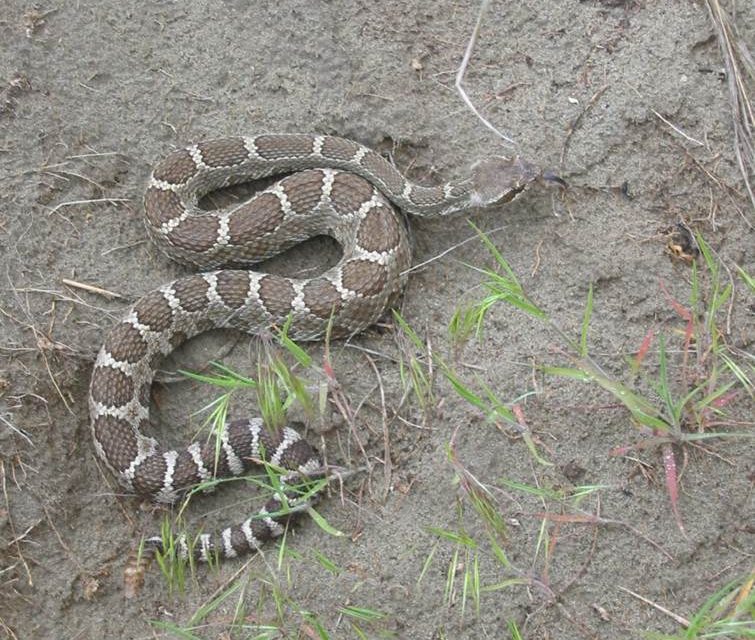

Rattlesnakes in the South Okanagan may bite if they are threatened or harassed. Use caution and common sense to avoid them.
Rattlesnake bites can be serious, and prevention is best. Every year, about 2-3 people are bitten in BC. Since the year 1900, two people have died as a result of rattlesnake bites.
The rattlesnakes that we have in the South Okanagan are called the Northern Pacific Rattlesnakes. They are not as venomous as those that live in the southern United States. They are also not out to get you, and will not chase you to bite you.
“The rattlesnakes of this area are rather timid,” says snake biologist Mike Sarell. “They will slither away to avoid conflict.” If they feel threatened, they will first give you a warning with their rattle, and give you the opportunity to walk away. Striking and biting is their last option for self-defense.
“Most often it has been people who harass them or try to kill them who get bitten,” says Sarell.
The Wildlife Act prohibits the harassment, killing, or capturing of snakes, unless it is to protect human life, domestic animals, or property.
“Farms and vineyards often have trained personnel who know how to handle a rattlesnake in order to relocate it if it poses a threat to workers,” says Sarell. “Workers should know who that person is on their farm, so that if they see a snake, they can call on that person to assess the situation.”
If you feel a rattlesnake is a threat, it is much safer to carefully and slowly capture it in a garbage can than to try to kill it. Release the snake as soon as possible in a wild area near the capture location, to ensure they are able to return to their den.
There are seven different kinds of snakes in the Oliver area, so it is important to know what they look like so you know which ones are harmless, and which potentially hazardous (the rattlesnake). The South Okanagan Similkameen Stewardship Program has a series of free downloadable brochures on local snakes (http://www.soscp.org/stewardship/caring-for-your-space/).
Snakes are generally unwanted and feared. However, they play an important role in the environment, being major predators of rodents (such as mice, pocket gophers, young marmots).
“Snakes can greatly reduce rodent populations that damage crops,” says Sarell. “Snakes themselves, are also an important food source for birds of prey like owls and hawks, and other predators.”
Snake populations are declining in the area, and efforts to raise awareness about them and decrease fear around them have been underway for several years.
Some tips to avoid being bitten:
- Be on the lookout for rattlesnakes where they are likely to be present (trails in rocky areas, open grasslands, wetlands, and agricultural areas where there is debris, waterlines, or shelter).
- Wear protective footwear, such as rubber boots or high leather boots, when walking in tall grass or areas where you cannot clearly see the ground.
- Never put your hands or feet where you cannot see if a rattlesnake is present.
- Avoid picking up objects under which a snake might hide. If you must, use a pole to carefully flip over the object.
- Avoid getting close to a rattlesnake and agitating it (stay at least the snake’s body length away).
- Stay calm when a rattlesnake is encountered and leave it alone. Ensure that others do the same.
- Do not harass snakes; they may bite when threatened.
If you are bitten, keep calm, minimize exertion, and get to the hospital as soon as possible. Don’t try to suck the venom out or apply a tourniquet as they do in the movies. Instead, let it bleed freely and remove all restrictive clothing and jewelry.
Fear of snakes can be reduced with knowledge of the different kinds of snakes, and with knowledge of what to do if we encounter one. Be safe, get informed, and help us co-exist with snakes.