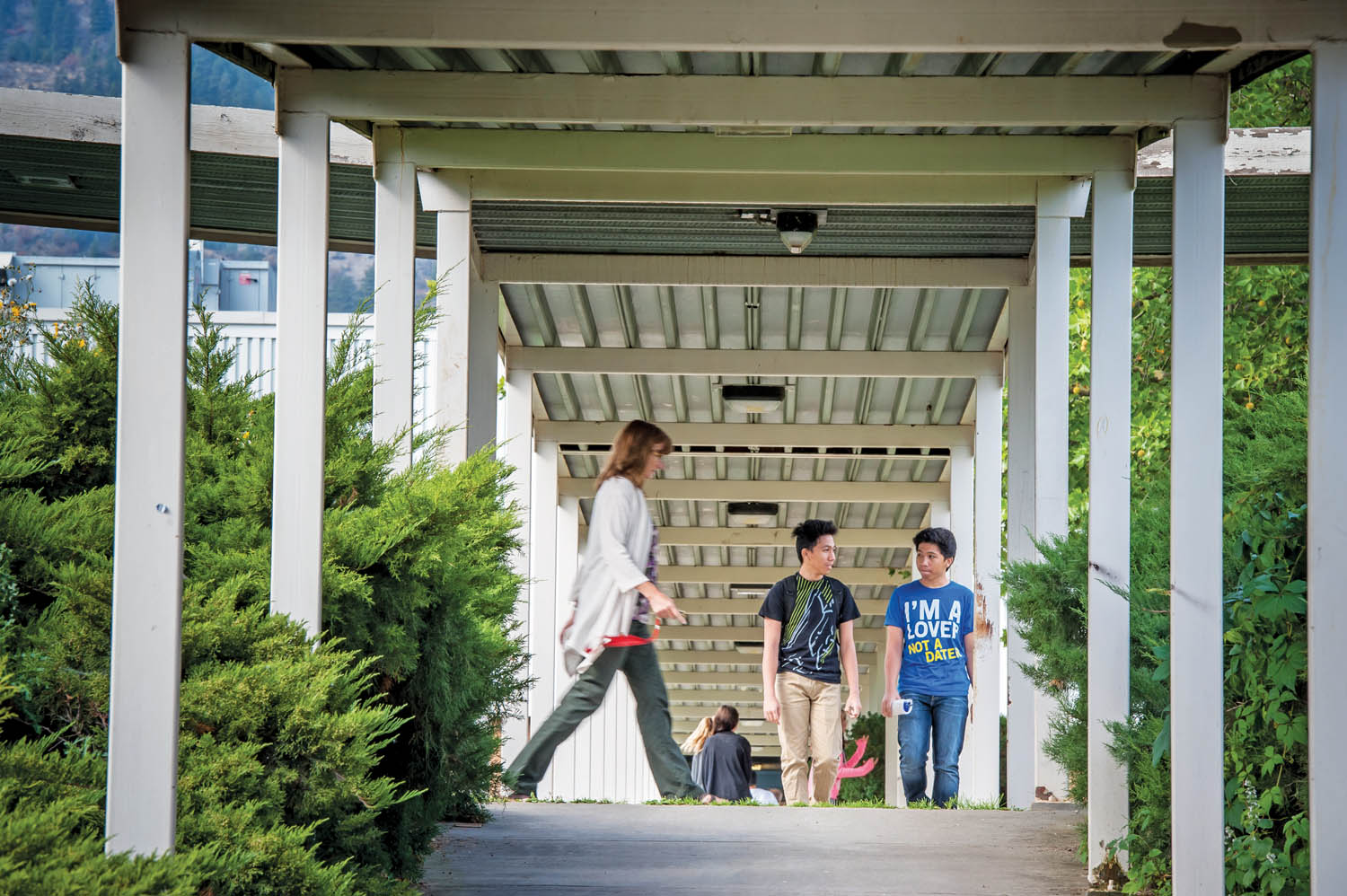
Students walk between classes at Osoyoos Secondary School in this file photo. School District 53 is again considering closing OSS and busing students to Oliver. (Richard McGuire file photo)
The annual savings from closing an Osoyoos school is less than $400,000, leaving the school district without enough to eliminate its structural deficit.
School District 53 revealed the cost savings in a slide presentation prepared for Tuesday’s night’s public consultation meeting being held as a necessary step to closing either Osoyoos Secondary School (OSS) or Osoyoos Elementary School (OSE).
The projected annual savings of closing OSS would only be $387,300 after additional busing costs are taken into consideration, School District 53 acknowledged.
This falls well short of the current structural deficit of $530,000 that the district has identified, and which is predicted to rise to $1.1 million in 2016-17.
Closing OSS would, however, avoid making nearly $4.8 million in capital upgrades to the school over the next five years.
Those figures were expected to be presented at Tuesday’s consultation meeting at OSS, taking place after the Osoyoos Times goes to press.
Closing OSE would result in $397,800 annual savings after additional busing costs are taken into account.
This figure doesn’t include the one-time $600,000 cost of renovating OSS to convert it into a Kindergarten to Grade 9 school. Under that proposal, students in grades 10 to 12 would be bused to Oliver.
Closing OSE would avoid $1.8 million in capital upgrades over the next five years, the school district said.
There are also differences in the ownership of the two Osoyoos schools, affecting whether the school district would benefit from selling them off.
OSE is owned by the school district, meaning it would retain any proceeds from the sale of the school. Those proceeds could be used for other capital projects. The district could also choose to lease out the school.
Proceeds from selling OSS, on the other hand, would revert to the provincial government.
Since 2005, total enrolment across the school district has declined by 651 students, or 23 per cent, the school district said. School districts are funded by the provincial government on a per-student basis.
At the same time, most schools are aging and are in poor condition, with limited capital dollars available.
The province requires school districts to submit balanced budgets by June 30 of each year.
The province provides a “small community supplement” for elementary schools with less than 250 students in a 5 km radius and secondary schools with less than 635 full-time-equivalent students in a 25 km radius.
This provides an incentive to the school district to keep schools such as Okanagan Falls Elementary School open. OSE doesn’t qualify because it has 317 students and OSS doesn’t qualify because it is only 22.5 km from Southern Okanagan Secondary School (SOSS) in Oliver.
The school district says it has made cost reductions since 2009 totaling $1 million including staff reductions, reduced transportation and administrative cost cuts.
As of 2017, schools across the district will have an excess capacity of 820 students. More than half that excess capacity – 424 students – is at the three Oliver schools – SOSS, Oliver Elementary and Tuc-el-Nuit Elementary.
Cawston Primary School is the only school in the district that is over its capacity, with six excess students projected in 2017. This is because students are bused to that school from Keremeos.
Schools in Cawston/Keremeos generate a special $500,000 provincial grant to the school district that would be lost if the Cawston school were closed.
The school district said that further initiatives to reduce expenses such as a four-day school week would require additional analysis and a district-wide consultation process.
“The board would be unable to commit that future consultations regarding the closing of schools would not occur if these strategies were implemented,” the school district’s slide presentation concludes.
The public may continue to provide written feedback to the school district on the proposed closures until March 3.
A second public consultation meeting on March 8, at OSE, will report on feedback received up to March 3 and allow the community to make further comments.
Individuals will be able to continue to provide feedback until March 29, with information received until then brought to the board when it deliberates on April 6.
RICHARD McGUIRE
Osoyoos Times