By Don Urquhart, Times Chronicle
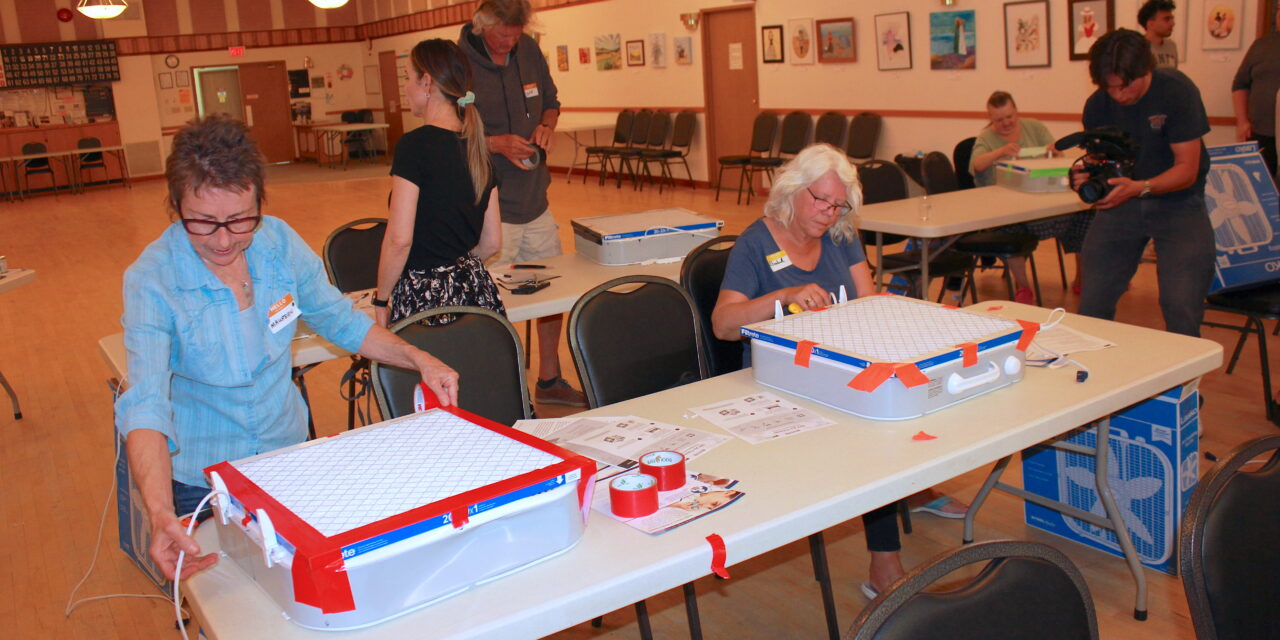
Oliver seniors were treated to a unique and obviously enjoyable workshop recently where they learned how to make a simple air cleaner aimed at reducing exposure to fine particulates associated with wildfire smoke.
Dr. Anne-Marie Nicol, Associate Professor of Professional Practice in the Faculty of Health Science at Simon Fraser University was in town with two final-year undergraduate students for the workshop that saw a dozen Oliverians construct their own filter fans during the Town of Oliver’s Seniors Week.
With growing wildfire activity now a feature of BC’s late spring and summer months on the back of global climate change, the importance of keeping the wildfire smoke out of indoor living spaces is all the more important and often overlooked, according to Nicol.
Fine particles (PM2.5) represent the main health risk from wildfire smoke and while they aren’t visible to the human eye they have been linked to a wide range of health impacts.
There’s no known safe level of exposure for some of these pollutants which means that smoke can impact your health even at very low levels. As smoke levels increase, so does the health risk. Air quality may be poor even if you can’t see or smell smoke, according to Health Canada.
This is especially important for vulnerable individuals, particularly older adults, new and expecting mothers, and those living with lung conditions such as COPD, asthma, and pulmonary fibrosis.
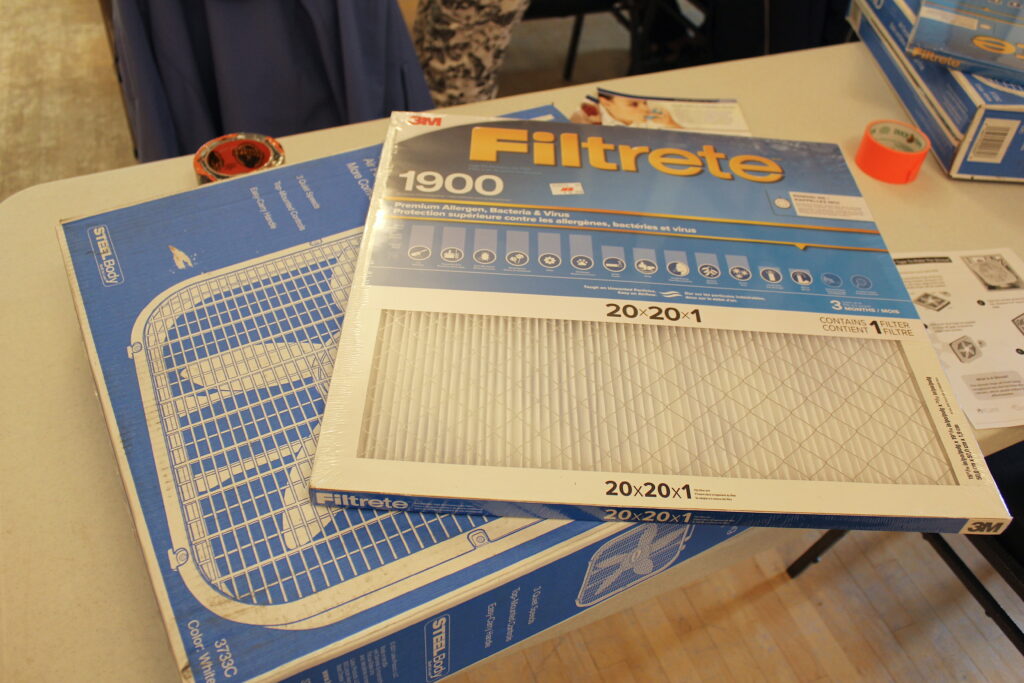
The key elements include at least a 75 watt box fan and 20 x 20 MERV 13 (MPR 1900) filter and a couple of rolls of Duck Tape.
The SFU-led Pacific Institute on Pathogens, Pandemics and Society (PIPPS) has led over 30 workshops around the province helping people build more than 500 air filters to clean the air in their homes.
The Oliver workshop was funded by a wider BC Healthy Communities grant for Seniors Week which enabled the town to offer all the supplies free which included a 75 watt box fan and 20 x 20 MERV 13 (MPR 1900) filter for each person along with rolls and rolls of Duck Tape and even a light dinner.
The participants unanimously expressed the ease with which they constructed their fan filters and in fact judging by the laughter and chatter in the Oliver Senior’s Centre thoroughly enjoyed the workshop. Many expressed the view that they would take the concept to their friends and neighbours and help them construct their own.
Nicol says the inspiration for the filter fans came out of the COVID-19 pandemic in which people were building various fan filter boxes and posting them online. “I though well, if it works for viruses, it’s going to work for fire smoke.” and that just continues to be a problem that plagues the province and really the world.
The project started small with workshops in Vancouver with various funding sources including the BC Lung Foundation and the City of Vancouver, because Nicol wanted to do something to help those suffering from wildfire smoke.
The idea isn’t complicated nor is it completely original, but it is an effective and clever twist on an existing technology that has evolved into an accessible DIY project complete with simple, clear instructions and even a YouTube instructional video.
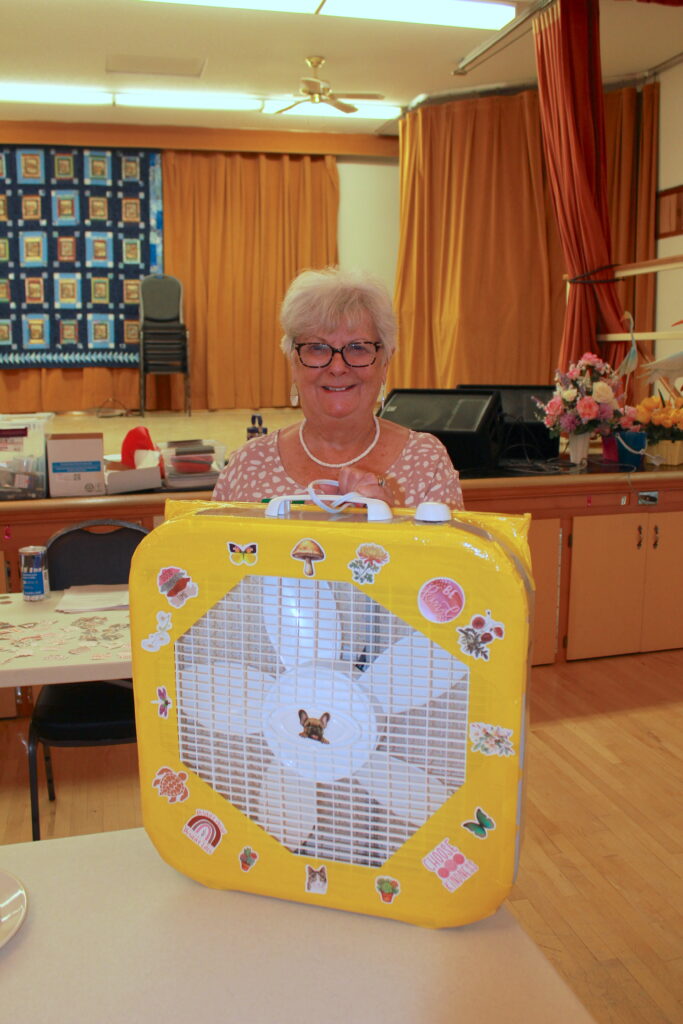
A workshop participant shows off her finished air filter fan.
At its heart, it is a simplified take on a Corsi-Rosenthal box popularized during the COVID-19 pandemic which was basically a cube made of four MERV 13 filters with a box fan on top.
The air filter fan is much simpler and more cost effective with one MERV 13 filter (capable of filtering down to PM2.5) Duck Taped to the intake side of a box fan which altogether can be purchased for under $100.
“I thought well, if it works for viruses, it’s going to work for fire smoke,” which she notes continues to be a problem that plagues the province. Covid is gone, but his technology still exists, and we’re repurposing for the next problem.”
It became clear to Nicol and her team that where they really needed to take the concept was to those areas most prone to wildfire smoke, like the Interior. She says she reached out to Interior Health and the community engagement side “got it right away.”
“We need people on the ground to learn how to protect themselves. People want to do this, they want to help themselves,” she said.
The success of the workshops is evident when Nicol says “we are overwhelmed by requests”. She would like to see workshops hosted in different regions across the province.
She notes that the workshops are helpful for those who may not know about air cleaners or where to go to get one, or maybe don’t have the resources for an expensive air filtration system.
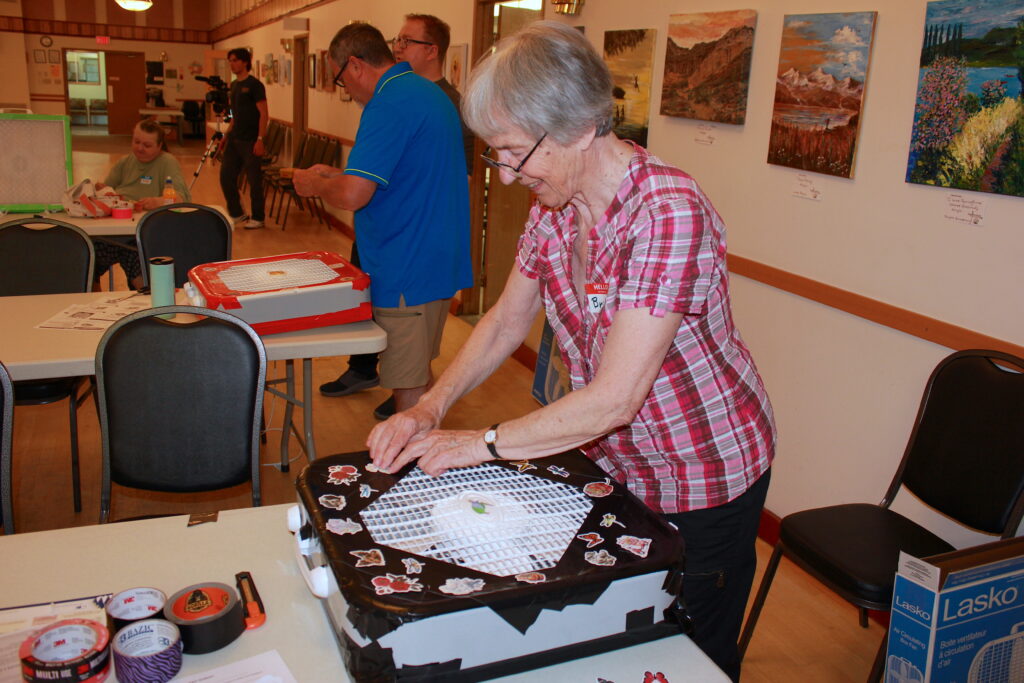
A workshop participant applies the finishing touches to her air filter fan.
While some people can control the air quality in their homes, many like renters, those in group living or subsidized housing and low income seniors, cannot. “This is a new phenomenon, a new idea,” she says and part of society may miss out on the use of this kind of technology.
Currently, PIPPS at SFU is working with the BC Lung Foundation to host the BREATHE Project, a community-based initiative that builds resilience to emerging airborne threats teaching community leaders and members how to build these simple air cleaner devices.
Aside from written instructions, the YouTube instructional video, and a new “Train the Trainer” manual is now also available for download.
The BREATHE Project is now being expanded into a full grassroots climate resilience campaign and community.
This includes a more robust workshop that delves not just into indoor air quality and extreme heat events, and other climate emergencies that can occur, like floods and other natural disasters that impact communities.
Downloadable instructions and a YouTube instructional video are available from the BC Lung Association or from the SFU BREATHE Project. For more information on PIPPS visit the website at pipps.ca.