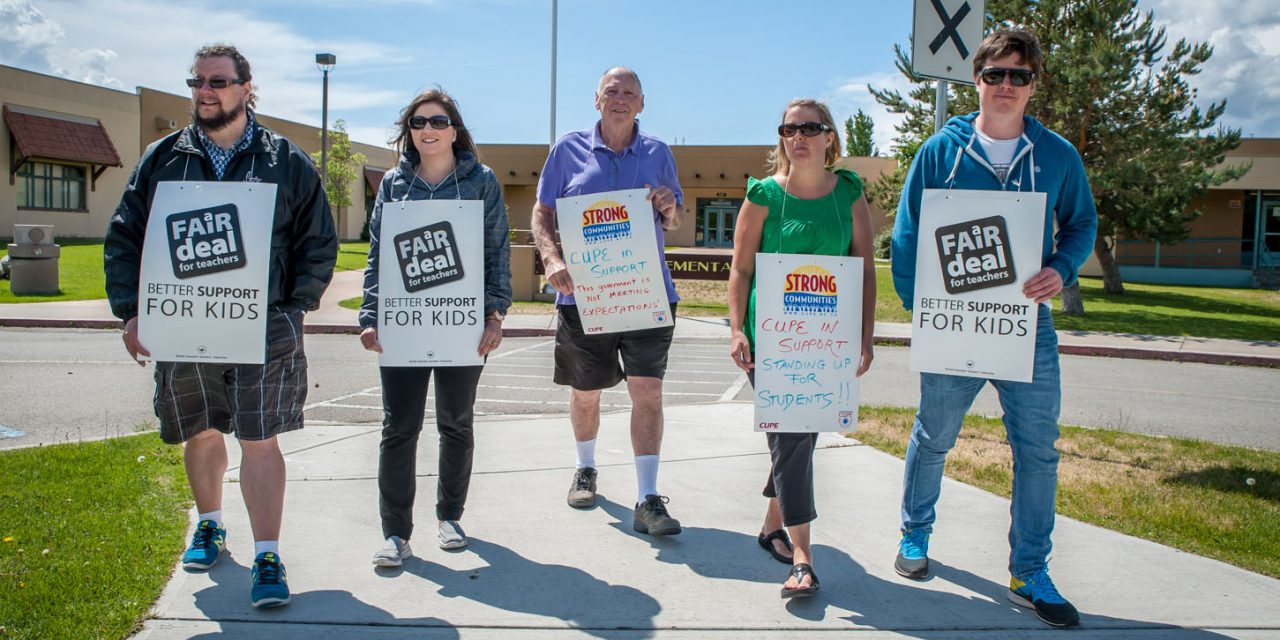

Thousands of teachers across B.C. hit the picket lines last year after negotiations broke off with the Ministry of Education. Those same teachers are thrilled with last week’s Supreme Court of Canada ruling that supported the BCTF and its longstanding efforts to have control over class size and composition. (File Photo).
The president of the British Columbia Teachers’ Federation (BCTF) was ecstatic following last week’s Supreme Court of Canada decision that ruled in favour of the federation in a longstanding battle with B.C.’s Ministry of Education over class sizes and composition.
“On behalf of B.C.’s 41,000 public school teachers, this win is a massive victory for our rights and vindication of all the years we have spent fighting the B.C. government’s unconstitutional legislation,” said Glen Hansman. :It’s also a very emotional day. We came to Ottawa today for a hearing and instead got a surprise ruling from the bench. Those of us there in the courtroom couldn’t help but cheer and I know there are thousands of teachers back home in BC doing the same.
“I am so proud of all our members, our past presidents, and executive committees for sticking with this fight for so long. It has been a tough journey and a long road, but today we finally have justice.”
Hansman said taking this matter to the highest court in the land is the final step in a very long legal process, in which the BCTF has consistently argued that the governments’ actions in stripping teachers’ collective agreements in 2002, and their further refusal to address the situation, was unconstitutional.
“Canada’s highest court affirmed teachers’ bargaining rights and agreed with the arguments that the BCTF has been making since then Education Minister Christy Clark first stripped teachers’ collective agreements,” he said. “That unconstitutional legislation allowed the B.C. government to underfund education. As a result, B.C. has fallen behind the rest of Canada and an entire generation of B.C. students has lost out.”
According to the most recent Statistics Canada data, B.C. is last on seven key measures of education funding, he said.
“B.C.’s funding is currently $1,000 less per-student than the national average,” said Hansman. “Only PEI is worse than B.C. in terms of per-student funding and it was the government’s action in 2002 that allowed it to happen. This is completely unacceptable for a province as prosperous as B.C.
“But now, there is hope that those students coming up through the system will start to see classroom conditions and support levels improve. There is hope for teachers that their teaching conditions will return to workable and fair levels. In restoring our contract language from 2002, B.C. schools will once again be able to offer smaller classes, more support for children with special needs, and extra help for all students. The government should take immediate action to get those provisions back in effect so we can get back to a place where our teachers, schools, and students are properly funded and supported.”
The BCTF values the productive relationship with Ministry of Education staff on areas of common ground like curriculum revision and enhancing Aboriginal Education, but it has been the political players in government that chose to keep fighting and needlessly wasted taxpayers’ money in court, he said.
“That time, energy, and money should have been invested in kids all along,” said Hansman. “With this Supreme Court of Canada decision, the onus is now on the government to fix this once and for all so we can all put the focus back where it needs to be – on our schools and students.
“We know the B.C. government has the funds available to make this situation right.” There is a $1.9 billion surplus and the government has continuously acknowledged our potential court victory as a cost against the province’s contingency fund, he said.
“The money is there and the government should take action now to improve teaching and learning conditions across B.C.,” he said. “Given everything that this government has done and forced teachers to endure, it is the only responsible and ethical action for them to take. The government should bring forward to the BCTF a plan to operationalize this language as soon as possible.”
The BCTF will be acting on the ruling and communicating in further detail in the coming weeks, he said.
“However, we must say that we are delighted to know that the B.C. Liberals and all governments across Canada must respect bargaining rights and collective agreements,” he said.
Finance Minister Michael de Jong issued the following statement in response to the Supreme Court of Canada’s ruling regarding the relationship between the Charter-protected process of collective bargaining and government’s pursuit of public-policy objectives that impact working conditions.
“We welcome the direction from the Supreme Court, as it addresses uncertainty in labour relations,” said de Jong. “The 2014 collective bargaining agreement was the longest agreement achieved with the BC Teachers Federation (BCTF) in B.C. history and it brought labour peace and stability to our classrooms.
“I would like to assure students, parents, teachers and employees in the education system that this stability continues, and this ruling does not bring disruption to classrooms.
“This was a ruling about the appropriate process to be followed in labour relations and the importance of constitutionally compliant consultation that must take place.
“The Court has confirmed that governments have the ability to legislate amendments to collective agreements. However, the process to legislate specific amendments in Bill 22, the Education Improvement Act (2012),was flawed.
“The six-year collective agreement we reached with the BCTF in 2014 included an agreement on the process that both the employer and union would follow when the Supreme Court gave a verdict. The collective agreement remains in place, and the employer and the BCTF will now meet to discuss how we move forward to address this aspect of the ruling.
“Government assures all parents and students we continue to be focused on outcomes for students. We have one of the best education systems in the world; student outcomes have improved significantly over the past 15 years. We have also established added investments like the $100-million Learning Improvement Fund that involves classroom teachers in how to best meet the unique needs of their students and classrooms. “We are committed to working constructively with the BCTF to keep making our classrooms better.”
Special to the Times
Osoyoos Times