The B.C. wine industry’s long-awaited sustainability certification has finally borne fruit after two decades of work and close to 15 recent years of on-again, off-again progress.
Penticton’s Tightrope Winery took the honour of being the first in the industry to be certified under the Sustainable Winegrowing British Columbia (SWBC) Winery Standard in mid-April.

The certification mark for wine produced under the Sustainable Winegrowing British Columbia (SWBC) Winery Standard.
“Through industry participation, through a diverse and really well-represented stakeholder group of the B.C. industry we’ve created a sustainability standard that really holds up to any kind of global sustainability standard out there,” highlights Katie Pease, SWBC program director.
The importance of this cannot be understated, as sustainability issues are rightly taking centre stage in an era where climate change is increasingly impacting our lives. It’s also important for wine exports, particularly to Europe.
By the end of June, Pease reckons there will be four wineries and a dozen vineyards certified under the new standards.
The program officially went live in November 2020 after a pandemic-induced delay of six months.
This first phase saw the publishing of the two sustainability standards – one for wineries and one for vineyards. This enables companies to undertake self-assessments in a lead up to third-party independent auditing, and if successful, certification.

Sandra Oldfield welcomes the inclusion of the people side of the business in the new standard.
Auditing only began in April according to Sandra Oldfield, principal of wine industry consulting firm Elysian Projects and former owner/winemaker of Tinhorn Creek Winery. Oldfield, along with her husband Kenn Oldfield, are two of the six officially recognized independent auditors in the province.
The far-reaching standard covers everything from waste management, water and irrigation issues, carbon emissions, soil nutrition, crop spraying, to safety issues, human resources, social equity, and even succession planning.
For Oldfield, the human element is a key facet that she’s pleased to see included. “From my personal perspective of somebody who worked on the program on the committee side for so many years, I was just really happy to see that the people side of it entered into it. It’s so overlooked and honestly, you can’t make a product without people, but why are they always left out of an improvement program? I’ve never understood that.”
Typically vineyards or wineries start by downloading the standards from the SWBC website and undertaking a self-assessment. The program is meant to be a continuous program and comes with an annual fee depending on the size of the operation. A number of aspects are mandatory in the first year, and once the business is confident they have achieved the requirements they can then be audited for possible certification.
This is where consultants like Oldfield can be brought on board to help with areas of deficiency. Some businesses take the assessment initially to see where they come out in order to understand what they need to work on in order to bring their operation up to certification.
“I’ve seen some that just get to work on it themselves and finish it, and then there are some who hire consultants like my company to come in for some sections they have difficulty with, let’s say for instance health and safety,” Oldfield says. She adds that in cases where Elysian is hired for consulting, they recuse themselves from the auditing role.
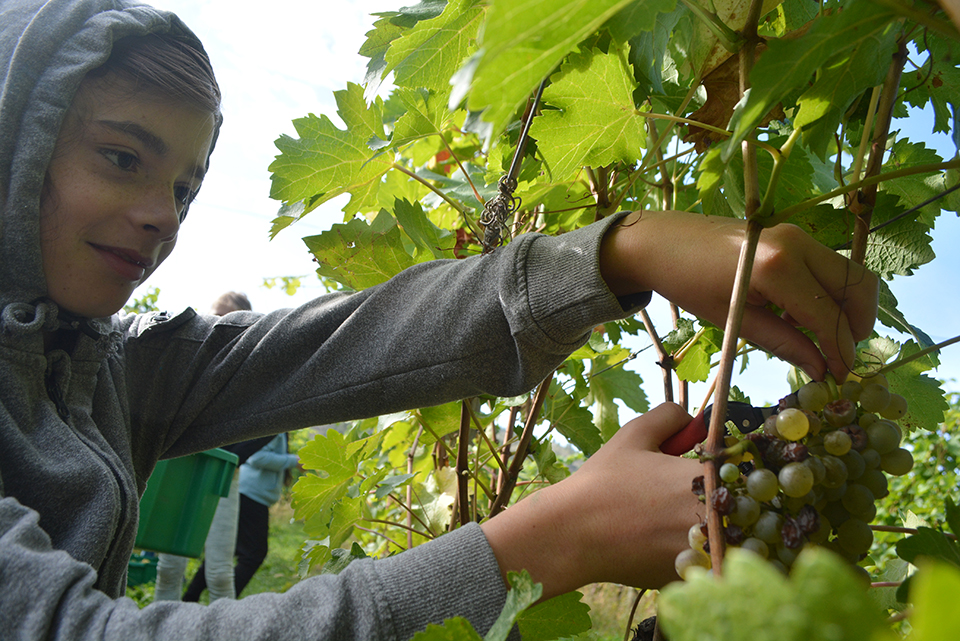
French immersion student Ethan Pearle harvests a cluster of grapes at Le Vieux Pin winery. (Photo by Lyonel Doherty)
While much of the process to prepare for accreditation does not really require financial investment, she notes one of the biggest issues encountered is simply the fact “many of these wineries have been doing these things, but they have not been writing them down.” And without documentation, “it doesn’t really count,” she says.
“If you are spraying the right things on your vines but you’re not keeping good spray records, that doesn’t help the next person who comes in to buy your winery.” This is the same issue with health and safety where companies may be doing all the right things, but if it’s not documented then WorkSafe BC won’t believe it’s being done.
Subsequent years are aimed at continual improvement and an independent audit is required every three years once the initial certification is achieved. Having served on the volunteer industry committee for a number of years, Oldfield notes that similar programs from around the world have been studied and analyzed over the years with a keen focus on those in New Zealand, Australia, California, and Oregon.
“In one sense we are kind of late to the game so we were able to glean off of other people things that they’ve worked on and hopefully come out of the gate with something pretty comprehensive right from the get-go,” she says.
A fellow member of the committee, Severine Pinte who is also winemaker, viticulturist and general manager at Le Vieux Pin and LaStella wineries similarly notes that the B.C. wine industry, “is not in its little corner and doing its own stuff – the growers and wineries are working on the same
standard as others in the world.”
This she says will further establish the B.C. wine industry’s profile on the world wine map.
“For the industry, I think it’s going to allow a lot of the winegrowers and wineries to rise to a similar standard in terms of quality, in terms of record-keeping, and in terms of care about how we farm and the care we take for the land and our team,” Pinte says.
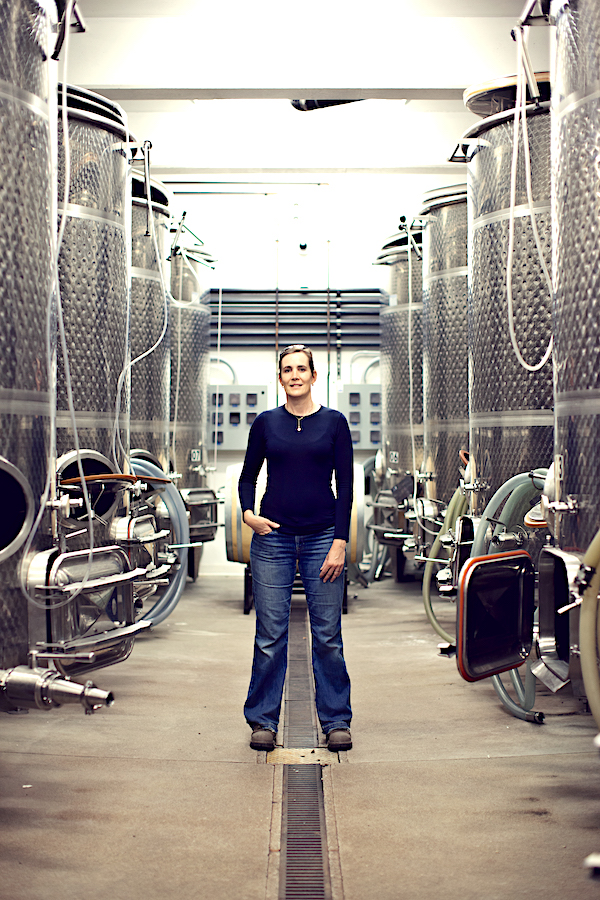
“I think a lot of the wineries and growers are going to
understand very quickly that it is to their benefit, ”Severine Pinte says of the new certification.
She adds that because everyone has to comply with the same parameters of the certification standard, “this is going to allow us to have a base of work that we can start and improve over the years and I think that’s very important for the industry.”
With certification preparation initiated in August at Le Vieux Pin and LaStella, which includes nine vineyards, Pinte notes her audit takes place on June 29.
“Going through the certification process has really allowed us to look with a magnifying glass at our operations.”
And what they discovered was they were already fulfilling the essential criteria that they needed to be certified, but a lot of that was not really written down, or there wasn’t a process in place, reflecting Oldfield’s observations to a tee.
A key benefit of the process is that everything is documented and everyone is aware of what and how everything is being done.
“We were already a really tight team, but it’s improved our ability to work together because we all know what we are working for, and it’s a positive goal,” she says. “Everyone feels part of the team, and the facts are matching what we are saying.”
And it has benefits for the business in terms of efficiency gains and cost savings too. “It’s a great way to look at how we run a business and make it more profitable,” Pinte adds.
For Pease, the take-up by the industry has met expectations and she is confident it will grow year by year.
Oldfield concurs, saying: “I don’t think we’re looking at a fast sign-on of half of the industry simply because it’s a very long process of all the things you have to do, but every year it’ll grow a bit more as vineyards and wineries get certified.”