By Don Urquhart, Times Chronicle
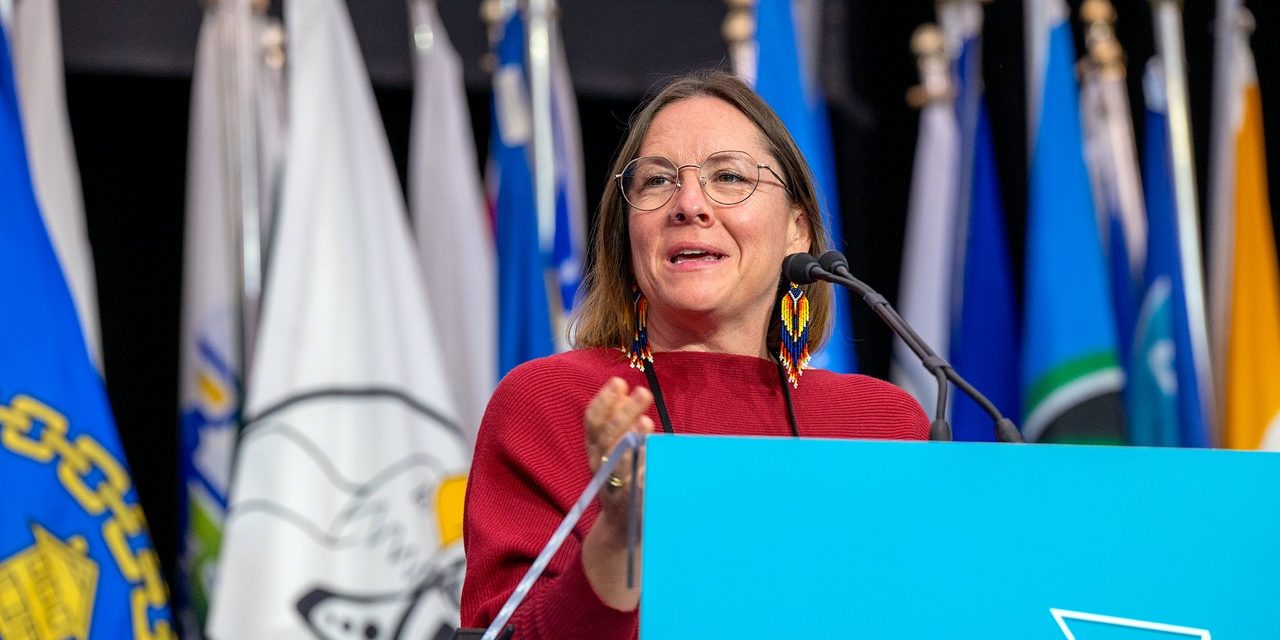
After nearly eight years on council, Aimee Grice says the next step is the mayor’s chair — not just as a natural career progression, but to provide a steady hand based on her experience on council and leadership skills as the town grapples with a raft of complex issues from housing reforms to healthcare recruitment and aging infrastructure.
This will be especially important given there may be some turnover in council, she said, noting that current Mayor Martin Johansen has officially declared he won’t be seeking reelection.
“We need that historical knowledge and some strong leadership, especially if we have people coming in with no experiences at the helm,” she told the Times Chronicle in an interview. wide-ranging conversation about her bid and priorities.
On a platform shaped by social equity and pragmatism Grice traces her political motivation to “a strong sense of social justice,” pointing to infrastructure issues, housing, homelessness, and healthcare as core concerns.
She argues the mayor’s role offers closer proximity to staff and decision-making than council, enabling more proactive leadership: “As a councillor, it felt a bit of a disconnect… Sometimes I’m finding out about things in the paper,” she laughs.
On accomplishments and provincial influence beyond council, Grice cites regional governance experience — president of the Southern Interior Local Government Association (SILGA) for two years, a Table Officer – 3rd Vice President – of the Union of B.C. Municipalities (UBCM) — as a conduit for ideas and advocacy.
UBCM, she notes, is more than an annual conference; it’s a year-round channel shaping provincial legislation, with local government voices previewing and offering feedback on policy changes: “We’re trying to advocate on behalf of local governments and protect our interests and our autonomy.” And try to stop the “download” whereby the Province shifts responsibility for some things to municipalities.
On the topic of housing reform Grice says she supports the Province’s goals to break down barriers to increasing housing accessibility but has concerns over one-size-fits-all strategies. She backs increasing options across the “housing continuum,” including revisiting tiny homes and “gentle density”.
She’s uneasy with uniform provincial mandates: “It’s difficult when they sort of paint everybody with one paintbrush… Just because we can do four units on every single-family lot doesn’t mean that’s what’s going to happen.”
She does welcome the thorough Official Community Plan (OCP) review which is part of the Provincial requirement and which began this fall will continue into next year with “heavier” public consultation.
This public participation is even more important now, she notes, that public hearings are no longer required for development permits as a result of Provincial housing measures, calling the OCP the “building blocks of the community” where “the dreams are made”.
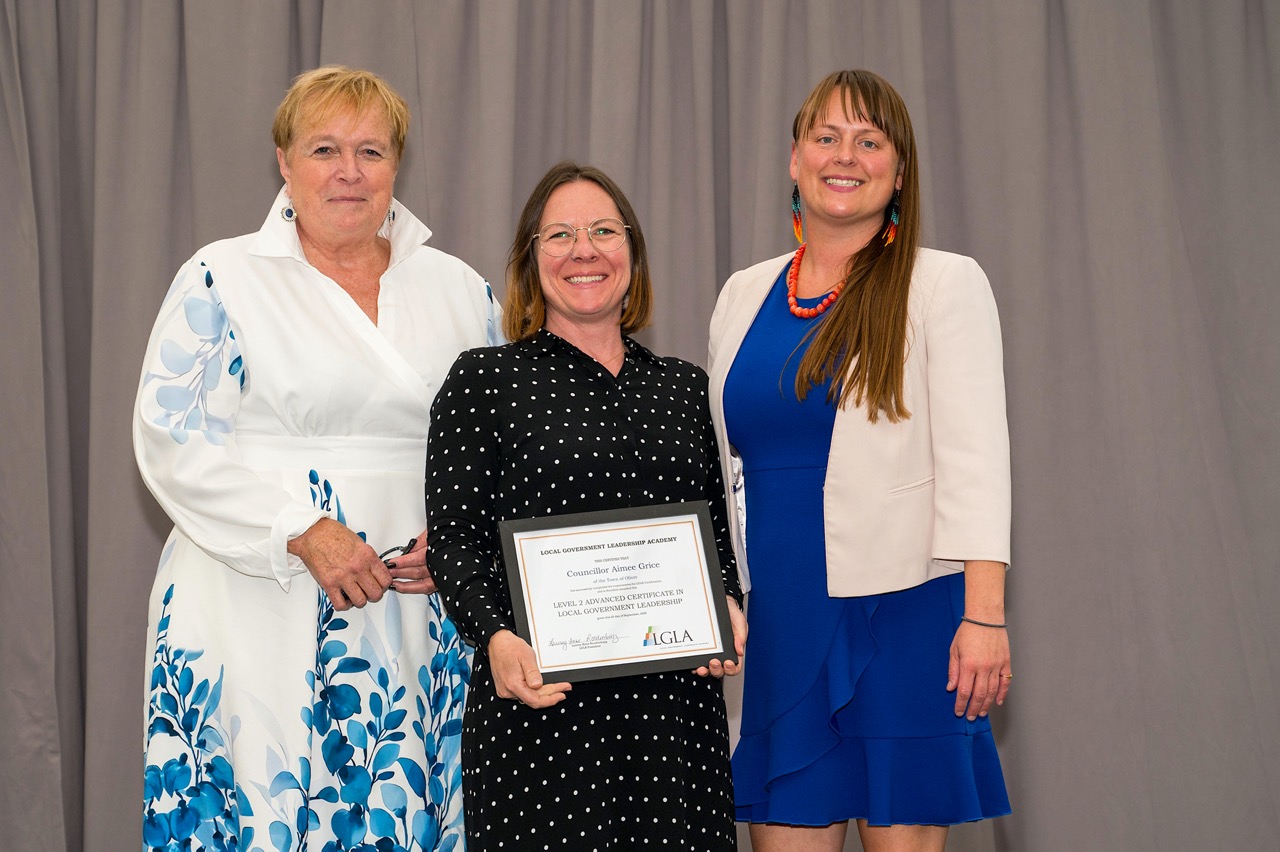
UBCM Convention 2025
Aimee Grice (centre) is awarded with an advanced certificate in local government leadership by the Local Government Leadership Academy.
Contributed photo
But tempering the dreams is the budget squeeze and implications for taxation that comes from aging infrastructure that Oliver, like virtually all of BC, is now grappling with. On infrastructure, Grice is blunt: costs are compounding while property tax tools lag.
“You start looking at a million dollars to redo a strip of road and sewer… a 1 per cent tax increase is like $28,000,” she notes, arguing Oliver has been fiscally responsible but constrained.
She would also like to see changes in the budget process to see the “whole picture” before decisions on water and sewer are made. She also credits the hiring by the town of a dedicated grant writer for improving Oliver’s competitiveness in an inequitable grant system. While this was previously handled by a town staff member, it was only part of their job.
Engaging youth and rebuilding civic connections is also a key issue for Grice. With voter turnout at just 16 per cent in the last election, Grice wants to increase outreach and add more channels.
She highlights classroom dialogues she’s had with local students on housing, homelessness, and civic roles — and strongly supports the new youth council model as a manageable start that could scale up over time. She says it’s important to “get them excited about what they want for their community and their futures.”
Healthcare – a torch that was carried high by Johansen with some significant successes – remains “at the top” of her agenda. But one thing is clear in Grice’s outlook, that being her opposition to poaching of medical staff from local and regional towns. “If we’re recruiting to our area from another community, then we’re just robbing Peter to pay Paul.”
She’s planning on bringing up the community-led “Healthcare Infusion” model — a template popularized in Nanaimo by Todd Maffin — to connect American healthcare workers with local ambassadors to the Oliver Physician Recruitment and Retention Working Group. This would complement Provincial efforts and federal immigration reforms. “Recruiting from the outside is going to be key,” Grice notes.
On local government ties Grice sees room for deeper collaboration with Osoyoos on shared concerns like physician recruitment and potentially a future RCMP model with a centralized detachment and satellite offices.
She also chairs UBCM’s Indigenous Relations Committee and stresses community-to-community forums to build relationships are important rather than a one size fits all.
“Every community has a different relationship with their indigenous neighbours. That’s where I feel like our best tool is in these community-to-community forums where there’s funding for communities to get together, or just gather and get to know each other. I think that’s where the real foundations for those relationships are built.”
Grice also sits on the UBCM’s Health and Social Development Committee which she says provides useful insights to what is going on within the province and what might be useful here, particularly with kids as the toxic drug crisis continues.
When asked about the North American drift toward polarized politics, Grice says Oliver’s council has avoided “nasty” extremes. Her bigger concern is making local government accessible because of the relatively low pay involved.
Councillor pay is roughly $18,000, she says, which narrows who can realistically participate. “You have to be there because you want to be there… But if people were paid more appropriately, we could attract more people to that table,” she argues.
Transit is another key issue with Grice supporting revisiting expanded regional bus service which directly impacts youth, seniors, and workers. She also argues that mobility underpins responsible densification of housing and also has the spinoff of reduced parking demands.
A localized Oliver–Osoyoos bus loop is “worth asking the community,” and she’s open to innovation across a future regional transit plan that could even contemplate rail: “There’s no reason to not try to be innovative… We should all be innovators.”
Grice’s pitch ultimately frames her candidacy as informed, experienced leadership. “You’re still only one vote at the table,” she says of the mayoral role. But as chair the job is to lead the team, synthesize expertise, and keep Oliver’s next chapter grounded in community voice and practical results.
“I care about the people of Oliver. I wasn’t born here, but my children were born and raised here, and I want this to be a place that they are happy to call home.”