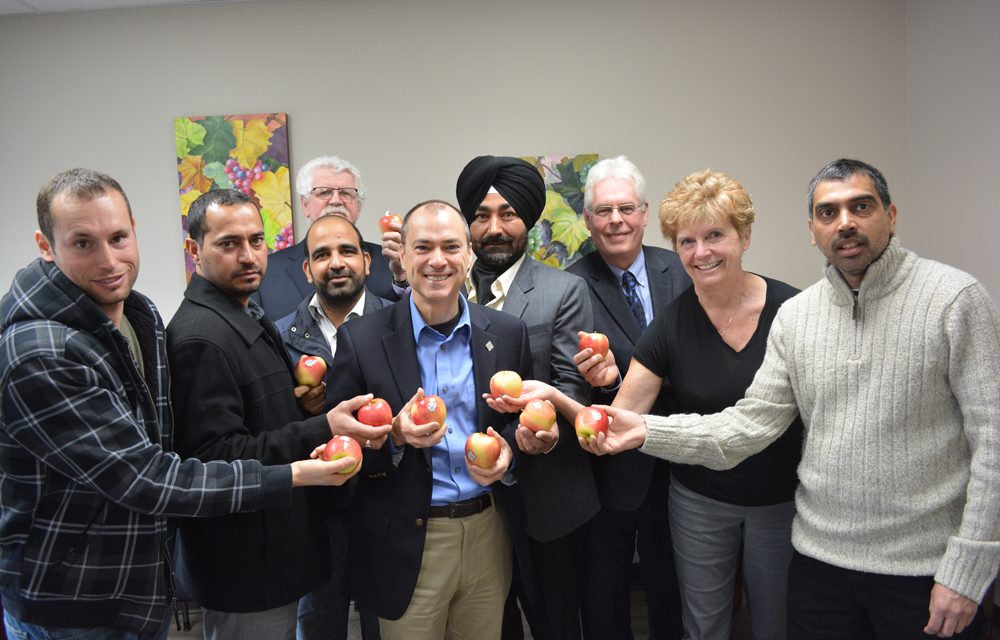
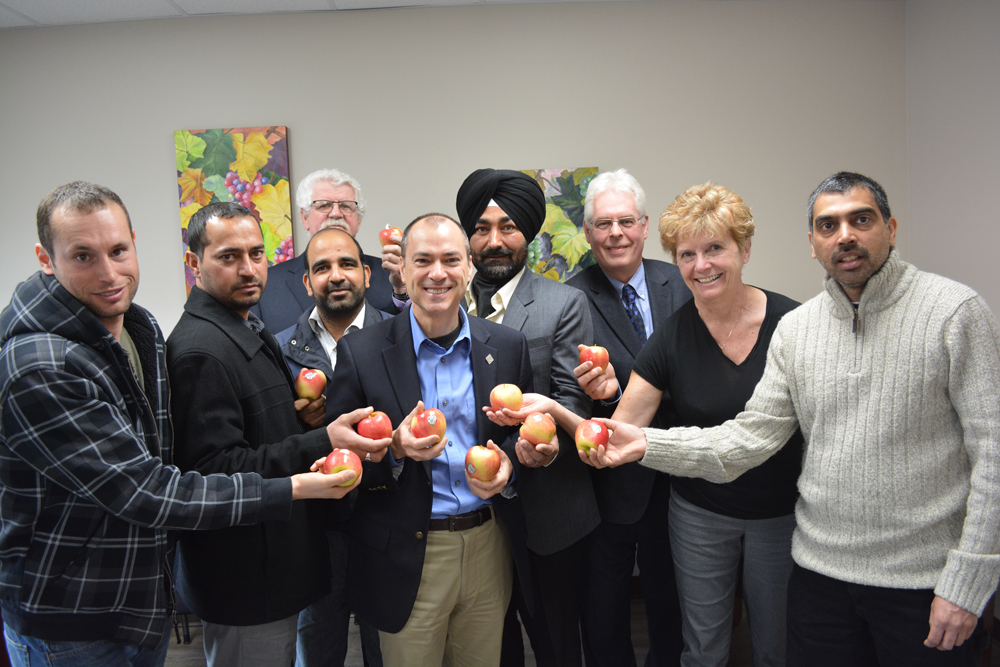
Minister of Agriculture Norm Letnick (middle) promotes B.C. apples with members of the BCFGA and B.C. Tree Fruits. Shown with Letnick are (from left) David Machial, Talwinder Bassi, Nirmal Dhaliwal, BCFGA president Fred Steele, Ravinder Bains, BCFGA manager Glen Lucas, MLA Linda Larson and Pinder Dhaliwal.
LYONEL DOHERTY
Norm Letnick talks about many changes needed to revitalize industry moving forward
B.C.’s Minister of Agriculture Norm Letnick pulled up a chair with local fruit growers last week and sat down to discuss everything from the new replant program to strategic planning.
Letnick met with members of the BC Fruit Growers’ Association (BCFGA) in MLA Linda Larson’s office in Oliver on February 5.
The big topic of discussion was the association’s new tree fruit “industry strategy” that will see changes to revitalize the fruit growing business.
“We’re working together to build a new industry that will be more than sustainable and profitable,” said BCFGA president Fred Steele.
He noted the association is looking at how to be more innovative.
If successful, the tree fruit sector will expand production, export more fruit and create more jobs.
Letnick said the tree fruit industry is moving away from being a mass, low cost producer in the world market for apples and cherries.
He pointed out that the industry has to differentiate and specialize, noting the key is expanding into international markets, while continuing to focus on the domestic market via the “Buy Local Program.”
Letnick said the new seven-year replant program that the government recently introduced would significantly impact how growers do business.
“They can have certainty (now). It’s good for processors, co-ops and nurseries. The nurseries told me it gives them certainty in terms of how many trees (to order).”
The minister said the replant program would help the industry transition into higher value plantings in order to compete in foreign markets.
Without an industry strategy, growers won’t know where they’re going, according to Steele.
“Without ideas and directions there would be no new ideas to consider,” he said.
The association says the industry needs to focus on its competitive advantages and respond effectively to its challenges.
The executive believes there is potential to double the tree fruit industry’s production and revenue.
The BCFGA stresses that strategy recommendations will not involve adopting or stopping certain activities, but rather allow for further exploration and business planning.
It agrees with Letnick that the tree fruit sector in B.C. cannot strive to be a low-cost mass producer. It must strive to change and be something else.
The strategy will be guided by growth and job creation; quality production; increasing exports; growth in domestic market share; and sustainability.
From 2015 to 2020, the strategy will focus on grower education in terms of new technology and improving horticultural practices; quality products (replant and renewal); infrastructure improvements (packing line and cold storage upgrades); and people (improve employee attraction and retention).
Steele said a lot of effort has gone into communicating the extra protections built into the Seasonal Agricultural Worker Program (SAWP).
“In order to preserve SAWP, industry must demonstrate it is also engaging in promoting work locally.”
Steele said he believes the BCFGA is on the cusp of rejuvenating the tree fruit industry.
“The road ahead won’t be easy but it will be possible to make progress.”
The BCFGA will discuss the strategy and many other ideas at its 126th annual convention in Penticton on February 20-21. The B.C. tree fruit industry is composed of approximately 600 commercial tree fruit growers, six apple and pear packers, 28 cherry packers, six commercial fruit processors and approximately 12 apple cideries. These players generate $664 million of economic activity annually.
LYONEL DOHERTY
Special to the Times