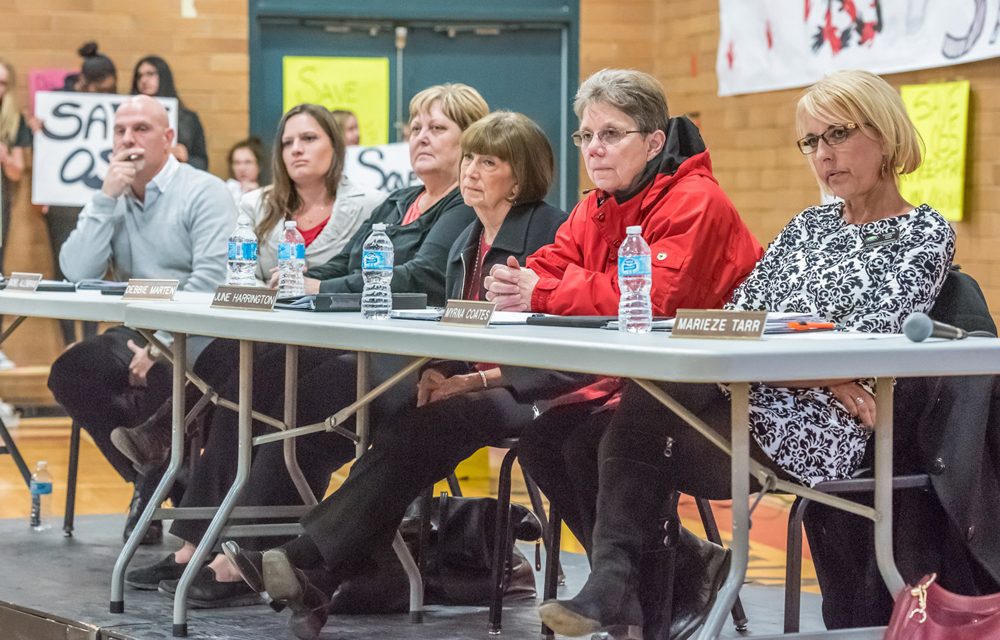

fter nearly closing Osoyoos Secondary School a few months ago due to budget restraints, the school district now finds itself in a surplus position. (Photo by Richard McGuire)
School District 53’s financial problems have taken a 180 – trustees now have to figure out what to do with too much cash.
For the past several years, the district has been forced to make cuts to its budget because of declining enrolment, nearly shuttering Osoyoos Secondary School last summer. School districts cannot submit a deficit to the provincial government – if a deficit is projected the budget must be balanced by tapping into reserve funds or making cuts to expenses. Trustees in the Vancouver School District were fired last month for submitting a deficit, among other accusations.
Thanks to a spike in enrolment in the South Okanagan – largely attributed to the opening of the new correctional facility in Oliver – the district is projecting a surplus.
“We did anticipate a little bit of an increase because of the prison, but we didn’t anticipate quite the numbers we ended up getting,” said board chair Marieze Tarr.
She said the per-pupil funding in British Columbia is around $8,000, adding that it’s the second lowest among the 10 provinces.
“What we did for the last three years or so, to balance our budgets, was we used money out of our reserve funds,” she said. “Like taking money out of the piggy bank to run our daily affairs.”
Had the downward population trend continued, the district would have only had enough money in the reserves to last one more year.
“That was why we were proactive; we were prepared to make some tough choices before the surplus ran out.”
In addition to spending money from the reserve funds, spending cuts were also being made. The district reduced its expenses by increasing the student-teacher ratio, cut administration time, and found other efficiencies that were “directly related to the feedback we got from the public during the closure process.”
With the shifting landscape in demographics, the district is looking at $400,000 in surplus for the 2016-2017 school year.
“But only if everything goes according to plan,” Tarr said, as the Ministry of Education may end up expecting the district to pay for cost increases. Also, the local district could find itself on the hook for unanticipated costs, such as a leaky roof or damage from an extreme weather event.
“Trustees will have a conversation again – what are we going to do with a surplus?”
Tarr said the board’s intention is to keep as much money in the classrooms as possible, especially by reducing the ratio between teachers and students.
“We like spending our money on things that increase student learning and make a difference for students.”
Come February, the district will have its projected enrolment for the 2017-2018 school year, which Tarr said will give the board a better idea of how much financial breathing room they have.
“We’ll have that conversation in the new year,” she said. “Then we’ll have a pretty good idea of what the budget will look like next year.”
While new spending decisions have to be approved by the board, Tarr hopes some of the surplus will be used to increase support for mental health among students. She said most schools in the district have a strategy pertaining to mental health, but those challenges have become more severe in recent years.
There are a variety of programs already in place throughout the district that address mental health, but the challenges persist and create “huge barriers” from achieving student success, she said
“If kids are not happy and not doing well mentally, you’re not going to be able to get them to learn.”
In addition to addressing challenges surrounding mental health, “We have to keep ensuring that our student achievement and graduation rates are either going up or being maintained.”
The ministry is currently reviewing the way it funds rural schools and Tarr is optimistic that the district will benefit from the adjustments that are made.
“Our district advocated over the last few years for a change in the formula,” she said, adding that rural schools have unique needs and a one-size-fits-all approach doesn’t work.
But beyond getting more money, Tarr said 99 per cent of school districts are advocating for the ministry to simply stabilize the funding it divvies out.
“It’s extremely hard to budget and make long-term plans when halfway through the year we’re told we have to find administration savings, increase CUPE benefits and find money to increase senior staff salaries.”
The administrative savings that each district was obliged to make last year were returned later in the school year. The district’s share of the savings was $118,000, which the board was happy to receive, but Tarr said it was frustrating that the ministry meddled with the money in the first place. Also, the announcement of those administrative savings led many to prematurely speculate that OSS wouldn’t be closed, though it ended up only being enough to add extra programming to the other schools.
It wasn’t until a month later – the day before budgets were due – when the province announced $490,000 would be granted to the district, the amount needed to save Osoyoos Secondary School.
By Dan Walton