By Don Urquhart, Times Chronicle
The election results are in and Osoyoos has a new mayor in Dustin Sikora along with councillors Johnny Cheong, Myers Bennett, Wes Greve and Zachary Poturica – except for one thing, these candidates were voted in by Grade 4-7 students.
Although the results differ from the reality of the recent municipal election in Osoyoos, the process that generated this alternative outcome was nearly identical to the real thing. This is what Christopher Lewis, a teacher at Osoyoos Elementary School (OES) strives for with the Student Vote program.
Lewis is passionate about this project which is supported by CIVIX, a national charity dedicated to strengthening democracy through civic education. Elections are turned into teachable events through which teachers can bring democracy alive in the classroom and educate children from a young age about the process, rights and responsibilities of voting in a democratic society.
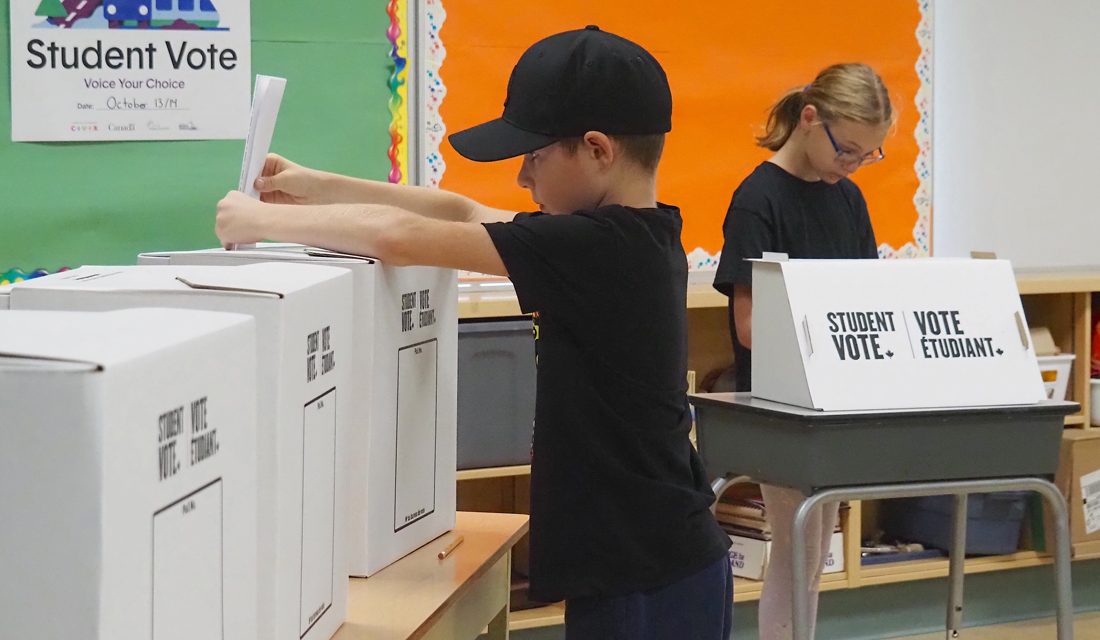
By experiencing the voting process first hand – from information gathering to casting mock ballots for the official candidates running in the actual election – the students learn both theory and practice.
“I find that it’s very unique and that it gives students a great opportunity to learn how to vote in the future so that they can be informed and good voters, and when the time comes their vote will matter,” said Zephyr, a student at OES.
Importantly, it’s far more than just the procedural process that Lewis hopes to inculcate. “At the end of the day my goal is to get them comfortable and understand how to be informed.”
This is the sixth student vote that Lewis has run, covering not just municipal but provincial and federal elections, for which other support is also available to schools. And for next year when there likely won’t be an election of any kind, he’s already got a plan to do a school election.
And Lewis’ enthusiasm clearly spills over to some of the school kids. Helping him out on voting day was a group from different grades that take over assumed roles such as voting clerks and voting officers.
“We have the ballots from the actual Student Votes so they look essentially the same as real ballots would,” he said. These ballots are even signed by the voting officer and each student that comes through to vote must show an ID card, which Lewis made for each student.
“They register, have their name checked off, get their ballot and go to a voting station and then put it in the ballot box. All the classes have little ID cards that I made for them so that they’re also learning that you need ID to prove who you are and we’ve got our attendance list for our voter registration list,” he explains.
Lewis said that once voting has ended the ballot boxes are sealed and later counted with the results not posted until the official results come out on election day. Part of the reason for this he said is that this could even in a small way influence the actual election. And interestingly enough the Student Vote is typically quite accurate in its results.
Lewis said it’s “super rewarding”, especially when some of the kids get so involved that they want to attend town halls, research candidates on their own or volunteer for the Student Vote.
“But part of what I’m trying to do, my goal is to help students become informed, to form an opinion regardless of what that opinion might be and I think it’s rewarding because you have different kids that kind of take it on themselves,” he said.
As an example, he points to the Times Chronicle’s Town Hall Forum. Every election where there is a candidate forum, he takes any students who are interested, typically preceded by pizza.
“Obviously it’s late at night for the kids but they just want to come. I think they see me excited about it so they want to join or just want too.” This year was no exception with Lewis and a handful of kids attending the forum and also getting in a question to the candidates.
“It’s really cool to see kids get interested and have a few that when they had free time they asked if they could do research on their own time and it’s a rewarding experience when you have kids that are excited to turn 18 so that they can go and vote,” Lewis noted.
Partly based on his own experience Lewis reckons that the biggest fear of young people going to vote is that they don’t know what to do, because they never learned about the process. And he added, “what 18-year-old wants to ask their parents how to vote?” he laughed.
Each election Lewis puts in effort to contact the candidates on behalf of the school or a class but interestingly enough the local candidates are always harder to get in contact with than the bigger provincial and federal parties.
This is largely because they have far more resources which makes it easier to get a hold of them. “But who responds and who doesn’t and how easy or hard it is to get a hold of them, that’s all part of the learning process as well.”
“I like that kids get to learn how to vote and how to do it when we’re older,” says Finley also an OES student. “Because if we don’t know how to vote then how are we going to vote when we’re older. It’s your right to vote but it’s also your responsibility to be informed,” she added.
Finley says she and her schoolmates learned about the candidates by going to the forum where they asked a question and “we learned from the newspaper and from the Osoyoos First website,” with Lewis explaining the slate were really the only candidates with online information the kids could access.
The depth of education around the election depends on the grade level, he notes. The grade fours just touch on the surface level, not getting into the background of rights and responsibilities, but instead focussing on which candidates appeal more than others.
“Grade fives we start to give them the background on what are the responsibilities of the municipal councillors and mayor,” he says. And then Grade 6 students learn about comparing the different systems for example a democratic society compared to dictatorships and other forms of government around the world. By Grade 7 Lewis says the students have become “seasoned voters”.
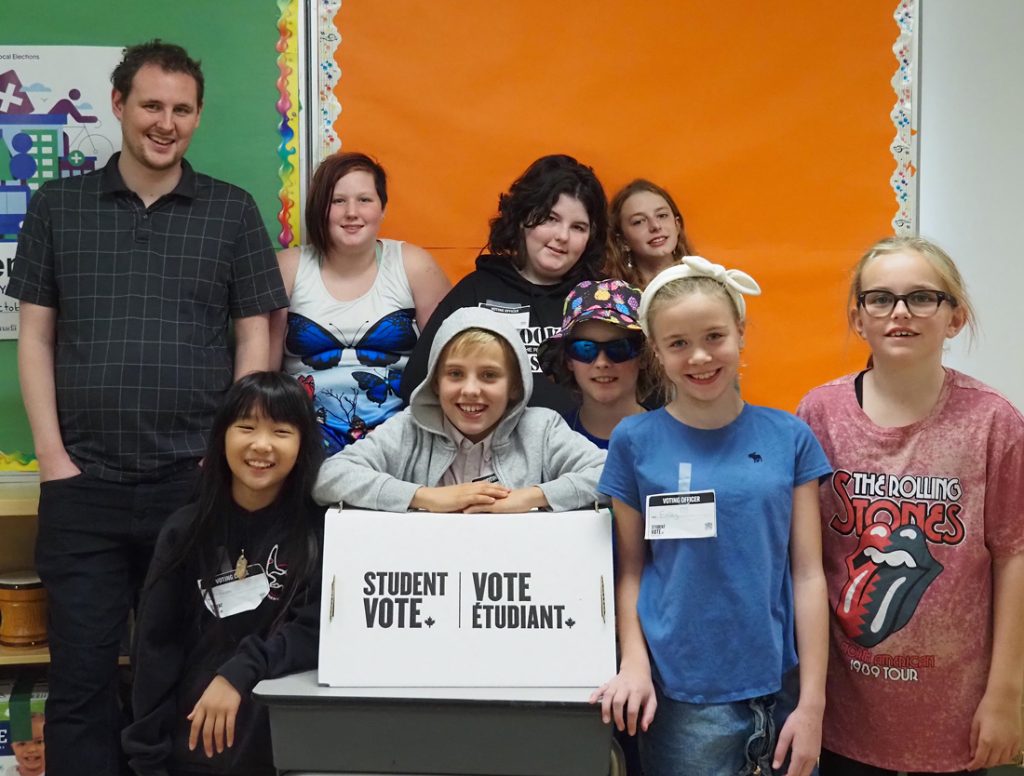
In front row from left are: Allissa, Zephyr, Rory, Finley, and Bravely. In back row from left are Christopher Lewis, Ebony, Arabella, and Katryna.
Don Urquhart photo
But just how much do parents’ views on candidates impact their children’s choices? “I think one of the challenges as a young person, you always think automatically ‘my parents are always right, my parents know everything’.”
He says it depends on their age and their own level of independence, “but yes there are kids that will always vote for what their parents want and then there are kids that go home and share what they learned about our process of getting informed.”
He’s even had some emails from parents telling him how excited their child was when they came home from school sharing information with them, with parents often learning something from their child.
Being so involved in the theory and practice of voting, what does Lewis think about Canadians of legal voting age? “I think in general the public is disconnected from or feels they have no power in their vote.”
He says that if he could get one message across it would be to attend or watch election forums and debates “because ultimately you are voting for your local representatives especially when we’re talking provincial and federal”.
Lewis isn’t sure about the precise number, but says Student Vote program has been quite successful, with statistics indicating something in the range of nearly 80 per cent of students voting once they became of age.
Lewis gives a final bit of advice courtesy of Spider Man, no doubt drawn from his pedagogical experience fostering young minds: “With great power comes great responsibility,” adding “ultimately if we don’t exercise that right eventually, if no one says anything or does anything, it’s not going to matter. If it’s too late, it’s too late so I think it’s a great thing to teach them now.”
Osoyoos Elementary School Student Vote
Grade 4-7 students cast their mock ballot in the 2022 BC Municipal Election. Although the Student Vote is typically quite accurate, this year was not quite so, although Lewis notes that the OES poll showed a tight race which does largely reflect the real election.
It didn’t surprise Lewis that the student results didn’t match the real election because “I think there was a lot of debate and a lot of information in town”.
Councilors were more reflective of the real election with Lewis pointing out that Johnny Cheong took the most votes both in the real election and in the OSS election. He was a popular choice amongst the student voters capturing nearly 85 per cent of the vote.
He also pointed to Wes Greve who did well in the student vote in part because “he has far more connections with the younger people in town, kids and families”. This young connection could also explain the popularity of Cheong and indeed Dustin Sikora as well, he noted.
Here are the results:
Mayor
Dustin Sikora 92 votes
Sue McKortoff 69 votes
Councillor
Johnny Cheong 140 votes
Myers Bennett 107 votes
Wes Greve 105 votes
Zachary Poturica 90 votes
Jim King 88 votes
Sy Murseli 74 votes