Bill Atwood
Times-Chronicle
While cases of COVID-19 continue to rise across British Columbia, and new health measures have been put in place across the province, schools have remained open.
In July Provincial Health Officer Dr. Bonnie Henry said “it is inevitable” that there will be cases in schools. This has happened in the Fraser Health region where the B.C. Teachers Federation has called for a class size cap of 15 students, and in Kelowna which has seen a number of confirmed cases.
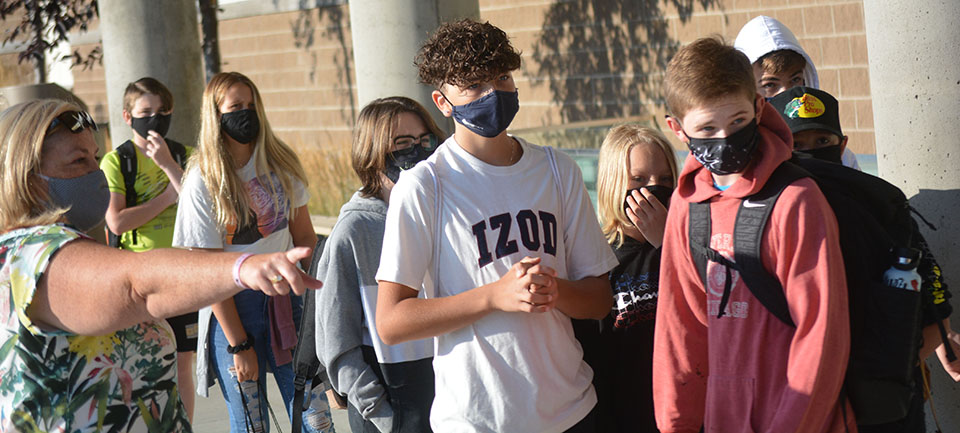
However, since the start of the school year in September, School District 53, which includes Oliver and Osoyoos, has not yet seen an exposure. Superintendent Bev Young credits the students following safety protocols for the lack of cases.
“I can tell you that students have been excellent at complying. There are some that need reminders, but overall, there has been excellent compliance,” said Young.
Tracy Harrington, principal of Southern Okanagan Secondary School, said there was some worry about whether or not the students would follow the protocols, but that has not been an issue.
“We had no idea if kids were going to be compliant, if we were going to end up with a lot of issues around that. But they’ve been unbelievable. They’ve been so good. So we’re grateful for that,” said Harrington.
According to Young however, if there were to be a case in the school district that wouldn’t be surprising because it means the cases would have risen in the general population.
“The schools reflect what’s happening in the community. So if and when we start seeing cases or exposures in our communities, it doesn’t mean that the transmission is in schools, but we could be dealing with it more,” said Young.
If there is a case identified in the district it would be up to the Interior Health Authority to implement contact tracing. Interior Health will then work with the district to inform those who would be considered a close contact to that person.
This would include anyone who was in close proximity with the individual for longer than 15 minutes. However, according to the British Columbia Centre for Disease Control website, not everyone that is around the infected person at school will automatically be considered a close contact.
“It is expected that most members of a learning group will not be deemed close contacts, and will only need to monitor for symptoms, not self-isolate,” the website said.
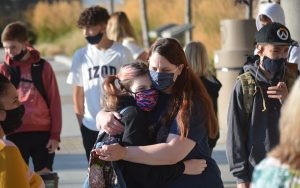
So far, there have been no official reports of COVID-19 in School District No. 53.
(Photo by Lyonel Doherty)
Some need more support
While some students are thriving, others are being left behind.
“[COVID-19] is just kind of bringing additional stressors for some kids and some families. So the mental health concerns, we’ve always had a lot of them. And we are managing them quite well, I believe,” said Harrington.
“But it’s just a matter of some of those kids that weren’t right on the radar before are perhaps more on the radar,” she said.
The pandemic has also been hard on students who, for whatever reason, have not returned to in-person classes.
“I’m sure it’s difficult for some students outside of school who are a little bit more isolated, perhaps, or maybe not doing the sports that they want to do and that’s tough,” Young said.
“We have minimal support trying to maintain connections, but they’re not at school in front of teachers. So it depends on when they’ll return and what gaps may or may not be identified. They certainly aren’t connected to other students as they would be if they were in the buildings,” said Young.
Young explained that there are a number of factors that could potentially lead to gaps including the style in which the student learns best, the amount of time spent and the level of support the student has at home. The district currently has 141 students, approximately six per cent of total enrollment that are learning remotely.
Angela’s (last name withheld) daughter has asthma and has been told to avoid the general public by her doctor. Because of this she has been getting her education through the district’s correspondence program, YouLearn. Angela has questioned the use of this program especially given the fact that all students were taught using Zoom meetings when classes were suspended in the spring.
“It would be nice to have the actual school teachers participate. Not that I have anything against the YouLearn teachers, they’re wonderful, they’re doing a fantastic job,” Angela said.
“But honestly . . . I don’t understand how difficult it would be to actually just have a computer recording the class lessons while they’re doing them. I don’t see how that would really cost any more money than it’s already costing,” said Angela.
According to Osoyoos Secondary School (OSS) principal Scott Tremblay, that is not a decision he made, but one that came from the Ministry of Education.
“It’s a direction from the Ministry of Education that school districts would have predominantly in-person instruction. And then any students that would be considered transition students would be looking towards their local distributed learning schools for their education,” said Tremblay.
There have been some advantages, however, including the fact that it’s less structured, Angela said.
“Sometimes she (daughter) feels like she’s finally getting into the flow of what it is she wants to do with this assignment and then boom, the bell rings and she just has to stop doing it right away and go elsewhere,” she said.
“Whereas with distance learning, if she wants to, she can spend eight hours on one subject. So she can do everything at her own pace or speed.”
The disadvantage is that Angela’s daughter doesn’t get to see her friends.
“But she does have a really good online group of friends which is very supportive,” said Angela.
She also noted there has been a lack of communication from the school.
“I think it would be nice if they reached out more. I mean, they still consider her a student of their school. And they said she’s welcome back at any time, even if she goes three quarters of the year with YouLearn and joins back at the end of the year. But there’s really not a lot of reaching out.”
Angela explained she is getting emails about what is happening at the school, such as events or report cards coming out, but that information is not relevant to her or her daughter.
Tremblay said he understands the frustrations, but disagrees that there has been a lack of communication. “There’s been an abundance of communication throughout the semester.”
Tremblay is one of three teachers at OSS who are case managers for the transition students. Case managers do weekly check-ins, but things do get lost in transition, he said.
“We’re not always able to make contact or someone’s not always returning each other’s communication.”