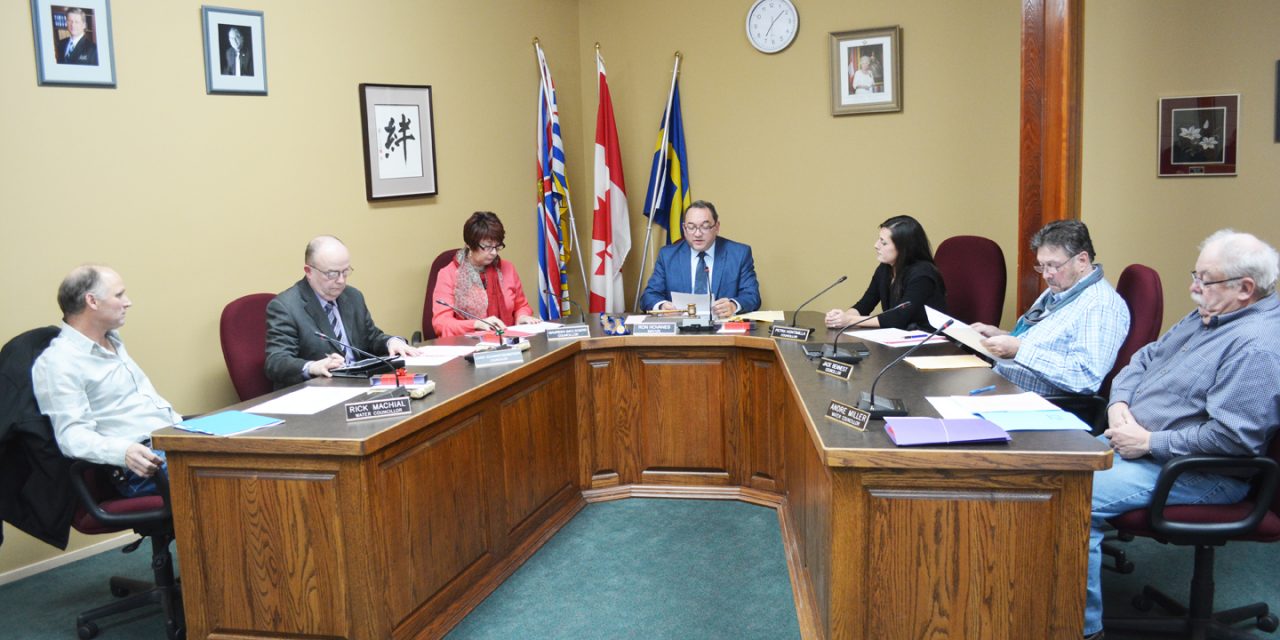

Town council meeting
With summer-like temperatures hitting the South Okanagan in the past week, water was the hot topic when the Town of Oliver met for its regular council meeting March 9.
In an area where water is key to the success of the many orchards, vineyards, and vegetable crops, the early spring has resulted in unprecedented growth and some concern from those in the business regarding their supply of much-needed water to those crops.
Shawn Goodsell, Director of Operations, gave his report detailing the potential start dates for the canal diversion and the official irrigation season start-up.
The staff recommendation was for the canal diversion start date to be April 1. Staff will turn on the irrigation system April 7, and the irrigation season will officially start April 9.
“We are looking to start diverting water from the canal on April 1st, and will take approximately four days to properly follow, fill and do checks in different sections of the canal system,” explained Goodsell. “Town crews are proposing to take the Friday off and continuing the canal diversion on April 6 (Easter Monday) with a smaller crew. Irrigation service turn-ons will start April 7 and this will ensure us meeting the start date on April 9.”
If these timelines are all met with success, it would mean the canal system would be fully functional on April 7.
Not soon enough for one Oliver councillor.
“This is a really early spring – one of the earliest,” stated Water Councillor Rick Machial. “The forecast is for warm weather to continue and temperatures to stay above freezing at night, so trees continue growing through the day and night. I favour this, but the earlier the better.”
Goodsell stayed on the hot seat to inform council on the next item on the agenda – System #1 Capacity and Irrigation Applications.
The purpose of this report was to update and inform Council on the irrigation service capacities for water system #1 and recent and older water applications, and to recommend a strategy moving forward for system #1 water applications.
“In 2014, staff was asked to work with a consultant on the water service capacities in irrigation system #1 due to the occasional irrigation service requests that come into the Town. What initiated this report was a request from Michael Walsh, located at 307 Park Rill Road, who inquired and made application for a 10.58 acre parcel in the summer of 2014.
At that time the last phase of the water twinning project was completed and it was assumed by staff and the town’s Consultant, that there could be approximately 120 US gpm (454 litres) per minute available since each property requiring a new domestic water line was given one, thus alleviating some possible capacity issues from the irrigation system. But staff was not 100 per cent certain that this was the case.
To get a better and more complete answer to actual irrigation system #1 capacities, staff asked TRUE Engineering to complete and run a water model for the system so we would have better data to make better decisions for future applications,” explained Goodsell. “To summarize TRUE’s report, they have found that we cannot add more demand to the existing irrigation system without affecting some existing customer’s pressures and that current operations already run on suitable pressures for these customers in areas of the irrigation system.”
And that left council with a number of staff recommendations to consider.
They flat out rejected one proposal which stated that council would not accept any further irrigation water applications in System #1.
Other options included upgrading the service pressure in the system to increase capacity. This option came with a potential price tag of $285,000.
“Would spending $285 thousand satisfy everyone?” questioned Councillor Jack Bennest.
After much discussion, Council deeded it will accept new applications provided that necessary upgrades are done at Mud Lake pumphouse, and the applicant(s) pay full cost of all pumphouse improvements and any associated irrigation service connection fee costs, as set out in Bylaw 1351.
Council decided not to spend the $285,000, and directed staff to address existing low pressure areas by providing existing customers a booster pump to help with residual pressures at their service. This option could potentially increase the range of demand to the system from 0 to 50 USgpm.
“We have to look at the people who are currently being underserved by our irrigation system in this community,” stressed Water Councillor Andre Miller.
Chief Financial Officer David Svetlichny also present Council with ‘5 Year Financial Plan Bylaw 1355’.
The plan for 2015 is to spend a total of $11 million. This total includes 59 per cent, or $6.5 million to the general fund, 26 per cent, or $2.9 million, to the water fund, and 15 per cent, or $1.6 million, to the sewer fund.
While the Town is looking to budget over a five-year period, Council was given assurances that changes could be made throughout the lifetime of the financial plan.
Council officially gave first three readings to the ‘5 Year Financial Plan Bylaw 1355’
One other order of business came out of the Committee of the Whole meeting, which took place prior to the regular council meeting.
The Town’s Grant – in – Aid Policy came under discussion.
With three teams from the South Okanagan Minor Hockey Association (SOMHA) heading to provincials this weekend, Council discussed dipping into the grant – in – Aid fund to help the three teams with travel and other expenses.
“It’s important to note that minor hockey association did not approach us asking for money,” offered Mayor Ron Hovanes. “Through discussions with Osoyoos Mayor Sue McKortoff, it came to light they have agreed to give each team $500. We don’t have a huge Grant – in – Aid pocket, but we do have a bunch of young players representing Oliver at provincials.”
Council voted to give minor hockey $750, and encouraged the Association to approach the Oliver Parks and Recreation Society for further financial help.
Dale Cory
Oliver Chronicle