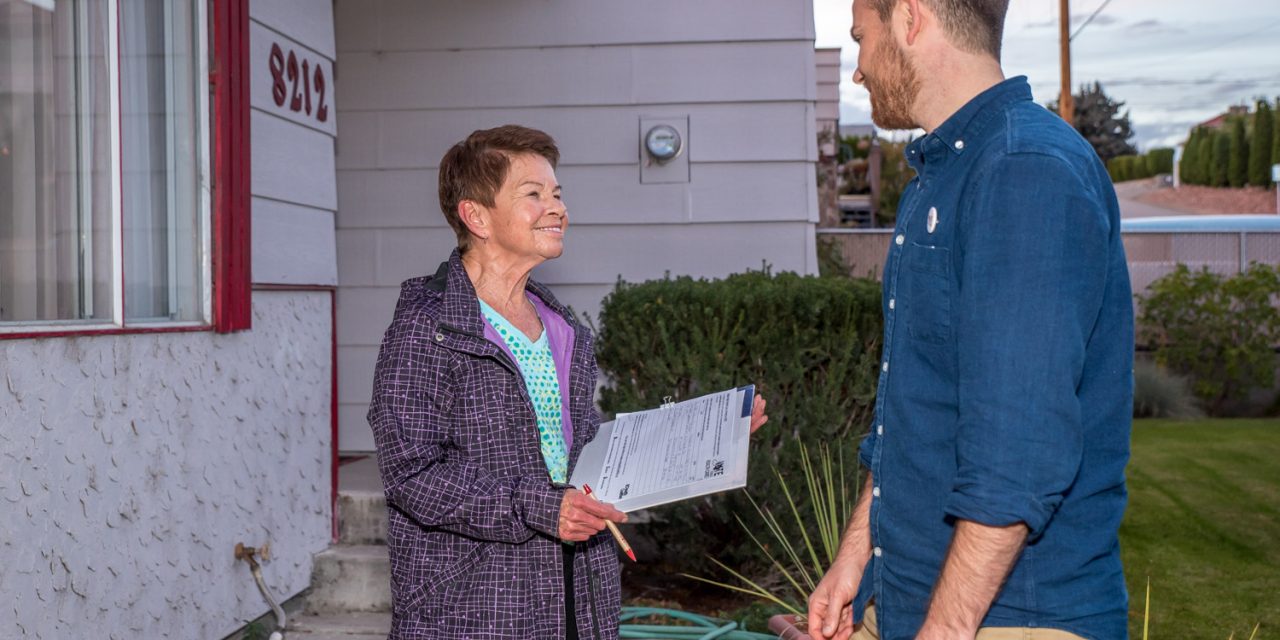
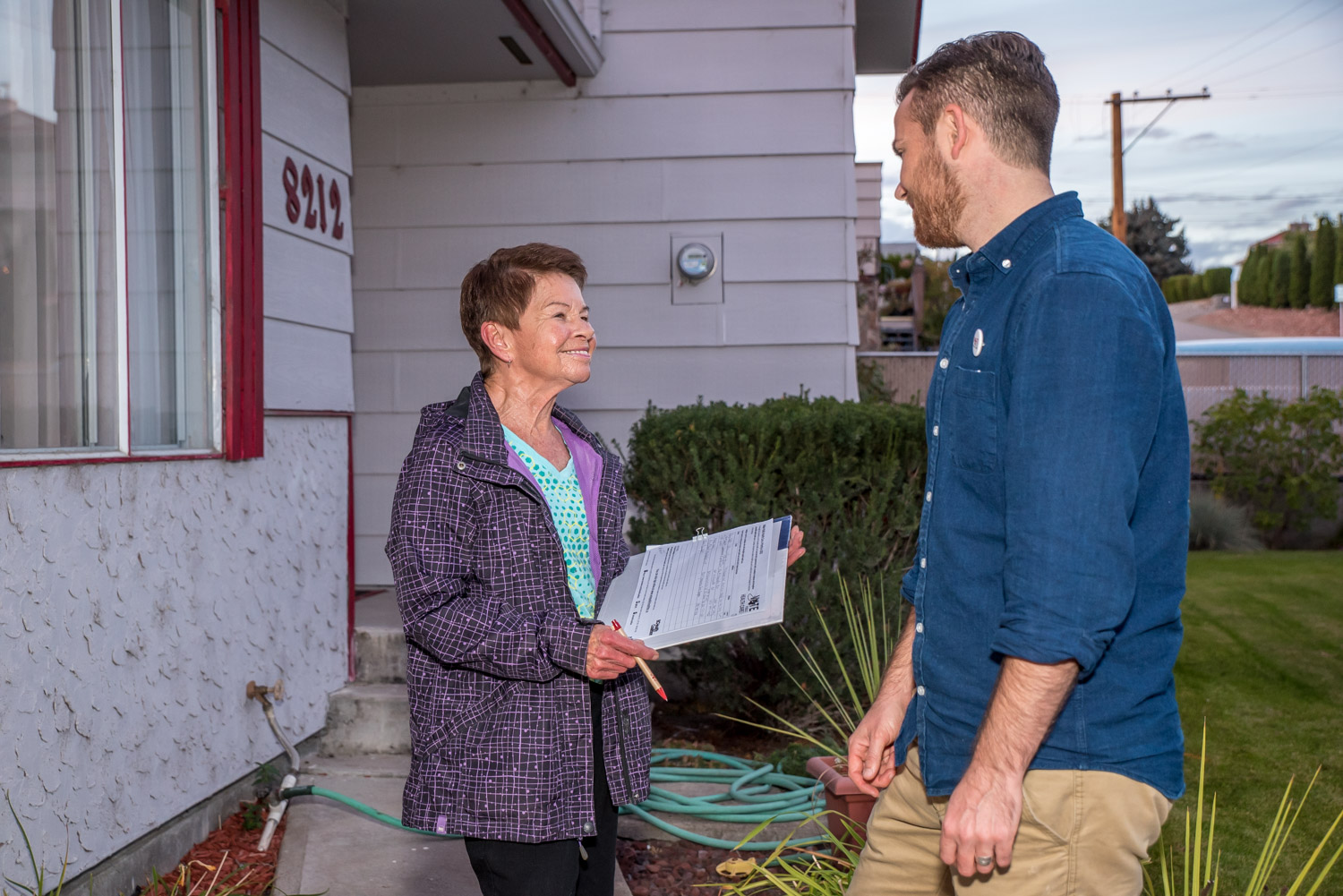
Adam Lynes-Ford (right) chats with Gravenstein Drive resident Donna Flintoft as he asks her to sign a pledge to consider health care when she casts her ballot in the Oct. 19 federal election. He didn’t need to twist her arm. She’s a retired nurse who was once regional vice president with the B.C. Nurses Union and she had a big NDP sign on her lawn. (Richard McGuire photo)
In an election dominated by the economy, jobs, the environment, Senate scandals, refugees and terrorism, there’s been little attention to health care, a major issue in some previous elections.
A non-partisan activist group, the BC Health Coalition, is trying to change that one door at a time.
The Vancouver-based group is one of nearly 80 groups across Canada registered with Elections Canada as a third party, allowing them to participate in the election under strict spending limits.
They’ve targeted South Okanagan-West Kootenay (SOWK) because it’s a riding where the issue of health care could make a difference to the election outcome.
We caught up to Jen Kuhl, an organizer for the group, and Adam Lynes-Ford, a campaigner, last Wednesday evening as they hop-scotched between doors along Gravenstein Drive in Osoyoos.
The young canvassers weren’t pitching any particular party, but they were asking people to sign a pledge saying that they would think about health care when they decide how they will cast their vote.
Those who express an interest are sent information on five key health care issues and where the parties stand on them.
They may get a call reminding them to vote, but they won’t be steered towards a particular candidate, said Kuhl.
“When we make those ‘go vote’ calls, we’re not going to say: ‘Hey did you notice X candidate has a stronger stance on senior care than Y candidate?’” she said. “We’re going to assume they’ve read our information and people can make their minds up from there.”
It’s clear, however, they aren’t impressed by the record or platform of the Stephen Harper Conservatives on health care.
The BC Health Coalition strongly supports the public health care system. It doesn’t just want to maintain it, but wants to expand it.
Although the conversations at the door are often brief, many people have health care on their minds, Kuhl and Lynes-Ford said.
Particular complaints in Osoyoos centred on the distance people need to travel for medical care and the difficulty getting a family doctor.
There’s also confusion about the respective roles of the federal and provincial governments on health care. The province handles the day-to-day operation of the medical system, but the federal government, through the Canada Health Act, sets the standards and provides a large chunk of the funding that maintains the public health care system.
Lynes-Ford was hesitant to let the Osoyoos Times come to the door with him out of concern for residents’ privacy, but he agreed to call up a reporter from the street if the resident was willing.
At one door he receives a friendly reception and he soon signalled to the reporter to come up. The home has a large lawn sign for NDP candidate Richard Cannings, suggesting the homeowner is politically engaged.
Lynes-Ford is in the midst of a conversation with Donna Flintoft, a retired nurse, who is passionate about health care, and tells him where the system is failing.
She’s been a regional vice president of the BC Nurses’ Union in the past. She’s also been an NDP supporter since the 1970s, she said.
She doesn’t need any arm twisting to sign the pledge, but it’s probably a case of preaching to the converted.
The BC Health Coalition counts a number of unions and retired union members among its member organizations, through it also includes some community activist groups.
Although many of the communities in SOWK, including Osoyoos and Oliver, have older populations, Kuhl said demographics wasn’t the primary reason this riding is targeted, along with Port Moody-Coquitlam.
Rather, the coalition looked at results of the 2011 election after results were transposed to the new riding boundaries. In SOWK, the Conservatives would have won the riding by just over five per cent.
“We were looking for places where mobilizing health care voters might actually make a difference in the outcome of the election,” said Kuhl.
The five key things BC Health Coalition is calling on the political parties to do are:
- Negotiate a new Health Accord and restore funding to the provinces. The existing accord lapsed in 2014.
- Invest in a national seniors care strategy.
- Implement universal pharmacare.
- Restore health care for refugees.
- Implement a national plan to eliminate poverty.
Kuhl and Lynes-Ford are sometimes able to get groups in the communities they visit to canvass with them, but in Osoyoos it was just the two of them. The next day they were headed to Grand Forks.
For more information, visit: www.bchealthcoalition.ca.
RICHARD McGUIRE
Osoyoos Times
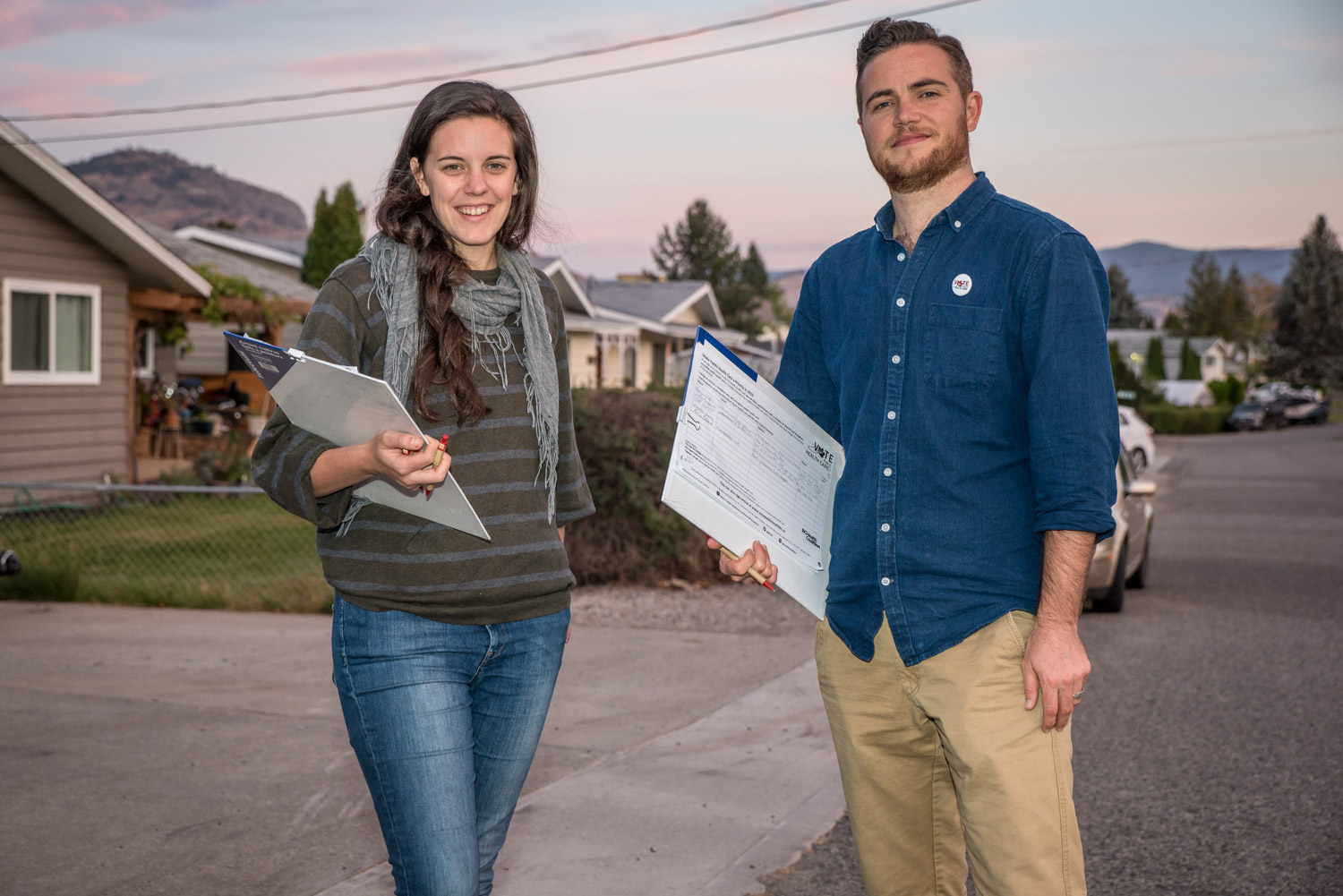
Jen Kuhl and Adam Lynes-Ford were canvassing for the BC Health Coalition on Gravenstein Drive last Wednesday night. They were asking residents to sign pledges saying they would keep health care in mind when they vote in the Oct. 19 federal election. (Richard McGuire photo)