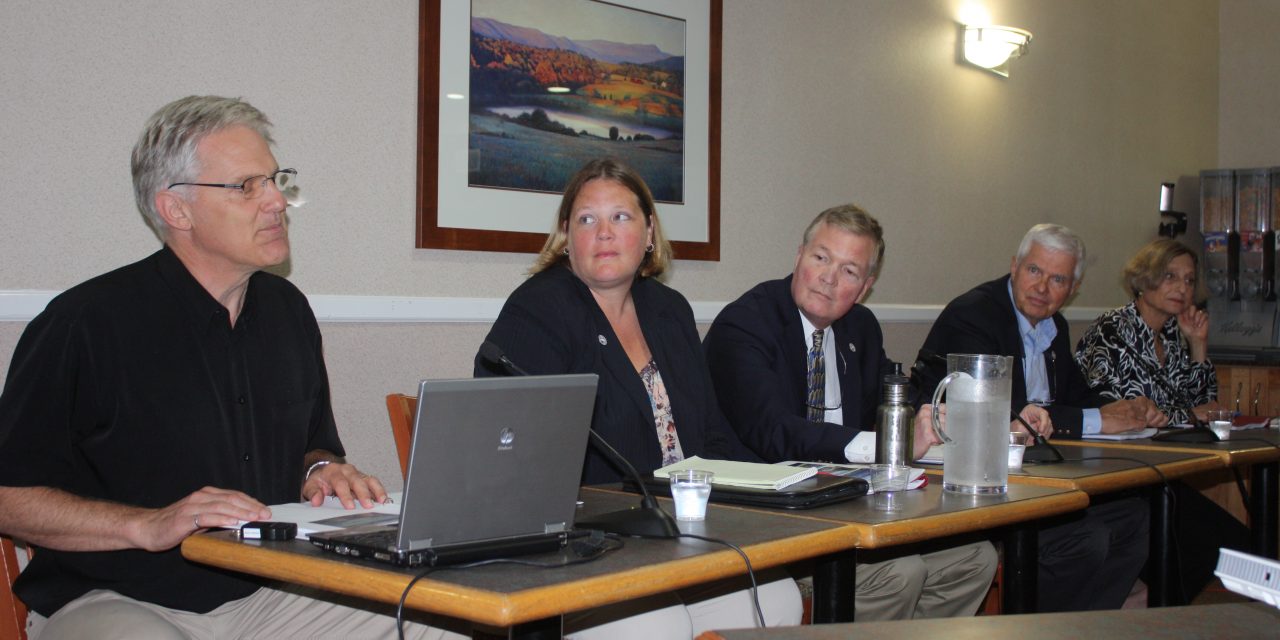
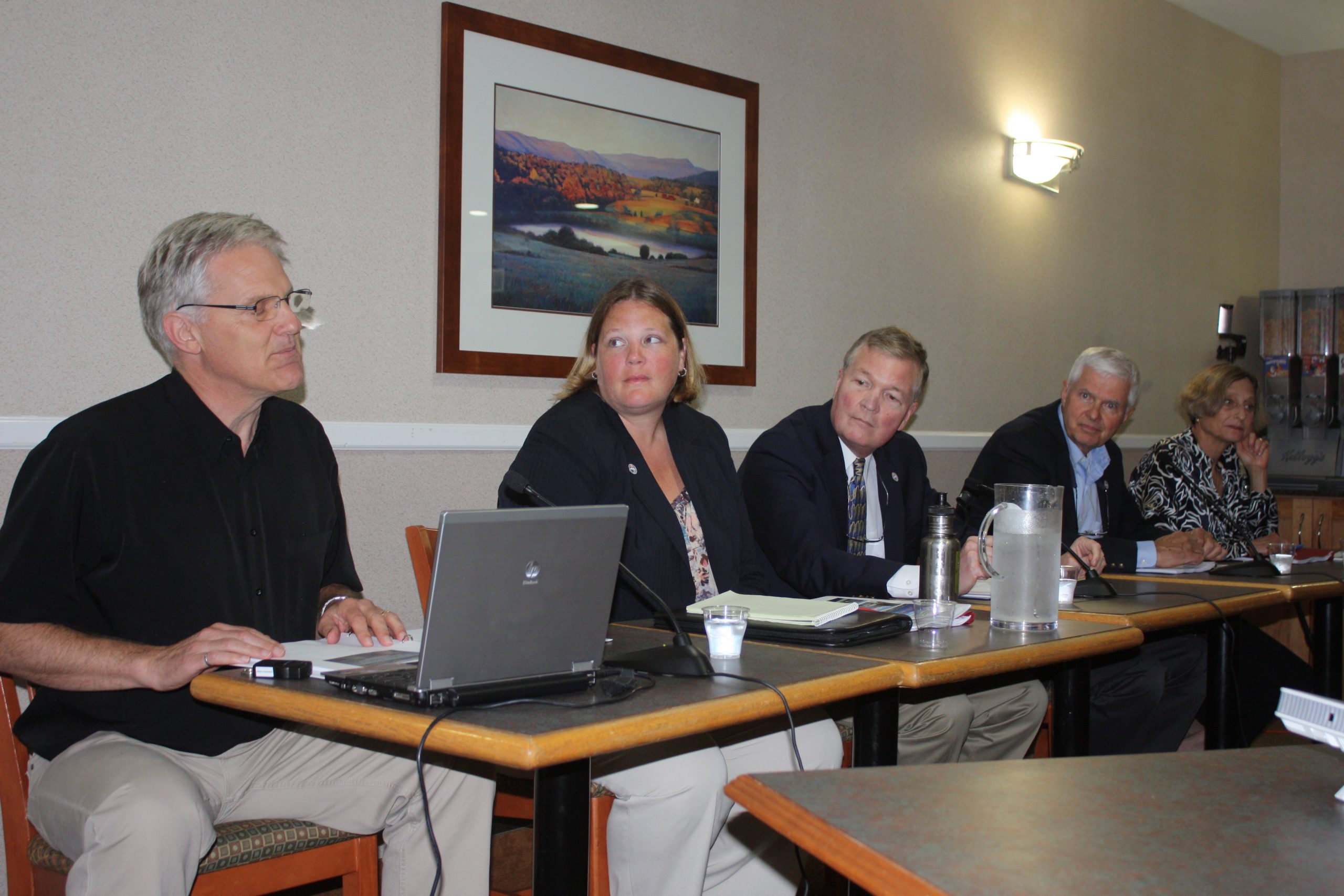
Members of the International Joint Commission (IJC) were in Osoyoos at the Best Western Hotel last Wednesday evening as part of a public meeting held to discuss recommendations to renew the board of control’s Osoyoos Lake order for the next 25 years. From left are, Bryan Symonds, who acted as host for the evening and is a member of the local Board of Control, and IJC commissioners Dareth Glance (New York State), Rich Moy (Montana), Canadian commissioner Lyall Knott and Lana Pollock (chair from Michigan). The IJC’s recommendation to raise Osoyoos Lake levels to 912.5 feet in the summer months raised the ire of several local property owners. Photo by Keith Lacey.
What a difference a foot makes.
After a well-attended public hearing at the Best Western Hotel in Osoyoos last Wednesday evening by members of the International Joint Commission (IJC) relating to the renewal of the Lake Osoyoos Order to control water levels on the lake, several local residents shared their concerns about a key recommendation by board members to limit the maximum regulated level to 912.5 feet to minimize shoreline erosion and inundation of lakeside property.
The current 25-year Osoyoos Lake Order is set to expire in February and the six-member Osoyoos Lake Board of Control has been gathering information and commissioning scientific studies for the past dozen years and holding public hearings over the past several months to listen to questions and concerns from all stakeholders on both sides of the border.
A similar meeting was held at the high school in Oroville last Tuesday night.
Water levels on Osoyoos Lake on both sides of the border are controlled by the Zosel Dam, located near Oroville. Because of high water in the Okanagan water system, the governments of Washington State and British Columbia signed its first deal to control water levels way back in 1946, said Brian Symonds, director of regional operations for the B.C. Ministry of Natural Resource Operations and a member of the International Osoyoos Lake Board of Control.
Symonds gave a detailed history of the formation of the IJC and its function since it was formed back in the 1940s, he announced the board of control has tentatively approved 10 key recommendations, which are subject to change until all public submissions are completed by the end of August.
The one recommendation which seemed to draw the ire of several Osoyoos residents was to limit the maximum lake regulated levels to 912.5 feet.
Most of the 60 people in attendance didn’t appear to have any significant problems with the process or the other key recommendations being considered by the Board of Control when the new deal – which is expected to be for another 25-year term – is struck in the coming months.
Having the regulated limit increase to 912.5 feet from the previous 911.5 would affect 24,000 square metres of shoreline and endanger dozens of plant species and cause serious flooding concerns during spring runoff, said Gary Ford, a member of the Osoyoos Sailing Club, who was the first local resident to ask questions of the board at Wednesday’s meeting.
In June of 2011, lake levels rose past 914 feet during spring runoff, which led to flood warnings for property owners around Osoyoos Lake and sandbagging of his property “which is not a good situation” and would only get worse if the regulated lake level is increased to 912.5 feet, said Ford.
“I see no benefit to British Columbia, Osoyoos Lake or Canada for the new lake level being proposed at 912.5 feet,” said Ford. “I want to know who will receive the benefit and what modifications are being made on the other side of the border in the United States.”
Board of Control member Rich Moy told Ford and everyone in attendance that all questions and concerns being raised at the meeting will be seriously considered before any final recommendations are adopted and he thanked Ford for his informative presentation.
Local resident Rosemary Voakes raised similar concerns saying raising lake levels will negatively affect her property and hundreds of other property owners around Osoyoos Lake here in Osoyoos.
“My major concern is the lake levels you want are not lower,” she said. “I would like to see you come down from 912.5. I think that’s too high.
“I’m losing some of my property whenever the lake gets too high and I’m not the only one who will lose property. We really do need to keep lake levels low so the lake doesn’t get too high (during heavy rains or spring runoff). Lowering it below 912.5 will be far better for a lot of other people as well.”
Ivo Tyl of Osoyoos echoed many of the same concerns.
“Having the regulated level at 912.5 doesn’t provide any margin of safety for the Town of Osoyoos,” he said. “I don’t think that’s fair.”
Other key recommendations being considered by the Board of Control as of last week include:
•Continue to limit the scope of the order to lake level management and encourage the continued co-operation between British Columbia and the State of Washington to balance flow needs across the international border and downstream of Zosel Dam, while respecting goals for Osoyoos Lake elevations and limits on releases that are possible from Okanagan Lake.
•Retain the Zosel Dam facility as presently constructed.
•Retain the requirement for the applicant (Washington State government) to periodically document the flow capacity of the Okanogan River between the lake and Zosel Dam.
•Keep the same winter operating range of 909-911.5 feet. Having the ability to draw the lake down to 909 will help prevent ice damage to shoreline infrastructure, while allowing levels up to 911.5 in winter provides the ability to store water in the winter if warmer temperatures in the future lead to more winter precipitation falling as rain instead of snow.
•Eliminate the drought/non-drought designation and replace it with a single set of operational criteria that would be followed at all times.
•Allow for lower lake levels in April and May to better match the current timing of the spring runoff. This will help with providing late winter fisheries flow downstream from Zosel Dam and will help to reduce the duration of naturally high lake levels during high snowmelt runoff years.
•Eliminate the use of fixed dates for switching between winter and summer operations and allow for more flexibility for transitioning lake levels between seasons.
•Maintain flexibility for filling the lake earlier in the year in anticipation of climate change, causing more winter precipitation falling as rain instead of snow.
•Incorporate an adaptive management strategy in the renewed order that enables an evaluation of water-level management performance.
The last order went into effect in February of 1987 after modifications were made to the Zosel Dam, meaning the existing order expires this coming February, said Symonds.
A total of eight detailed scientific studies have been commissioned by the IJC in the past few years as part of the process to establish a new long-term order, said Symonds.
A copy of the Recommendations for Renewal of the International Joint Commission’s Osoyoos Lake Order can be found online at www.ijc.org