


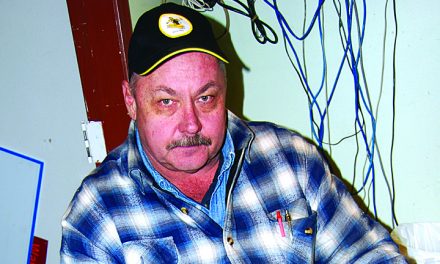
Hilary Robertson spoke to the Rotarians earlier this year about her struggle with myalgic encephalomyelitis.(Richard McGuire photo)
Some years ago, when Hilary Robertson was suffering from extreme exhaustion and continuous pain, she visited a medical specialist to try to pinpoint what was wrong.
“You’re almost 70,” he told Robertson, who was then actually 62. “Get on with your life. There’s nothing wrong with you.”
Since that time, Robertson has been diagnosed with myalgic encephalomyelitis (ME), a condition commonly referred to as chronic fatigue syndrome (CFS).
And she’s become an advocate for people with this condition, which is still misunderstood in popular culture.
“There were jokes even on Jimmy Kimmel about yuppie flu and ‘oh, I just don’t feel like going to work today,’” Robertson said earlier this year in a talk to the Rotary Club of Osoyoos.
And while popular culture and even some medical professionals still see those with ME as malingerers, there is now widespread medical recognition that ME is a real and serious condition.
“It’s a neurological disease that occurs in sporadic and endemic forms and affects over 560,000 Canadians,” said Robertson. “The cause of the disease is unknown.”
Some researchers believe it is caused by a virus that results in some, but not all, people developing the condition.
Robertson suspects that in her case it resulted from a viral infection that she and a group of others with her picked up in Victoria some years ago.
“Three of us were hospitalized,” she said. “They could never figure out what we had, but in my view, that was the beginning of my disease journey.”
After the specialist told her to get on with her life, Robertson gave it a try.
“That summer I pushed myself really hard thinking, ‘maybe I’m crazy,’” she said. “This is not an unusual reaction for any patient. That’s actually when I pushed all of my systems into what I would call ‘under drive’ instead of ‘overdrive.’”
ME results in a continuous state of fatigue.
“No matter how long you sleep or how well you sleep, you wake up feeling exhausted,” said Robertson. “You don’t feel refreshed.”
Sleep patterns are disrupted with patients often experiencing hypersomnia, or excessive sleepiness, during the day and insomnia at night.
“We sometimes say in the ME community that we have a battery and we never get it to charge to 100 per cent,” said Robertson. “And when we take it down to five per cent, we don’t just lie down. It can take three or four days, even a week or two, to bring yourself back up to maybe 60 per cent.”
During that time, there is a cascading effect of symptoms, though not everybody experiences the same ones. Even mild exertion activities such as taking a shower or standing for a period of time can result in exhaustion.
Pain can be experienced in muscles and joints and it’s often widespread and migratory in nature.
“It can be where you feel like you’ve got shooting knives all over you or it can be deep bone and aching muscles,” she said.
There is neurological and cognitive impairment.
“We get very spastic, our legs don’t necessarily work, our muscles go into spasms,” she said.
When Robertson talked to the Rotarians, she sometimes had difficulty speaking due to irritable larynx syndrome triggered by the disease.
She acknowledged her talk would likely drain her battery, but she said it was important to get the word out.
“I will probably be at home for the next couple of days from this,” she told the Rotarians. “I make choices about where I spend my energy, because I only have a certain amount of energy every month.”
That can mean showering or cooking dinner instead of going for coffee with a friend or walking more than a block with the dogs.
While ME itself isn’t fatal, it can contribute to cardiac conditions such as arrhythmia that might be. And it can lead some people to take their own lives.
The disease can affect all ages and both genders, but it tends to be predominant in women. And, for an unknown reason, it is more prevalent in people who are “type A,” high achieving, quite fit and very active.
“You’re going full tilt as I was with the expectations of life and work and community and it just stops you in your tracks,” said Robertson, who was a university professor.
“I went from snowshoeing up on (Mount) Baldy for 10 km on the sides of those mountains to not being able to walk more than half a block,” said Robertson. “I now can walk four blocks.”
Obviously this disease, which can take years to diagnose and lasts for years, has a huge impact not just on the patients, but also on their families.
“It affects both John and me and all of our families,” she said, referring to her husband, an active Rotarian.
And there are feelings of loss for the active life that is gone.
“I often find myself filled with grief on seeing a person running along the canal, playing pickleball, hiking the trails, walking their dogs and even planning vacations,” Robertson says. “So often the response is, ‘you are looking so well. You are getting better!’ when in fact I am simply managing myself to a better degree.”
A Canadian ME advocacy group calls itself Millions Missing Canada. Robertson said the term applies to the millions of people around the world with ME who are missing from their community, their life and family. But it also applies to the severe lack of research funding in relation to other diseases.
Robertson says that the Canadian Institutes of Health Research typically provides $158.58 per person for research funding for chronic diseases. ME gets 11 cents per patient, compared to $575 per patient for HIV research, she said.
It’s taking time for awareness of ME to become more widespread, but Robertson sees signs of progress.
“My doctor has been phenomenal,” she said referring to Dr. Elzaan de Witt. “She knew nothing about this disease when it first started, so it’s been a learning journey for her also.”
Other doctors are also becoming more aware.
Robertson points to the 2017 release of a documentary by Jennifer Brea called “Unrest” that documents Brea’s own battle with ME that transformed her from a Harvard PhD student to someone who couldn’t even sit in a wheelchair.
Robertson and her husband plan a showing of the film in their attempt to raise awareness.
And she’s finding a new role as an ME advocate.
“It’s funny, when one door closes another opens,” she said. “I was teaching university, loved it, but couldn’t do it any longer. I said to my doctor that maybe my next job is to become an advocate for this disease and so it’s funny how that has been happening.”
She’s been receiving calls from such places as Smithers, Vancouver and locally from people waiting to be diagnosed or waiting to get into the Complex Chronic Diseases Program at BC Women’s Hospital.
“My doctor has referred some to me (for conversation),” she said. “It is a very isolating, very lonely disease. It’s a very confusing disease. But the world is getting smarter.”
RICHARD McGUIRE
Osoyoos Times





I would love to talk to this lady. I have been suffering for 3 years with no answers. My email [email protected]
sent you a pm
Would love to talk with you. I live in Kitimat B.C and have been diagnosed with M.E. over three years ago.
I sent you a pm through FB…take care. Hilary
Great article, Hilary! And wonderful to have you on the ‘advocacy team’.
thank you James.
This is wonderful, Hilary Robertson. Thank you for all the work you do on this! Unfortunately, I’ve yet to find a medical GP/Dr. here in Ontario that knows anything about it.
Linda. I live in Ontario as well. I am in Milton right now. Where are you? Perhaps we can help each other. I, also, think you will agree with my comments/reply to Coral
thank you Linda, it is a journey for sure and I do hope that with further research and education that you are able to find a GP who can advocate for you. I have found that you need to be aware of your own needs, research your data, be prepared, be informed…and then rest as this is all taxing! Take care. Hilary
Richard McGuirr – CFS/ME is fatal. But like Diabetes type 1 you usually die of a condition that started because of your CFS/ME. Most insulin dependent diabetics due of heart disease caused by sugar crystal damage frim high blood sugar in veins causing arterial sclerosis. People with severe CFS/ME strip absorbing nutrients right and seem to waste away with no energy to feed themselves and multiple sensory sensitivities, but the vast majority die earlier than expected by 15 years or so of higher rates of cancer, heart failure, liver and pancreas problems. This is in addition to most of us being house bound at least partially, in pain, exhausted, weak, unable to think clearly or interact with people socially (too exhausting), with severe allergies or multiple chemical sensitivities or multiple sensory sensitivities and just poor quality of life. Yet we are still treated as if this is a minor inconvenience with research funding less than male pattern balding. It’s been 23 years. My antibodies are attacking my thyroid again, so my free T3 is 240, but my body and pituitary think my thyroid is low because it is being blocked from being absorbed or used so TSH IS 5.48. My Lipase is high and amylase is up 39 points because pancreas iand liver are freaked about who knows what – so doctor removed all supplements and most meds to calm them – but he’s winging it. My heart rate has been averaging 54 most of the year, so I’m headed for a two-fest stress test in LA to see what that can tell us about my metabolism and energy production. I’m an experiment. We ALL are.. i don’t know if I’ll still be here next year for my grandkids, but people keep saying CFS/ME doesn’t kill anybody. We haven’t won the political battle yet in most places to get CFS/ME listed as a cause of death, but did finally officially get one UK cause of death listed as CFS/ME. https://www.newscientist.com/article/dn9342-first-official-uk-death-from-chronic-fatigue-syndrome/ Here’s a website that people use for memorials: http://www.ncf-net.org/memorial.htm
Coral Bohne-could you please expand on your comment “CFS/ME strip absorbing nutrients”
I am also from Ontario, Canada. The USA and UK definetly have a superior medical community. I,also do not have a doctor.
Carol, it seems as though you might be in the ‘severe’ stage of ME. I am in my 29th year. Home bound. Worst symptoms having to deal with family members who are terribly misinformed, say “I should dig deeper” to be able to travel and attend events – no clue of the price I’ve paid for pushing through and running on adrenaline. I have had to ‘detach’ from family members because I cannot change them and cannot handle toxic response. What is left but pain and isolation. Brain cannot handle any anti-depressant nor any mixture of cannabis. Would like to correspond with someone in similar stage of illness.
Wonderful that you are doing this Hillary, so many need an ear or to just learn more about this dreadful disease. Keep up the good work.
I’M BACK TO FEELING LIKE I HAVE A FLU AGAIN LIKE I DID 17 YRS AGO WHEN I 1ST GOT SICK. SO SICK, WEAK, BEDBOUND.
I hear you Bonnie, that is often how I react and feel. Rest well and I hope you have some people around you to help out. Such a tough disease. take care. Hilary
Great article but I would like to point out that M.E. can unfortunately be fatal!
I agree Julie it can be. Only recently have death certificates began to list that ME was the cause. Not a great celebration, but a step forward in understanding. take care Hilary