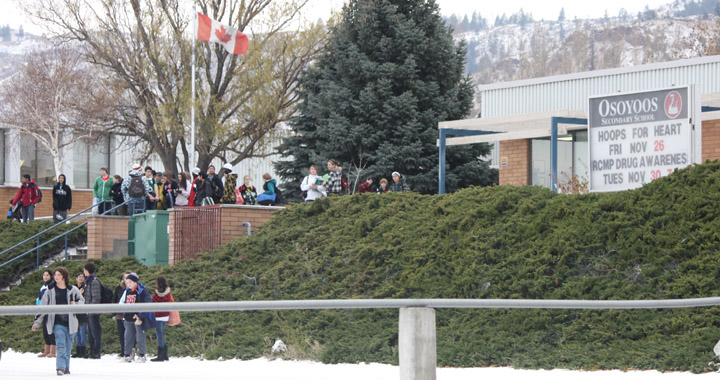
Facing increasing operational costs and looming funding cuts from the provincial government, School District 53 is considering several options to save cash including the proposed closure of Osoyoos Secondary School. Photo by Paul Everest - Click on picture for larger image
OSOYOOS TIMES-December 1, 2010
By Paul Everest – Osoyoos Times
Grade 9 student Blake Loura of Osoyoos isn’t keen on the prospect of having to switch schools partway through his high school career.
If he had to begin attending Oliver’s Southern Okanagan Secondary School (SOSS) should Osoyoos Secondary School (OSS) close down, Blake said the change would affect him in a number of ways.
Having to travel further to and from school would make it difficult for him to continue his participation in extra-curricular activities such as playing minor hockey, he said, and it would be a challenge for he and his friends to get used to a new school after attending classes here in Osoyoos their entire lives.
Blake also worries that if Osoyoos doesn’t have a high school, people won’t want to move here anymore and the town’s economy will suffer.
Because School District 53 faces a projected annual deficit of more than $875,000 in the next few years, the idea of closing OSS has become all the more real.
At its Nov. 24 meeting, the district’s board of trustees was presented with a five-year capital plan report from district staff which focused on the dire financial future the district is facing due to declining enrolment in the region and under-utilized space in many of the district’s schools.
The district receives provincial funding on a per-student basis and although the B.C. Education Ministry has provided funding protection to the district for several years to offset cash shortfalls caused by declining enrolment, including $875,843 for the 2010-2011 school year, the government has signaled that such funding protection will dry up in the next two years.
With costs to the district going up for needs such as electricity and diesel for buses, the district is faced with slashing its budget and the capital plan presented to the board included four recommendations to save some cash.
The option that would provide the district with the most savings would be to shutter OSS and transfer the school’s students to SOSS as early as September of 2012.
Despite a projected increase in transportation costs of $120,000 to bus Osoyoos students to Oliver, closing the school would save the district an estimated $725,088.
The school is currently operating at 83 per cent capacity, but that figure is expected to drop to 64 per cent by the 2015-2016 school year.
The proposed closure would mean the loss of one principal, one vice-principal and two clerical positions but would provide Osoyoos students with a broader range of learning opportunities since a number of classes offered at SOSS aren’t offered at OSS, the plan states.
The district would have to pay roughly $17,000 to maintain minimal light and heat at the school every year after the closure to ensure the facility does not deteriorate.
Another option presented in the plan is to move the Osoyoos YouLearn.ca, formerly the Osoyoos Learning Centre, into the Osoyoos Bus Garage facility beside the Sonora Community Centre.
While it would cost between $120,000 and $125,000 to renovate the garage to accommodate YouLearn.ca, the plan states, the move would eliminate the district’s annual lease costs of $27,000 and maintenance costs of up to $7,000 for the current YouLearn.ca site on Main Street.
Closing Oliver’s Tuc-el-Nuit Elementary School and transferring its students to Oliver Elementary School for the 2012-2013 school year to save more than $385,000 and moving Grade 4 students from Cawston Elementary School to Similkameen Elementary Secondary School next year to save roughly $70,000 were other options included in the report.
The projected savings are based on financial figures from the 2008-2009 school year.
Following an emotional report on the options from district Superintendent Juleen McElgunn, who will retire in the new year, the board narrowly passed a motion not to discuss the four recommendations until a new superintendent is hired.
Board members said they wanted more input from the community on how the district should proceed in the face of its financial challenges.
They added that it would be easier to deal with the matter once a new superintendent is hired rather than having to bring the new superintendent up to speed after decisions on the capital plan have been made.
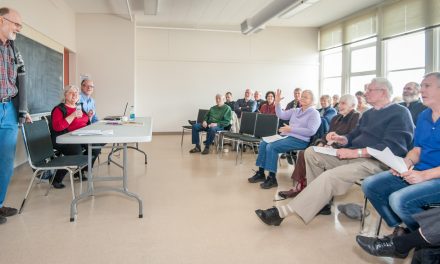
Roughly 25 people including teachers, school administrators, representatives of Osoyoos council and several Osoyoos realtors attended the board’s meeting and were given the chance to express their thoughts on the options before the board.
Mayor Stu Wells said closing OSS would devastate the “social fabric” of Osoyoos.
“You want to see a dead town, go to a town that’s lost its high school,” he said, adding that he wants to see as much dialogue on the matter as possible.
Wells also advised the board members that, if they choose to close the school, they shouldn’t lock it up as alternative forms of education, including a community school run by the Town of Osoyoos, could be explored.
Local realtor Payam Sanai said closing the school would be a “short-sighted” move by the board as it would hurt Osoyoos’s chances of attracting young families to the community.
A teacher from OSS said there are other ideas out there that could save OSS if the district would allow the school’s administration to seek a solution.
He also suggested that the district close some of its administration buildings rather than schools to save money.
Osoyoos’s Ken Davreux, a strata property manager, said the board should look at cutting more of the “little things” and criticized the board’s decision at the meeting to approve the use of a new web-based budget program that would cost $12,000.
McElgunn responded, however, that the board has cut the budget in every place it could to protect the classroom and has worked to delay any school closures in the district while other school districts have shuttered schools.
But because of the current financial challenges, she said, the board now has to make big cuts.
[email protected]