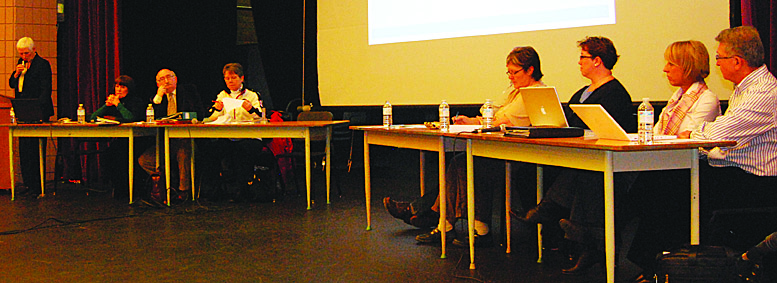
School District 53's board of trustees held a special public meeting in Osoyoos on Feb. 10 to address budget, enrolment and full-day kindergarten issues. Photo by Laurena Weninger - Click on picture for larger image
OSOYOOS TIMES-February 17, 2010
By Laurena Weninger – Osoyoos Times
“We do not have a hidden agenda,” said school trustee Marieze Tarr. “We have made no decisions. We are wanting to hear what do the people want – that is the whole purpose of this meeting.”
Tarr was addressing a gathering of about 150 community members in the Osoyoos Secondary School Mini Theatre on Feb. 10.
The gathering was a special board meeting of School District 53 organized to address three main topics: options for the administration of full-day kindergarten, budget challenges facing the district for the 2010/2011 school year and declining enrolment.
But while parents were interested in hearing about full-day kindergarten options, their minds were clearly on the bigger, budgeting issues – which are closely tied to the declining enrolment issue.
“This year, we are going to have to cut deeper than we’ve ever had to cut previously,” said Juleen McElgunn, the district’s superintendent.
The budget for 2009/2010 was already trimmed by $700,000, McElgunn explained.
It’s looking worse for next year.
Estimated revenue for next year is $23.8 million, she said.
But the district is facing estimated expenses of $24.7 million.
That’s a budget shortfall of more than $850,000 – and that’s only if the B.C. Ministry of Education doesn’t “throw any curve balls.”
The district’s board has some ideas about how to make some cuts.
Their list included a reduction in staffing allocations; cuts to the transportation program; sealing off unused classrooms to save heating and cooling costs; sharing services throughout the district; charging more for facility rentals and trying to cut back on garbage and recycling costs.
Some of the budgeting concerns are caused by declining enrolment, because the ministry pays an allotted amount of money per full-time-equivalent student in the district.
Fewer students means less money, which translates into difficulty providing a range of programs.
It means schools like Osoyoos Secondary School (OSS) suffer.
“You have a school of 260 students, there’s only so much you can offer them,” McElgunn said.
For example, classes like physics may not be in high demand.
In the 2009/2010 school year, only 22 students wanted the class, across all four high schools in the district.
“It’s a matter of numbers,” McElgunn said about how the district can continue to offer a range of programs and the need to adopt options like virtual schools that allow students in remote locations to take less-popular classes.
The board presented enrolment statistics to give some perspective to the issue.
In 2001, there were 351 students at OSS.
For the 2010/2011 school year, the district anticipates that there will only be 252 students at the school.
Projections show that in 2019, there will only be 197.
Part of the problem is demographics in general, McElgunn said, adding people are having fewer children.
Parents at the meeting wanted it straight up.
“Be honest – should we be worried about our school?” asked one of the attendees.
McElgunn was unwilling to offer any concrete predictions about what future budgets might mean for the district.
“(We’ve already) nibbled off all we can and if we face the same amount of budget challenges next year?” she said, leaving the question unanswered.
But it’s also a concern that a general annual increase in funding from the ministry doesn’t match the inflated cost of expenses, including wage increases, heating and cooling costs and even the cost of diesel.
Suggestions from attendees at the meeting included amalgamating schools between Oliver and Osoyoos (a suggestion that spurred some arguing among audience members), more satellite schooling options, looking at a four-day school week and cutting the busing budget entirely, leaving parents to foot the bill of getting children to school.
That suggestion was the most popular with those in the Mini Theatre.
“Cut it! Cut it!” the audience responded to trustee Sam Hancheroff’s query about cutting busing entirely.
But some of the other audience suggestions, like a four-day school week, were shot down on the spot.
“We’re here for education,” said trustee Myrna Coates, about why the district won’t consider the four-day week. “We have to decide what is more educationally sound.”
She said even though some other districts are adopting that program to cut costs, it isn’t the best choice for learning retention.
The four days students are in class become longer, so students learn less, and then the three-day weekends undo some of that learning.
Plus, it doesn’t save on staffing costs, since teachers are still fitting their full-time hours into the shorter week.
The implementation of full-day kindergarten for half of the province raised the ire of some of the parents, especially in light of shortfalls elsewhere.
“We can’t fund what we already have,” said one of the parents, suggesting the district use the money for the kindergarten program for other needs.
But it’s just not an option, explained McElgunn.
The ministry is allocating money for the specific purpose of kindergarten and it’s well-supported by research that children who take part in early learning opportunities meet greater success in later years, she said.
The district will only receive funding for 111 of the 151 projected kindergarten students, leaving more decisions to be made about how those seats are split up through the district.
Options include a “first-come, first-served” concept, as well as identifying specific schools to adopt the full-day program while leaving others as half-day.
The board plans to hold meetings in other communities and then finalize its budget, which has to be forwarded to the ministry no later than the end of June.
[email protected]