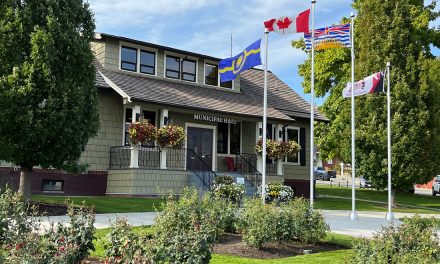
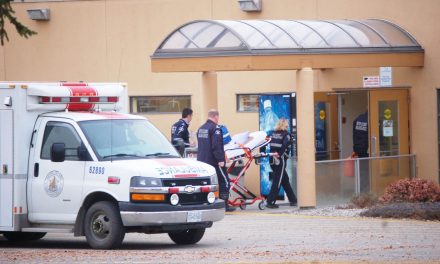
Alan Profili, the Canada Border Service Agency’s acting chief for the Osoyoos port of entry, said how many Canada-bound lanes are open at the border depends on traffic volume and where the agency’s resources are most needed. Photo by Paul Everest - Click on picture for larger image
OSOYOOS TIMES-October 14, 2009
By Paul Everest – Osoyoos Times
The reason people waiting to enter Canada at the Osoyoos port of entry may sometimes face long lines is because the Canada Border Services Agency (CBSA) often has to balance its resources between keeping B.C.-bound traffic flowing and protecting the border.
That’s the response Alan Profili, the agency’s acting chief at the port, gave in response to recent local concerns raised about long wait times at the border.
“We shift our resources to where they’re required,” he said, adding that circumstances sometimes come up where the attention of CBSA officers processing traffic at the border is required elsewhere.
For example, Profili said, “If we encounter a serious border protection matter, we would direct our resources towards that.
“That happens all the time.”
When CBSA staff at the border have to search a vehicle or respond to someone trying to cross into Canada illegally, it may mean guards who otherwise man the gate have to look into another matter and leave only one lane open to traffic, even during busy times such as evenings and weekends.
When asked why there aren’t more staff at the crossing to handle traffic flow and border protection, Profili said the “border protection nature of our work is unpredictable.”
“We have to respond as needed,” he said, adding that while it may make sense to bring in more staff for the summer when the crossing is busier, there won’t be much for them to do during quieter times of the year.
Concerns about wait times of up to 45 minutes or longer at the border were most recently put to Alex Atamanenko, federal MP for B.C.’s Southern Interior, at a community forum in Osoyoos on Sept. 24.
Don Brunner and Albin Hochsteiner said when such concerns have been brought up to CBSA officers at the border, the response they have received was that the crossing was short-staffed.
Profili, who has managed the crossing since 2007, said he has never responded to wait-time concerns at the port with comments about short-staffing issues.
He said such concerns are welcomed by border staff and he suggested anyone who perceives a problem with long lines or wait times ask to speak to a supervisor at the crossing.
“Most problems are quickly resolved that way.”
He added that people should not feel intimidated to bring their questions or concerns to border officials.
Over the summer, Profili said, a second lane was open between 11 a.m. and 6 p.m. daily and a third lane was “frequently” open.
Friday and Sunday afternoons are the busiest times of the week for the crossing, he added, and CBSA officers will process “just under 900 vehicles on a typical Sunday.”
The port’s busiest time of year is the B.C. Day long weekend in August and this year 4,180 vehicles were processed that weekend between August 1 and 4, Profili said.
Although more staff are “likely” to be working at busier times such as weekends or holidays, Profili’s recommendation to travellers is not to cross the border at these busy times.
The Canadian side of the crossing has three multi-purpose traffic lanes, two lanes dedicated for trucks and one bus lane.
Profili said lately the number of trucks crossing to Canada has not warranted opening up the truck lanes.
He added that the crossing processes fewer than 100 trucks a day.
Profili also said there was no truth to a suggestion that the truck lanes aren’t opened because a truck would not have room to turn towards Hwy. 97 once through the port.
The bus lane is not used because there is little bus traffic coming through the port.
The current Osoyoos border crossing facility was completed in 2003 at a cost of $31 million US and Profili said it was built to meet the needs of the time, but expansion is possible.
Last year, the port processed 313,010 vehicles, with a daily average of 858.
Volume data about the U.S. portion of the port was not available before press time.
Profili said keeping the border protected is just as important as keeping traffic moving through the crossing and there is a “dedicated team here to facilitate your travel and keep the community safe.”
[email protected]