By Dale Boyd
Times-Chronicle Staff
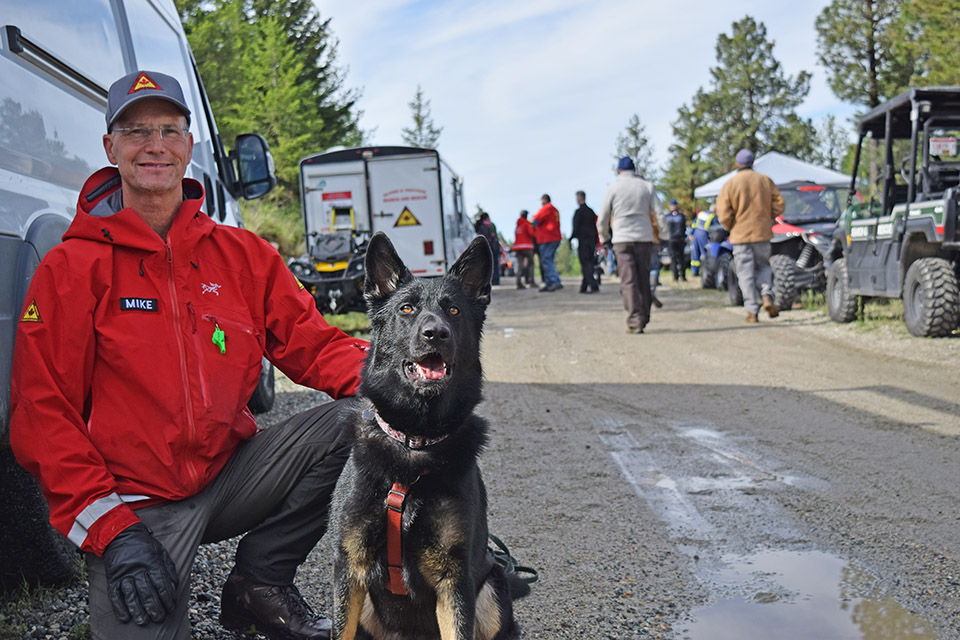
Search and rescue manager Michael Arychuk and rescue dog Kaya conduct a tracking demonstration on Anarchist Mountain in last Saturday’s training exercise. (Photo by Dale Boyd)
A hunter went missing in the heavily-wooded areas of Anarchist Mountain last week, but thankfully on purpose, as local search and rescue volunteers joined together for the first time with local firefighters for a mock search.
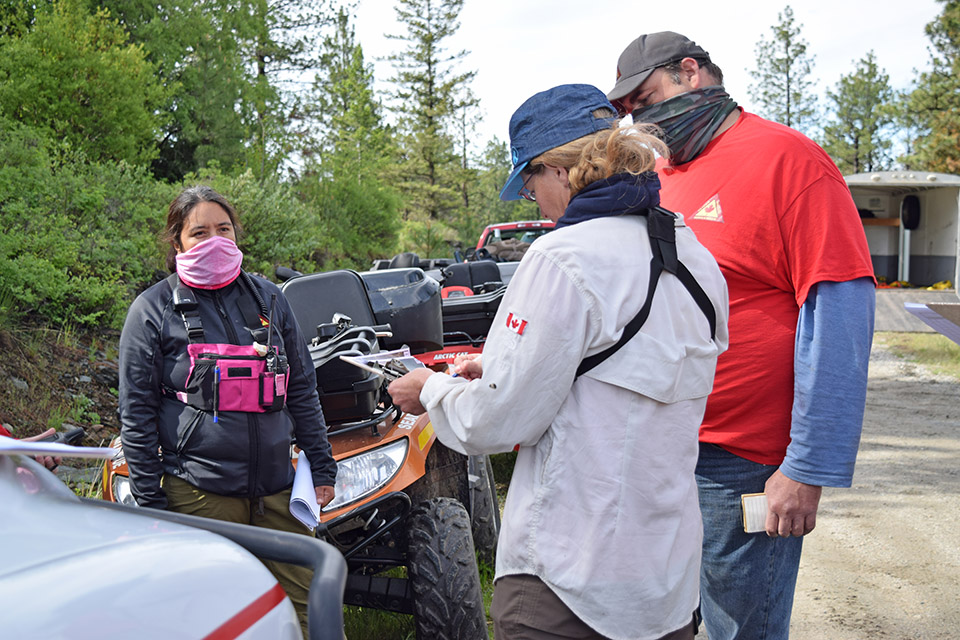
The training exercise was planned a year ago and Oliver and Osoyoos Search and Rescue (OOSAR) along with the Anarchist Mountain Fire Department (AMFD) decided to go ahead with the mock search to also put the special COVID-19 training they have undergone since March into practice.
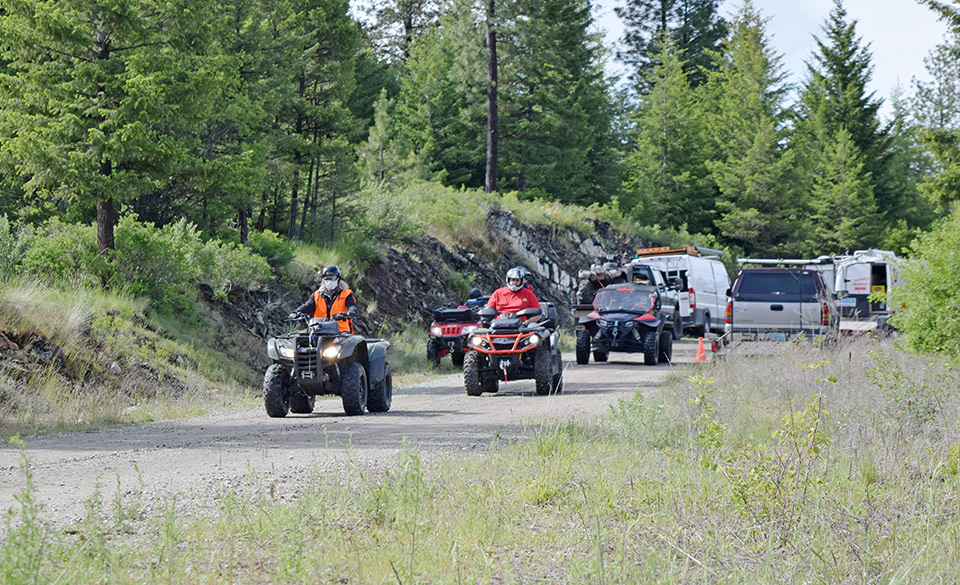
The training scenario had crews searching for a hunter. who’s wife contacted authorities after he didn’t report back the night prior. The hunter, or “hider” played by an actual volunteer, was travelling on an ATV for the training scenario and knew the area well — as crews headed out on coordinated teams of ATVs to begin the search Saturday morning.
The mock search coordinator and OOSAR manager Michael Arychuk was out with one of the first training demonstrations of the day with OOSAR’s top tracker dog Kaya. The night prior, a search and rescue crew member walked a track dropping two articles of clothing over half a kilometre leaving a trail for Kaya to track and giving search crews an opportunity to take in some crucial tracking skills.
“That was to simulate for everybody to understand when you find a piece of evidence, like the quad we are looking for right now, you are going to want to find the quad, and not go walking all over the place because there are specialty resources like our tracking team,” Arychuk said.
“They will look at things like footfall and find a direction of travel, or if there is a dog team available, you bring a dog in and pass the area for the track. If you can pick up the track he’s going to run you to the person.”
Which Kaya did successfully Saturday morning.
The training also featured locals who would contribute their knowledge of the area in a real search called “convergent volunteers.”
“Since we are based out of Oliver, we’ve got a basic knowledge of the area, but it’s nice to have local knowledge and local people come out,” said Tanja Kranz, Oliver paramedic and SAR manager.
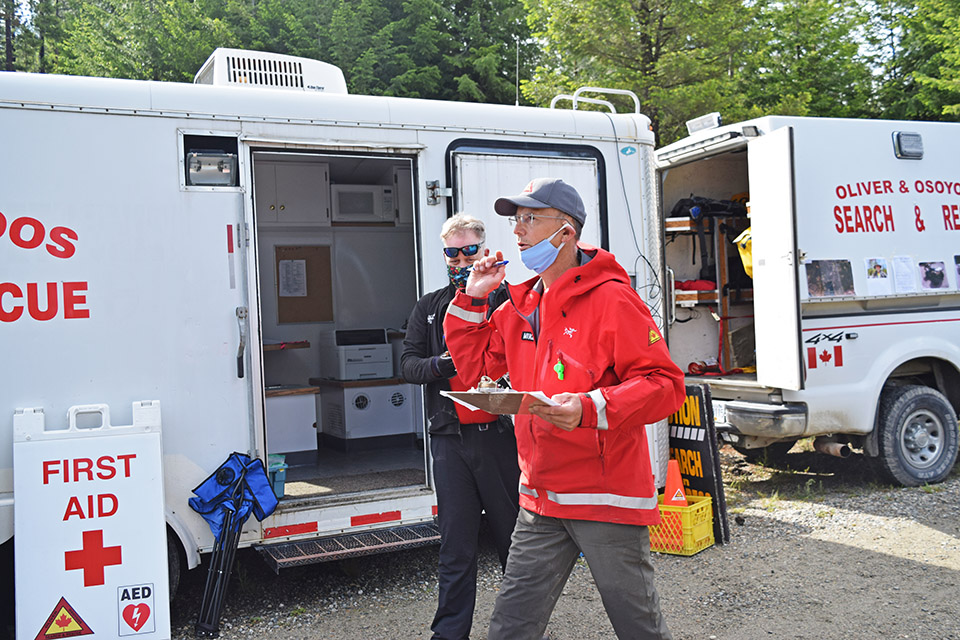
Search manager Mike Arychuk and OOSAR member Kyle Fossett. (Photo by Dale Boyd)
A key aspect of Saturday’s training is working with mutual aid partners like the AMFD.
“Any time you can train with other teams, other fire departments or other search and rescue teams, the better you work together, the faster things come into place,” Kranz said.
Like it or not, search and rescue operations now occur in the same new reality we all do, with COVID-19 protocols top of mind during the exercise.
“This is where we are going to see where we have holes in things. What are we missing? What do we need for cleaning equipment?” Kranz said.
One clear example of how the pandemic has shifted norms was the many personal vehicles lining the gravel road leading up to the command centre for the search on Bullmoose Road.
“Typically we would load everyone into one car, so how do we manage that? This task is a little easier than some, so we will see how the day progresses. Everyone is on quads so we are safe,” Kranz said. “It is when it becomes a rescue that we are close quarters where we start seeing where those challenges are.”
The number one priority is the safety of the search and rescue team, she said.
“And COVID is now that one thing in play. So even before we are out, we have some steps, sanitizer, cleaning stations, all of our equipment. Things take a little longer now, but again, the number one priority is we don’t want anyone to get sick,” Kranz said.
Coordinating the exercise with the AMFD is valuable time to identify different resources and local knowledge that can benefit both teams, according to Kranz.
“It’s kind of seeing strengths and weaknesses, what we can provide, what they can provide. One of the things we always work closely at is fire season, when it comes to evacuations and things like that,” Kranz said.
“Once you know everyone, no one is a stranger. There’s more efficiency and you can run as a unified command.”
Be prepared
With search and rescue crews in Penticton responding to six calls in seven days last week, search and rescue volunteers are reminding those exploring their own backyards to do so safely — and let someone know where you are going and when you plan to be back.
Another key message from search and rescue teams: don’t rely solely on technology like cell phones and GPS that can break down.
“Make a plan, be prepared. With COVID there are a lot more people venturing out into the woods,” Kranz said, adding that search and rescue crews province-wide are seeing more calls as the province reopens.
“A lot of the areas were closed before that you couldn’t access and a lot of people are venturing to places they normally wouldn’t go,” Kranz said. “It’s great getting outdoors, but the biggest thing is to be prepared. Let somebody know where you are going.”
So far the year has been good for search and rescue calls south of Penticton with few incidents in the Oliver and Osoyoos areas.
“It will be interesting to see when the tourism comes back a little bit because we’re not getting a lot of out of province stuff,” Kranz said.
More recommendations on how to safely explore the outdoors can be found at adventuresmart.ca.
(Photo by Dale Boyd)