By Don Urquhart, Times Chronicle
On the cusp of freshet flooding and the start of the wildfire season, the Town of Oliver is now scrambling to find a new Emergency Support Services team after it “fired” its experienced director prompting the volunteer team to quit in solidarity.
The ESS fulfills a crucial role in providing short-term basic support to people impacted by disasters such as evacuees forced to flee their homes as a result of wildfires or flooding for instance. Financed by the province and administered local governments, it relies completely on volunteers.
For the now former-director Bill Morrison who has been involved with the Oliver ESS first as a volunteer since 2019 and then as co-director and director since 2022 he was somewhat, but not entirely, surprised when he received his “termination” letter from Oliver’s Chief Administrative Officer, Wayne Anderson.
Internal machinations
That letter, he says, informed him the town was “heading in a different direction,” and his services were no longer needed. Morrison isn’t losing sleep over being fired and in fact, is very cognizant of the humour in being fired from a volunteer position. “How great is that,” he laughs.
The ESS team didn’t quite see the same degree of humour and has effectively quit.
Oliver ESS member John Hong says the news came as a surprise to the volunteer team who found out when they attended a meeting organized by Anderson and Adam Goodwin, Emergency Program Coordinator for Oliver. Morrison was not invited to the meeting as technically he had already been relieved of his position.
Even Oliver Mayor Martin Johansen was caught off guard, finding out only when an ESS volunteer caught up with him as he was getting into his car to catch a flight.
Johansen told the Times Chronicle that he was “not at liberty to discuss the details because it involves personnel issues with somebody that provides services to the town.”
He did acknowledge that he hadn’t been kept up to speed on the matter which made for “an awkward conversation when I don’t have all the information I should have,” about the ESS volunteer that approached him.
Hong says no clear explanation has been provided other than the “town heading in a different direction” and he adds that “at no time was the team ever made aware of any issue.”
Goodwin is now the interim director until a replacement can be found. Two likely candidates with the requisite training and experience – Hong included – were part of the former Oliver ESS team but because of the recent events are unlikely to step up.
One member of the team candidly expressed their view that the position will become a paid one to be filled by Goodwin. This seemed to be given credence by Johansen who noted that Goodwin is operating in one of his roles in emergency management.
“My understanding is he’s taking over the ESS group and is looking to establish or re-establish members as needed, and there are some changes coming to the emergency management program in general for the province and all the things that municipalities have to do,” he said.
Morrison also believes that the province is pushing to make the director’s position across the province a paid one but Anderson insists, in Oliver at least, it will remain a volunteer position.
“We are definitely looking for a volunteer position,” Anderson said. “If we get some applicants from within the team that’s totally great but if we’ve got to go outside it would definitely be a volunteer,” he said adding there are not many non-volunteer type positions in communities the size of Oliver.
Timing is everything
Anderson agrees the spring timing is “not optimal” adding, “It’s never a good time . . . and coming into wildfire season is even more important,” he said.
“It’s hard to get volunteers and it’s hard to get volunteers with the experience that the ESSD [ESS Director] had as well. We respect the work that he did over that time and the decision wasn’t an easy decision by any means to start to look for other ESSD but it’s something that the town needs to do.”
He did allude to at least one potential reason for letting Morrison go, saying that “the province has a new way of doing things and that involves the use of technology in order to process evacuees. There were things that we need to be complying with that were not being complied with so those kinda left us in an awkward situation,” he said.
“It’s just how the ESS operated in situations over the last 16 months, things need to change in how we do things.” He recognizes the passion of the ESS team and the director saying this was not the issue.
“There’s getting things done, and then there’s a way of getting things done right. We were definitely getting things done when it came to emergencies, it was just the manner in which it was done,” Anderson added, declining to comment further pointing to privacy issues.
But Morrison, humour aside, is nonetheless disappointed and concerned over the fact there currently is no ESS in place for Oliver, Osoyoos – which has been covered for the last year or so by the Oliver team as the Osoyoos team dwindled to just two people – along with Keremeos, Cawston, Olalla and Twin Lakes areas.
It’s not surprising that the entire ESS team sided with Morrison as the Oliver ESS was known to be a very cohesive and effective team with a substantial skillset. The team has been roundly praised by politicians – federal, provincial and local – and awarded community service awards for their work.

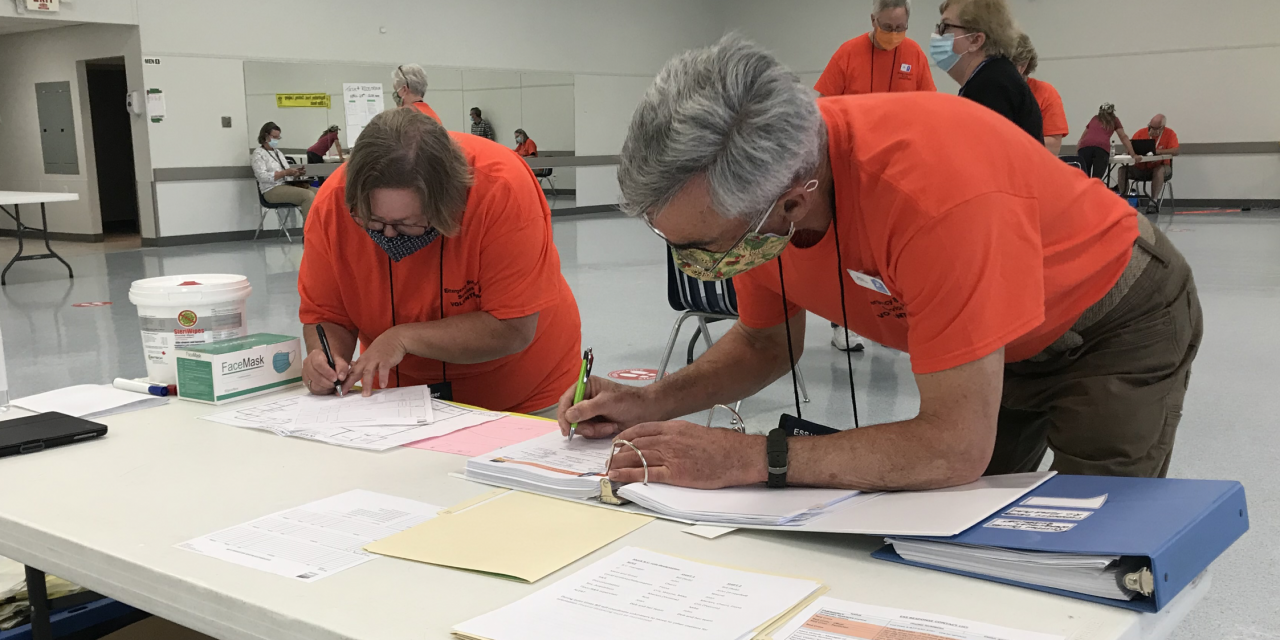
The Oliver Emergency Support Services (ESS) won the Group Volunteering Award at the town’s 2023 Spirit of Oliver Awards. Sebastian Kanally photo.
Substantial skillset
Morrison himself brings substantial emergency “cred” to the table, having had a professional career revolving around emergency management in the Lower Mainland.
This included many years with the Burnaby Fire Department, being certified in technical rescue and as a Master Rescue Instructor, and both he and his wife Sherri (who was also an ESS member), volunteered with the RCMP Victim Services Unit in Coquitlam for over a decade.
“We got fabulous training there,” he says, adding that “it’s just skill sets that you pick up over the years and when you add it all up, I don’t even think about it anymore, but when I look at this Emergency Support Services program and the way they roll it out I can tell you in five seconds it’s not going to work, it’s just going to fail the way they’ve drawn it up.”
And this is where the crux of the problem appears to lie. The combination of Morrison’s vast real-life experience and training with a tendency to be quite outspoken sets him on a course to rub somebody the wrong way at some point.
A key part of the problem as Morrison sees it, is what he describes as an overbearing top-down bureaucracy of provincial emergency management. “No one breaks ranks in that organization because careers are dependent on everybody doing what the top dog wants done,” he said.
Digital distress
One of the key issues for Morrison and very likely the issue that was inferred by Anderson as being one of the factors for letting him go was a major – and expensive – ongoing digitization push by the province.
He notes that the process used to be a carbon copy paper form that was filled out by hand which became digitized to a similar style form that could be filled out in about 20 minutes.
“And then in the offseason, they decided that they were going to have another go at it and redo it again and make it better. So it comes out and we’re using it in Keremeos the following year and again last year, and it was brutal.” He says that the fastest anyone on the team could fill it out was 45 minutes.
He points to the fires around Kelowna last year as evidence of the utter failure of it.
With 1,000’s of people evacuated from their homes many were left sleeping in their cars for days waiting to be registered for ESS because it was taking up to an hour and a half to register each family.
“That is not workable,” he says. “Our mandate is neighbours helping neighbours by providing timely, compassionate, emergency support services to our communities. That’s our mandate. The first word is timely and they don’t seem to care about that.”
He was so fed up with the system that he was planning to circumvent it by scanning the paper form into a fillable PDF form in order to make the process more efficient. “I don’t know what they paid the developers to build this over the course of years, but you know, it’s only making it more and more arduous as they go along.”
Pushed out?
Morrison never did actualize his plan but he reckons he made enough noise and attracted enough attention that the province began to apply pressure on Oliver to have him replaced.
It may seem a trivial thing, or even conspiratorial in nature but Morrison feels his vociferous criticisms are seen as potentially undermining the effectiveness of the whole program because others who feel the same but are currently tight lipped, might also join the chorus.
“I just want to let all of the community know; this is what’s going on and this is where you’re at. You won’t have that face to face, neighbour helping neighbour moving forward.”
When asked if he would return to the position if requested, he’s unequivocal that he will not return. “I could never trust the powers that be in the town ever again. When are they going to cut me off at the knees the next time?
“This isn’t about me. This is about the community at large. You guys were hired to look after the community. I volunteered and I do feel a sense of duty to the community to let them know about this,” he said.