Lyonel Doherty, Times-Chronicle
He will still be smacking them, but Oliver’s rural director says he’s happy to see that mosquitos will have less bite financially on local taxpayers.
Director Rick Knodel told the Times-Chronicle that taxpayers in Area C may no longer be paying the majority share for mosquito control. That’s because the board is looking at converting the program to a full regional service, spreading the entire budget (tax burden) across the region.
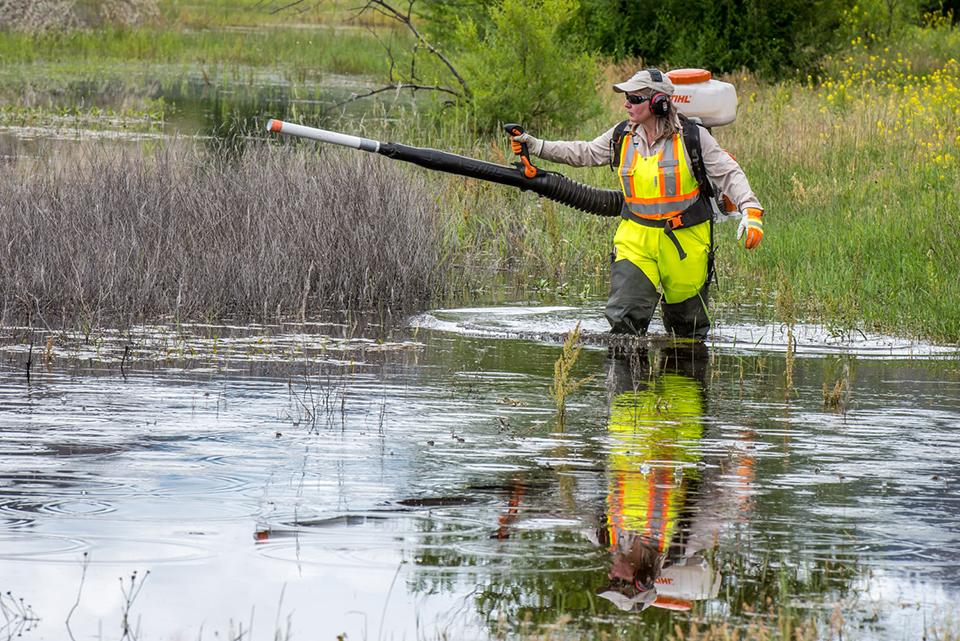
The program’s objective is to limit the spread of nuisance mosquitos and reduce the possibility of disease. From March to September, the program monitors more than 400 sites throughout the region, including Oliver and Osoyoos. According to Knodel, a mosquito can travel as far as 48 kilometres.
Program cost is based on time spent in each area, but during budget discussions last year the fairness of this method was questioned. There was a large variation in annual rates, and the time spent in treating the mosquitos varies significantly with the changing habitat.
“No one was hit as hard as we were,” said Knodel, noting Area C taxpayers were paying the highest share (approximately $60,000) a couple of years ago.
The director said areas like Deadman’s Lake between Oliver and Osoyoos, and Vaseux Lake are prime mosquito areas, in addition to ponds and oxbows. He pointed out that some of these areas cannot be treated for mosquitos due to sensitive wildlife habitat.
Tax requisition for the current service is also based on assessed property values (for improvements only).
Under the current tax system, Area C is paying $23.69 per $500,000 of assessment (that’s $45,800 this year). Oliver pays $3.17 while Osoyoos pays 98 cents.
Electoral Area B pays $103.68 per $500,000 of assessment (the highest per capita).
Under a full regional service, all electoral areas and municipalities would pay approximately $2.50 per $500,000 of assessment.
Knodel said the new converted system will spread the tax burden evenly throughout the region. He praised his fellow directors for realizing the inequity of the current system.
The board has yet to officially approve the amended bylaw and conduct an alternate approval (public) process for each area.