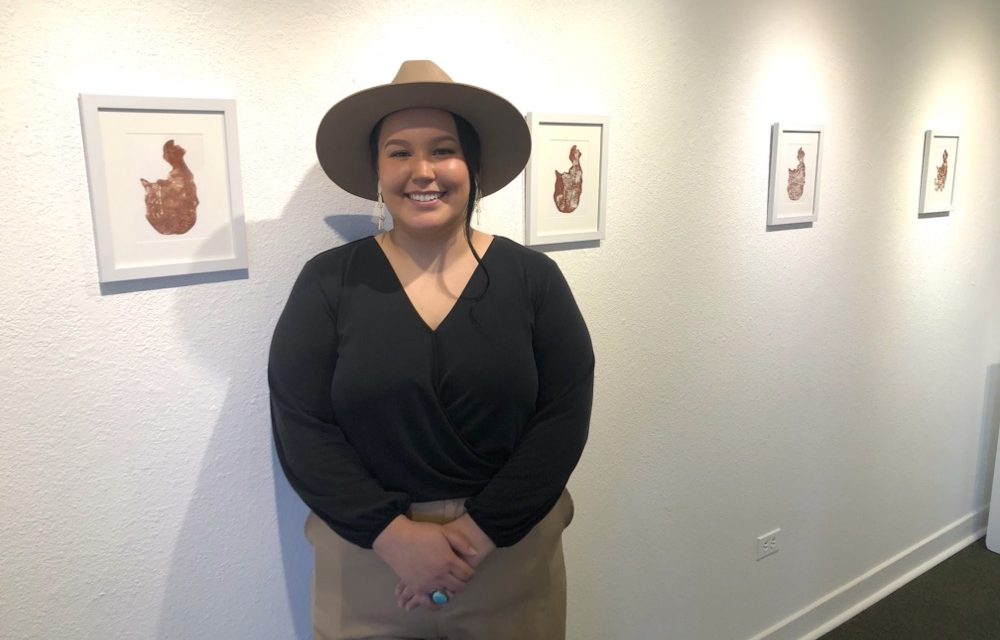
By Don Urqhart, Times Chronicle
On a shelf in the corner of the art gallery curiously sits a mortar and pestle, and beside it four small jars of different hues of reddish-brown to sagey-beige powder. Simple, yet purposefully placed. Innocuous, yet poignant.
For Taylor Baptiste these jars of varying shades of ochre represent a crucial metaphysical link that kept her connected to her homeland of Nk’mip while living seemingly a world away on the Musqueam Nation reserve in Vancouver.
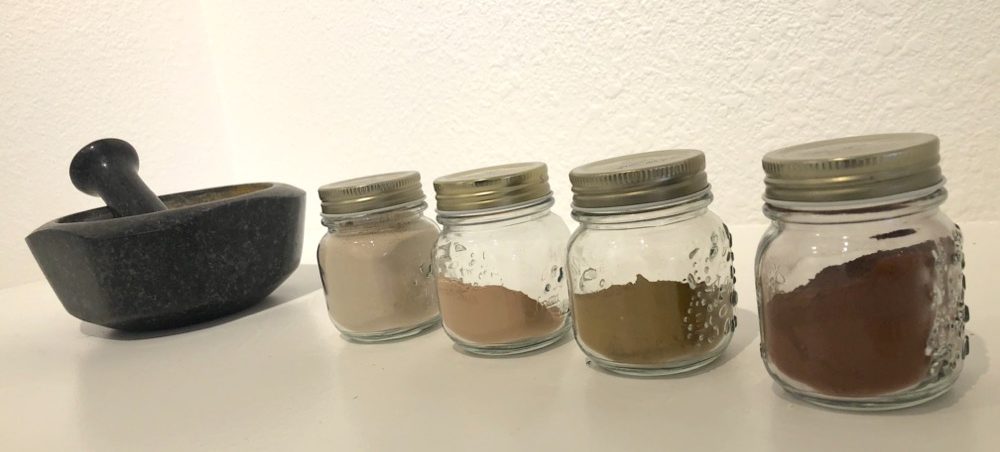
Don Urquhart photo.
“I’ve been very removed from my territory that I’ve been very close with my whole life, so this collection of items are ways that I used to stay engaged and keep a relationship with my culture and land,” she says.
Ground from the earth of her family’s land, a land inhabited by Syilx Okanagan people for thousands of years, Baptiste transformed this representation of cultural territory into a five-piece series of art titled ‘Living Lands.’
“I harvested my own pigment called ochre from the soil out of the land here at home and I brought it with me to school at Emily Carr and processed and ground up the rocks into my own pigment to use for paint.”
She then created Linocut prints in the shape of the Syilx Okanagan territory and then “every time I pressed the Linocut into the paint and onto the paper, it would behave differently, so I think this really shows how the land itself is a living, breathing relative,” she says.
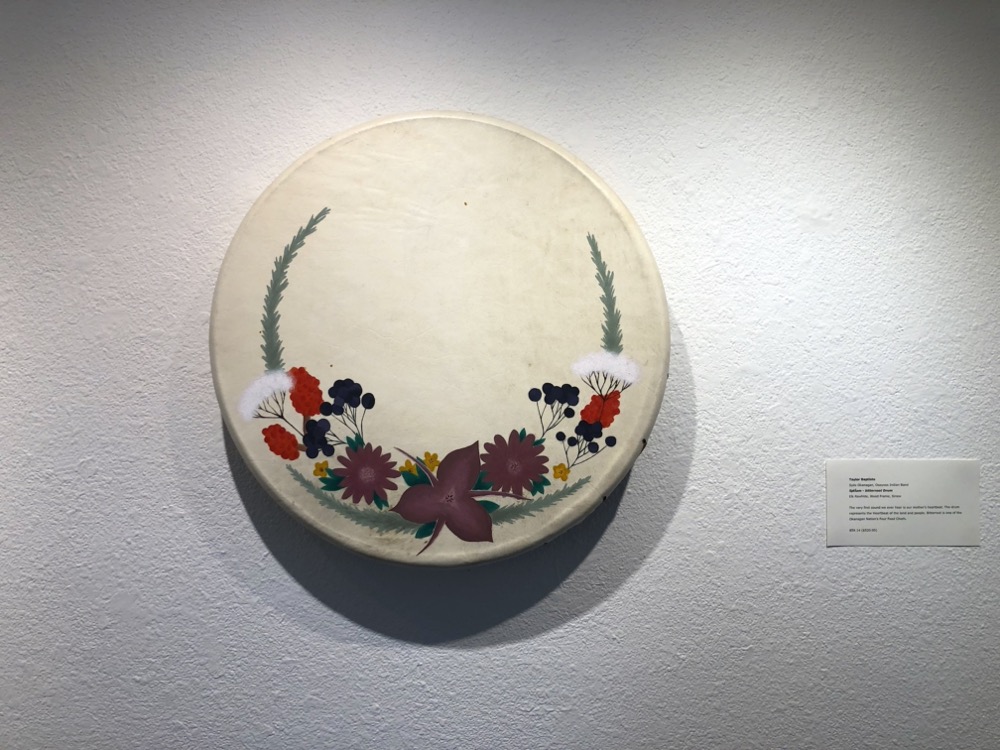
Don Urquhart photo
These are her favourite pieces, she confides, brimming with a palpable energy that is offset by a smile that just seems to calm the space around her. A subtle nervousness betrays the otherwise outward projection of calm, and it’s quite understandable.
In just 20 minutes the doors of the Art Gallery Osoyoos are set to swing open on her first solo art show, not a trivial event for the young artist who only just completed her second year at the venerable Emily Carr University of Art and Design in Vancouver.
This is a monumental moment for not just this young woman from the Osoyoos Indian Band, her family, her partner and her community, but for the gallery itself. In the critical language of our time it’s arguable that the gallery is undergoing a bit of its own ‘decolonization’, because as inconceivable as this may seem, Baptiste is the first Indigenous artist to ever show at the gallery.
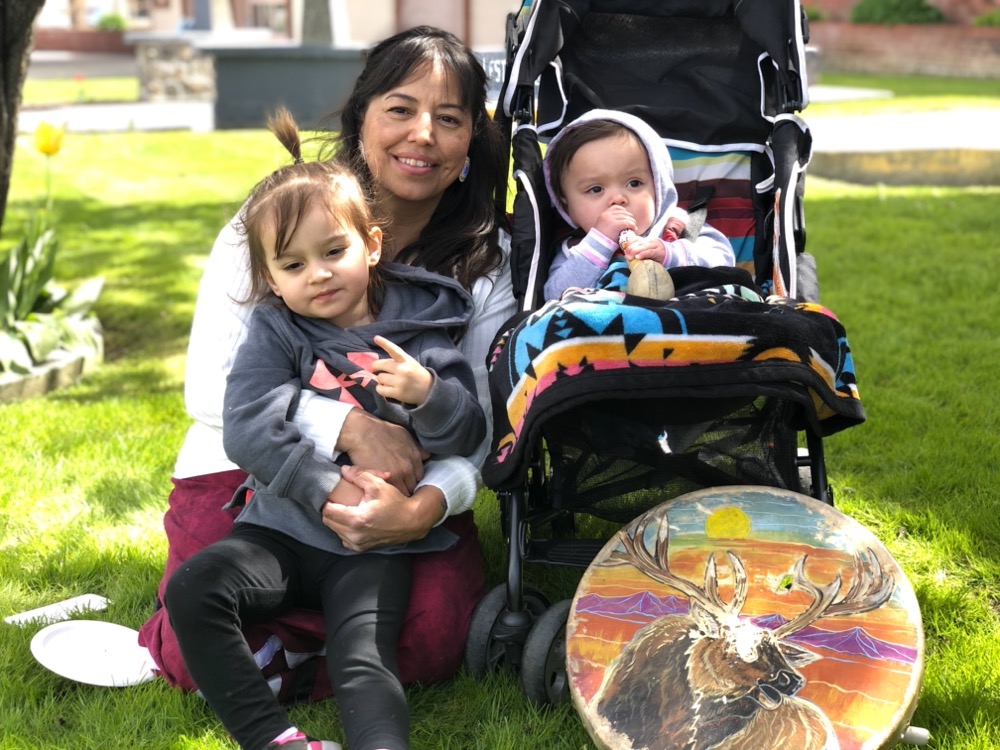
Imee Lezard with Aleia and Scarlett Baptiste. Lezard’s singing and drumming captivated the gathering. Don Urquhart photo
As to the whys and wherefores, an educated guess would probably fall along the lines of part systemic colonialism and part tragic reflection of Indigenous cultures pushed to the margins, if not the brink of extinction.
Baptiste observes that in the Okanagan there’s not a lot of Syilx Okanagan-based artwork out in the public. “You have to go to Indigenous-run businesses to find it,” she adds. “A lot of people come here and ask, where is the Indigenous art because in Vancouver it’s much more present.”
“Okanagan art is very unique; you can’t compare it to other Indigenous art,” she says, citing the example of Coastal Salish art which has specific rules for their art form in contrast to the Interior Salish art forms.
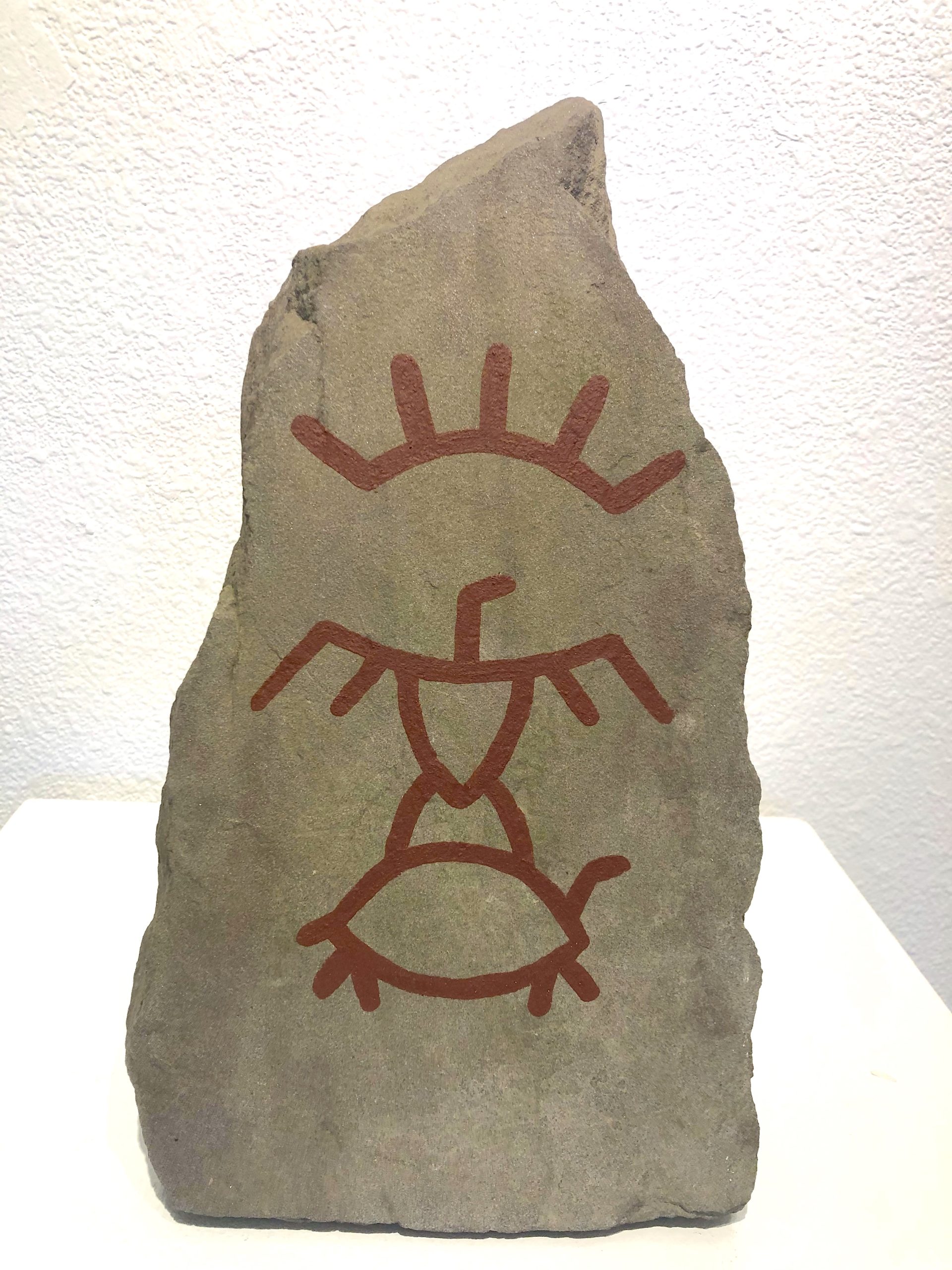
“The Okanagan people traditionally were pretty nomadic, they would travel up and down the valley to gather their food sources and they couldn’t stay sedentary in one village, so our art is in our tools and the things that we had to carry with us – our nets, our bows and arrows – the gear that we used for daily life, that’s where a lot of the art comes from.”
Don Urquhart photo
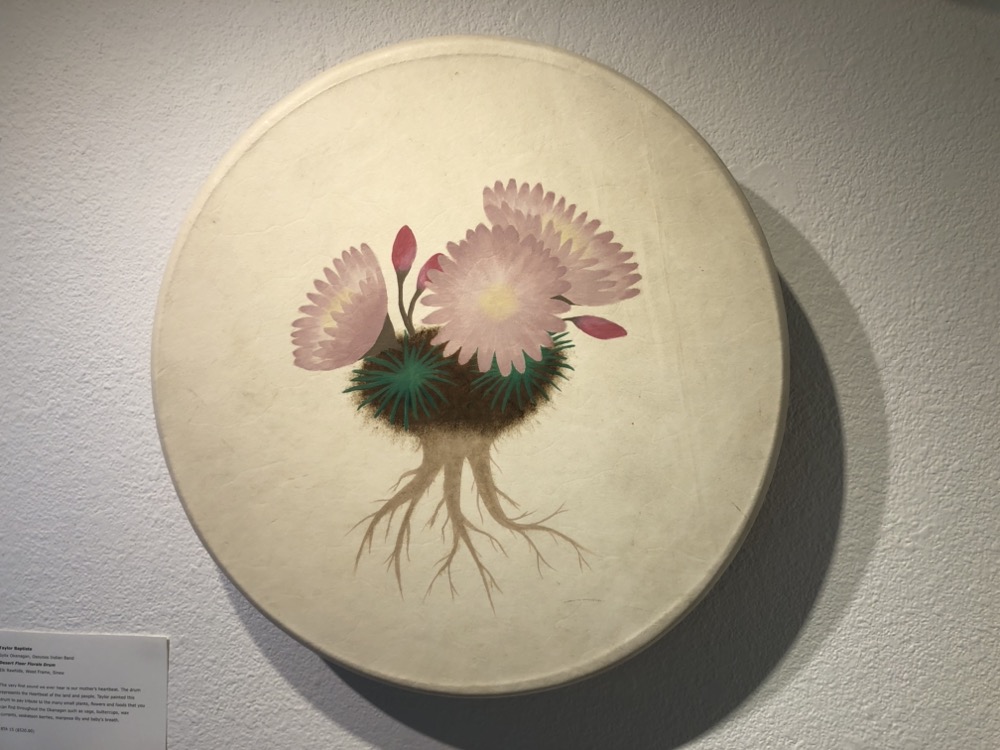
Baptiste says much of her art is informed and inspired by her relationship to the land that nurtured her and includes the use of local Indigenous plants or Indigenous made materials, things that were used by the Okanagan people like rattles and drums, birch bark for baskets and so on.
“I was raised on the reserve here and my dad always taught my brothers and I to have a strong relationship with the land. So that included hunting, fishing, berry and asparagus picking, and gathering roots.
“He would have us walk the perimeter of our property every day and get to know the lifecycles of all the plants and animals and the materials there and how to gather them and how to use them. So that’s why I’m drawn to using natural materials to really engage with the land here in the Okanagan, but a lot of it also comes from my culture as an Okanagan person. So I try to engage, interact and express the different Okanagan teachings that I have been taught growing up.”
On hand to support Baptiste were not only her family and friends but former colleagues from School District 53 where she worked for about five years (before dropping everything to embark on her art education at the beginning of the pandemic no less), as well as members of the OIB Council.
Don Urquhart photo
Fittingly this show’s opening was unlike any that came before it. “It was very important for me to follow our Nation’s protocol for having events so it was really important for me to feed the people that came to the event,” she says, noting that normally there isn’t catering for gallery events. The Indigenous-inspired catering was crafted by Shan and Sean Peltier. The event on the lawn of the gallery under an electric blue sky punctuated by dramatic white billowy clouds also included Okanagan drumming, songs and a food prayer.
OIB Chief Clarence Louie expressed surprise that Baptiste was the first Indigenous artist to have a solo show at the gallery, saying: “It’s awesome and I’m glad it was Taylor, a member of the Osoyoos Indian Band. We are so proud of her, she does really great art,” he said.
Louie added that it is “super cool” that she’s attending Emily Carr University and following the footsteps of her grandfather. “Francis Baptiste was one of the best artists that the Osoyoos Indian Band has ever produced and I think that’s what kinda got her into that,” he reckoned. He added that back in the day, Francis studied art in the southwestern U.S.
“We’re all very proud of her and hopefully she’ll become a famous artist one day,” Louie added.
As for Baptiste: “I’m very honoured to be the first Indigenous artist showcased here and I just hope I’m the first of many more to come. I think this will create the opportunity for a lot more to showcase their art here and other galleries in the Okanagan.”
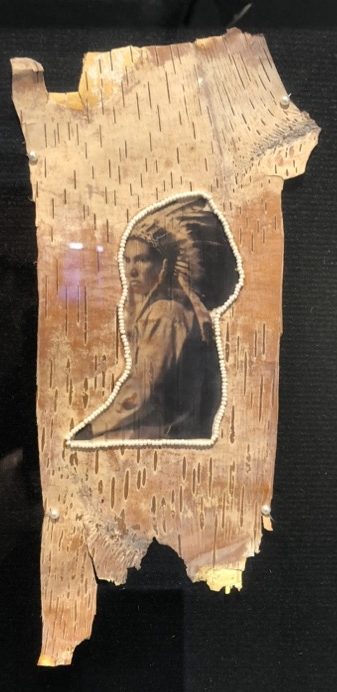
A portrait of Baptiste’s grandfather Francis Baptiste on birch bark. Don Urquhart photo
She adds, “I’m like a toddler in my art career. I’ve got a long way to go, this is just my very first step so I’m really looking forward to what’s to come and to collaborate with other Okanagan artists and just get more of it out there in the public.”
Her art, she says, will always be centred around her culture and Okanagan lands. When asked whether there is a growing desire and movement to reclaim culture, Baptiste says without hesitation, “There is definitely a hunger and thirst for culture, and it’s coming.”
Baptiste’s show titled kʷu scʕacʕacúlaʔxʷ – We Are of The Land, opened May 7 and will run until May 28 at the Osoyoos Art Gallery. She will also be participating in an exhibition hosted at the Bill Reid Gallery in Vancouver opening on May 17.