By Lyonel Doherty, Times Chronicle
A world champion race car driver who visited Area 27 last week said you can’t have fear behind the wheel or you’ll lose. Or crash first.
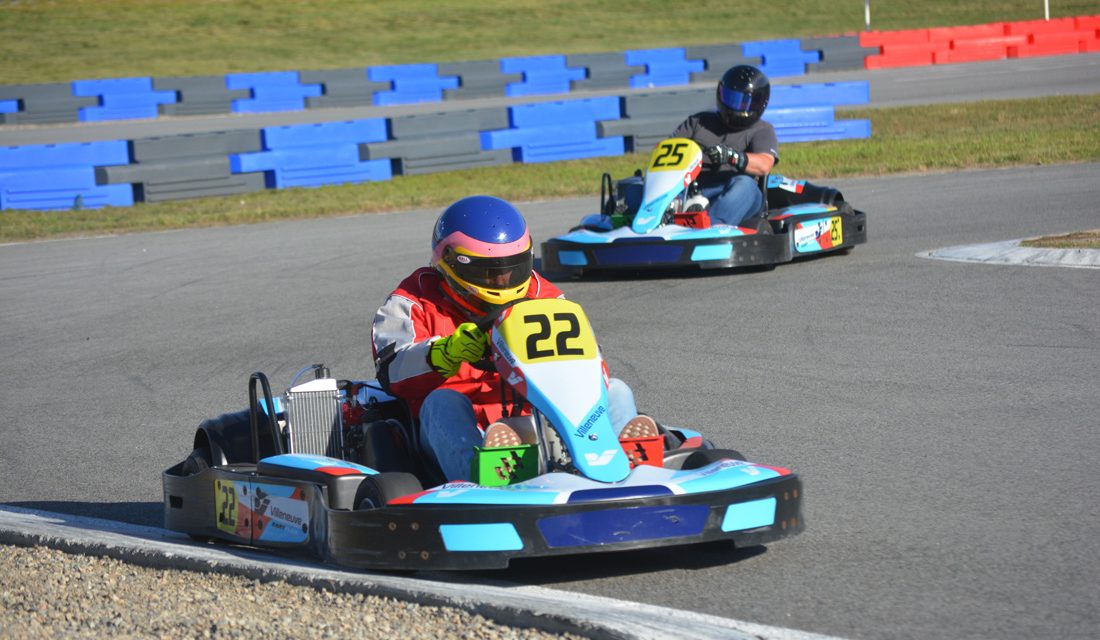
Former F1 and Indy 500 champion Jacques Villeneuve was in Oliver for the grand opening of Area 27’s Kartplex (go-kart facility).
During an interview, the Times Chronicle asked Villeneuve if he ever felt fear during a race and how far he pushed the limit.
“If you have fear behind the wheel then you should do something else,” he said.
When fear creeps into your mind, you suddenly don’t think straight, he noted, adding it has to be natural; you have to enjoy the moment. Fear cannot enter the picture.
“You have to feel you can keep pushing the limit and do it better than anybody. It’s a little arrogant but you have to be like that, you have to be selfish and believe in yourself beyond what is normal.”
Villeneuve said if you start having fear you will get to the point where your foot will back off from the accelerator. On high-speed corners you’re going very fast and suddenly your foot comes off the pedal.
“If you have fear you’ll actually end up crashing by going slowly because you won’t react naturally.”
But how far do you push the limit?
“You ride on the edge, not beyond. It’s not a question of always pushing more, there are physical limits and you have to be able to judge what is your personal limit, how you will react and what the car will do.”
Villeneuve said there are some drivers that shouldn’t be in Formula 1. They can drive fast but they are not winners.
“Even if they do go beyond that limit, it doesn’t really matter. You need to be able to find exactly where that edge is. If you go beyond you will either crash or be slower.”
Villeneuve was asked what his routine was in preparing for a race.
First, you need eight hours of sleep, and make sure you go to the bathroom.
“If you have a full bladder, every time you shift gears or brake, you can’t concentrate and you slow down.”
During a race, Villeneuve would normally lose approximately three kilograms due to sweat.
An hour before the race he used to eat a big steak. If he didn’t, he would suffer cramping. “The only thing that saved me was that big steak.”
Villeneuve was asked what is the current state of racing in this country and if Canada will see another superstar.
He said there are not many stepping stones for young drivers in Canada.
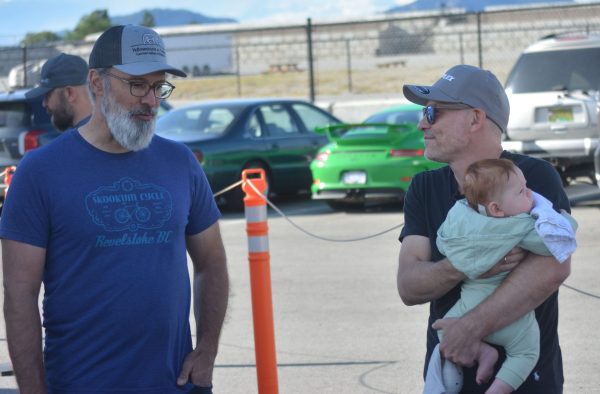
NHL legend Scott Niedermayer (left) chats with Jacques Villeneuve during the grand opening of Kartplex in Oliver recently.
Lyonel Doherty photo
“Normally you have to go to Europe or the U.S. You don’t have the series here, you have Canadian Nascar but that’s not a stepping stone. You have to race outside of Canada.”
He also noted there is not much Canadian sponsorship which is required for racing.
Villeneuve said racing is a lot safer than it used to be, which has made it very costly.
He noted that in the 60’s, 70’s and 80’s rich fathers would ban their children from racing or disown them if they disobeyed. He used Niki Lauda as an example, saying the Austrian F1 driver had to borrow money because his father forbid him to race and threatened to kick him out of the family if he took up the career, which he did.
“Sometimes you have the situation where a kid doesn’t want to race but is forced by his father,” Villeneuve said.
Whatever the case may be, the competition is fierce, even within your own team, he pointed out, adding that you often have to “destroy” your teammate.
“When two teammates are on the podium, the one in second is so happy for his teammate who won and that doesn’t seem to be very naturally human.”
And there are some things you just can’t explain, Villeneuve said. Such as why you are faster on some tracks, even in a “bad car.”
He admitted that when he first started driving Indy, he was “young and dumb” and thought he didn’t need any training. But when it became 40 degrees in the car and it felt like he was “dying,” he changed his attitude.
In F1 he stepped up his training inside a specially-built machine where they lowered the oxygen and cranked up the temperature and humidity. He wore helmets with weights, and in the first year started pulling 17 kilograms with his neck. By the end of F1 he was pulling 45 kilograms.
“At the end of an hour of training if someone talked to me, I would probably punch him. It made you an angry person which was good training.”
In the beginning, they didn’t have a lot of technology such as data tracking to help you race better. They did it the old- fashioned way on pieces of paper, Villeneuve said.
“You explained what you felt, how to drive it better and how to change. Later [as years went by], they told you to sit down, shut up and drive the car, we know how to make it fast. But that didn’t work too well. If you can’t drive it naturally you will always be second thinking and you will not drive it well.”
Today, Villeneuve lives in Italy and is a race commentator on French television. He said it’s fun but stressful.
“On TV you have to commentate continuously and you cannot swear,” he said to laughter.
The Times Chronicle asked Villeneuve if there is a push to get more women behind the wheel and what females bring to the sport.
There is a huge push, he said.
“There is a perception that men in racing don’t want females, but it’s quite the opposite.”
Villeneuve said it’s a big dream if you can get a female driver who wins and secures sponsorship.
He started a racing school in France four years ago but only four girls tried out.
“There are not enough girls to get the talent out and you need a lot of girls to find that talent.”
Villeneuve said the girls in racing school were super quick, but as soon as it became “money time” they had a tendency to “collapse.” When the pressure was off, they were quicker than the guys again, he noted.
Craig Finer, president of Kartplex, said there are some very accomplished female drivers, but “when the time comes to cut throats in motorsport racing, we have to cut throats.”
He acknowledged they need to bring the female perspective to the podium, but the question is how do you entice more girls into the sport?