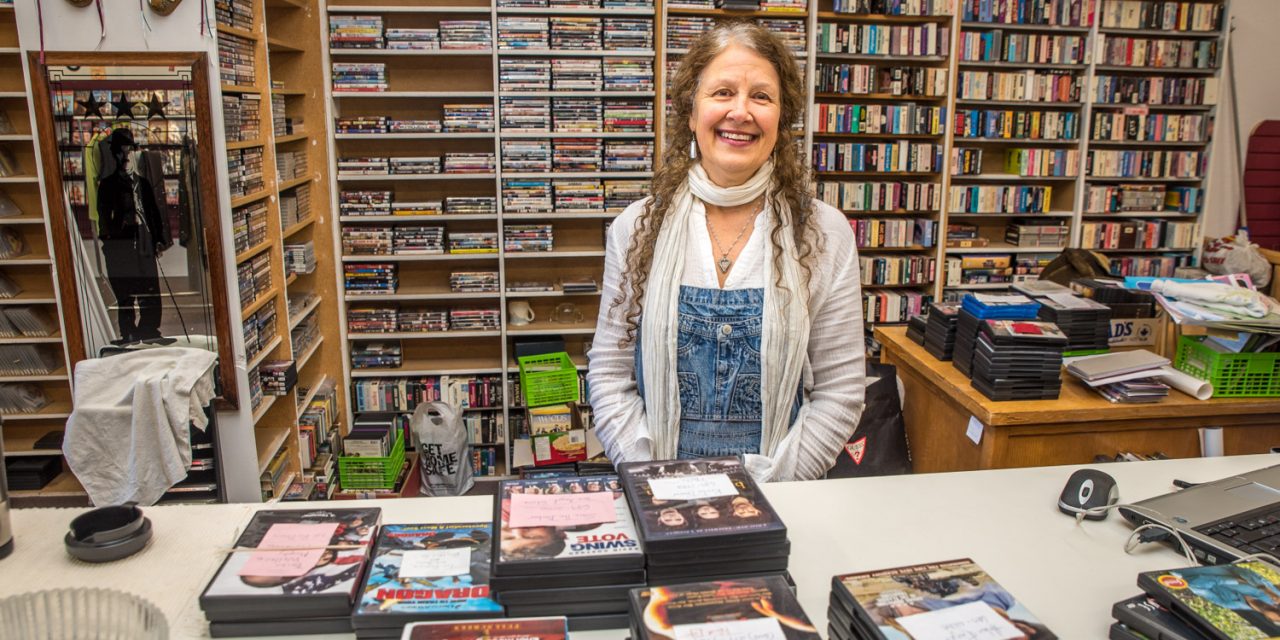

Barb Stephens, the longtime owner of Yore Movie Store in Osoyoos, closed her video rental store in October after 28 years of business. Stephens was passionate about movies, but the trend towards streaming movies over the internet and on pay-per-view made many video stores unprofitable in recent years. (Richard McGuire file photo)
Water meters and water matters in Osoyoos, the election of a well-known environmentalist during the federal election and the closing of a longtime local video store made headlines in October.
Town of Osoyoos council heard that water metering programs in other Okanagan Valley communities have been successful in reducing the amount of water being used by more than 20 per cent.
Mayor Sue McKortoff and members of town council agreed to review a comprehensive consultant’s report before deciding whether or not they will approve or reject spending $1.9 million to install water meters on all local homes, apartment complexes and commercial businesses.
Jacob Scissons and Peter Gigliotti, who work for the Kelowna-based consulting firm Urban Systems, made a presentation to town council detailing the highlights of a report they prepared on behalf of town council relating to a possible universal water metering program in our community.
“We are here to evaluate various water conservation strategies, including water metering, and recommend an approach for the Town of Osoyoos to achieve its water conservation goals,” said Scissons.
It has been proven that universal programs are the most effective and voluntary programs aren’t effective, he said.
The technology currently being used would be well-suited for Osoyoos, he said.
The benefits of a water metering program stretch beyond simple conservation as they allow municipalities to closely monitor peak periods, which sectors are using what amounts and determine a fair and equitable rate system in the long term, he said.
Metering programs instituted in other Okanagan Valley communities, including Kelowna, have resulted in more than a 20 per cent increase in water conservation, he said.
Water meters inform users daily about their water usage and eventually result in behavioural change, he said.
“At the end of the day, meters are just tools … it’s people who save water, not the water meters,” he said.
“The impact from lawn irrigation appears to be one of the major factors (of water use) at single-family residences,” he said. “This was similar to results obtained from 2014.”
Coun. C.J. Rhodes said Statistics Canada reports clearly indicate that communities with water metering programs have been successful in attaining their goal of dramatically reducing the per capita water usage of citizens.
The third Osoyoos Water Science Forum was held in early October and participants were informed the severe drought of 2015 provided a preview of what’s to come in B.C. and the Pacific Northwest as the impact of human-caused climate change is increasingly felt.
“Many of us in the climate community have talked about this year being a dress rehearsal for mid-century,” said Meade Krosby, a research scientist with the Climate Impacts Group at University of Washington. “That’s a useful way to think about it.”
Among the changes we can expect are decreased snowpacks, winter precipitation increasingly coming as rain instead of snow, an earlier melt and warmer, drier summers putting stress on trees, crops and fish populations.
Many communities, said a B.C. official, were unprepared and some came perilously close to running out of water.
Of course drought and climate change were far from the only topics discussed at the forum, but they kept slipping into other conversations – the state of the salmon fishery, water rights, the effects of forest fires on water, the threat of toxic blue-green algae, protection of wetlands.
Human activity will also be affected with impacts on hydro power, flood control and reservoir operations, Krosby said.
As voters across much of Canada painted the electoral map red in a historic Liberal majority, South Okanagan-West Kootenay (SOWK) elected Richard Cannings of the NDP.
Cannings beat his closest rival, Conservative Marshall Neufeld, by nearly 5,000 votes. Liberal Connie Denesiuk came in strongly in third place.
With all polls reporting, Cannings took 24,823 votes (37.2 per cent), Neufeld took 19,894 votes (29.8 per cent) and Denesiuk took 18,727 votes (28.1 per cent).
Far behind them were Samantha Troy of the Green Party with 2,851 votes and independent candidate Brian Gray with 432 votes.
The election appeared to be a strong repudiation of the Conservative government led by Stephen Harper as riding after riding swung to the Liberals.
The Conservatives announced that Harper would step down as leader.
Nationally, the final results saw the Liberals win 184 seats, the Conservatives 99, the NDP 44, the Bloc Québécois 10 and the Green Party only one (leader Elizabeth May).
As Cannings talked to reporters, Denesiuk, whose supporters were at a bar just down the hall, came up to him to congratulate him and for a short moment, the two reminisced about how they’d gotten to know each other attending about 20 forums around the riding over the 78-day campaign.
“It was a clean race,” Denesiuk told reporters. “I would say there weren’t the personal attacks that you might find in some campaigns, so I give credit to Richard Cannings and Marshall Neufeld and Samantha Troy and Brian Gray because they were great candidates. We were actually friends. There were times that we ate meals together and I certainly appreciated that we weren’t running a dirty campaign here.”
Both Cannings and Denesiuk emphasized that voters wanted change.
“People want Canada back,” said Denesiuk. “They want to be proud to be Canadian again. That’s exactly what’s going to happen, starting tomorrow morning.”
Cannings pledged to work hard for constituents and to keep an open-door policy.
An elated Cannings circulated the conference room crammed with supporters, embracing or shaking hands with most of them. He then took to the stage with his wife Margaret Holm to thank his volunteers.
Then he thanked outgoing NDP MP Alex Atamanenko.
“Alex has been a real mentor to me and an inspiration over the past couple of years,” said Cannings. “Everywhere I go in this riding, people talk about Alex and say ‘if you’re going to be as good as Alex, I’ll vote for you.’ I have big shoes to fill.”
For more than 28 years, many residents of Osoyoos have gone to Yore Movie Store to rent video movies.
That era comes to a close in October as owner Barb Stephens planned to close the store at the end of the month, a casualty of changing technology in the way people watch movies.
Ironically, the store’s location reflected an earlier movie evolution. The building once housed the Sunland Theatre that had been the town’s movie house in an era when most people watched movies by going to a theatre.
During an interview days before closing her store, Stephens was touched with emotion. “It’s going to be tough. I don’t go willingly from this. I would have loved to have hung in for a couple more years. I can count on one hand the number of bad moments I’ve had in 28 years.”
KEITH LACEY
Osoyoos Times
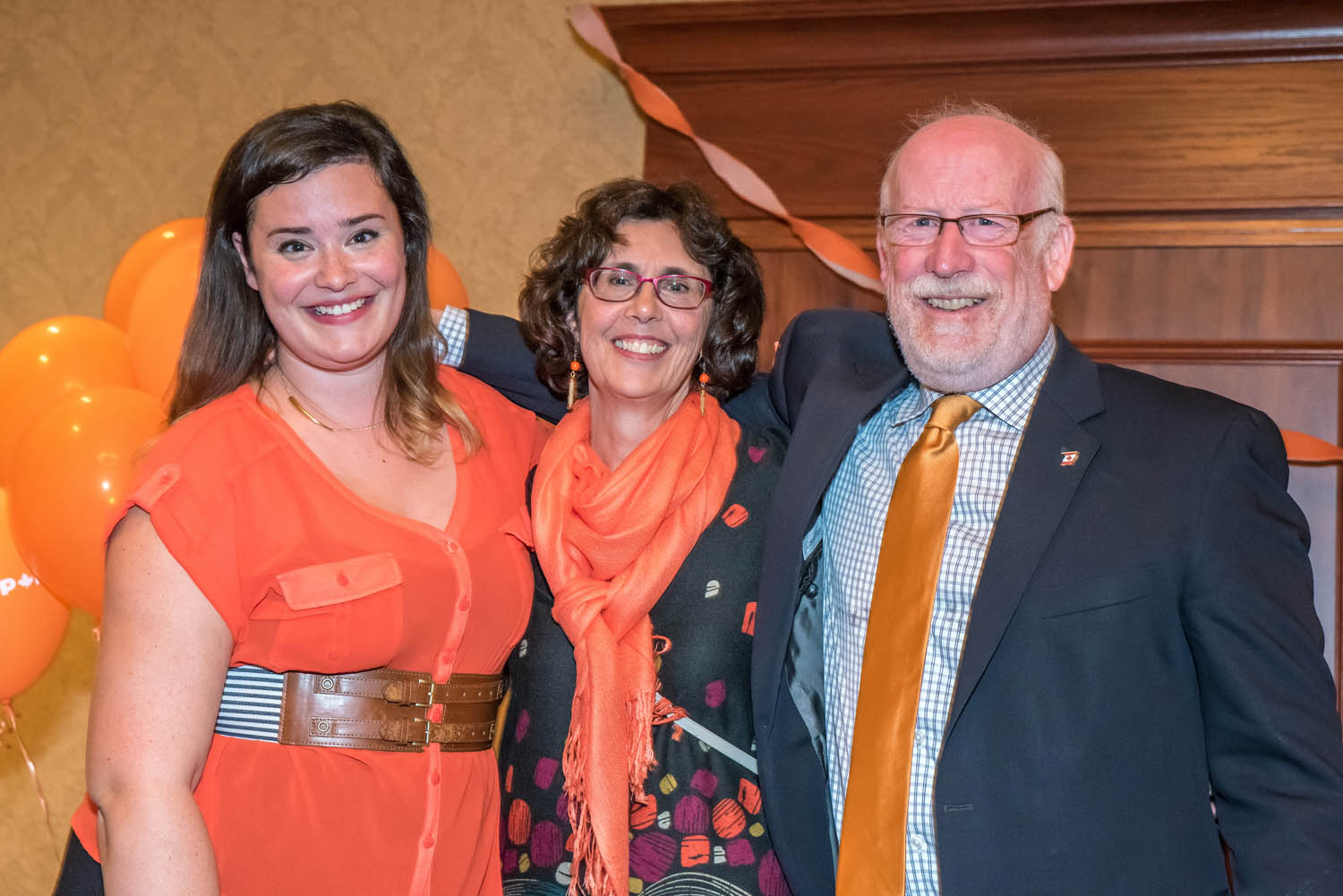
Richard Cannings, the new NDP MP for South Okanagan-West Kootenay was joined on stage by his daughter Julia Cannings (left) and his wife Margaret Holm after he won the Oct. 19 federal election. (Richard McGuire file photo)
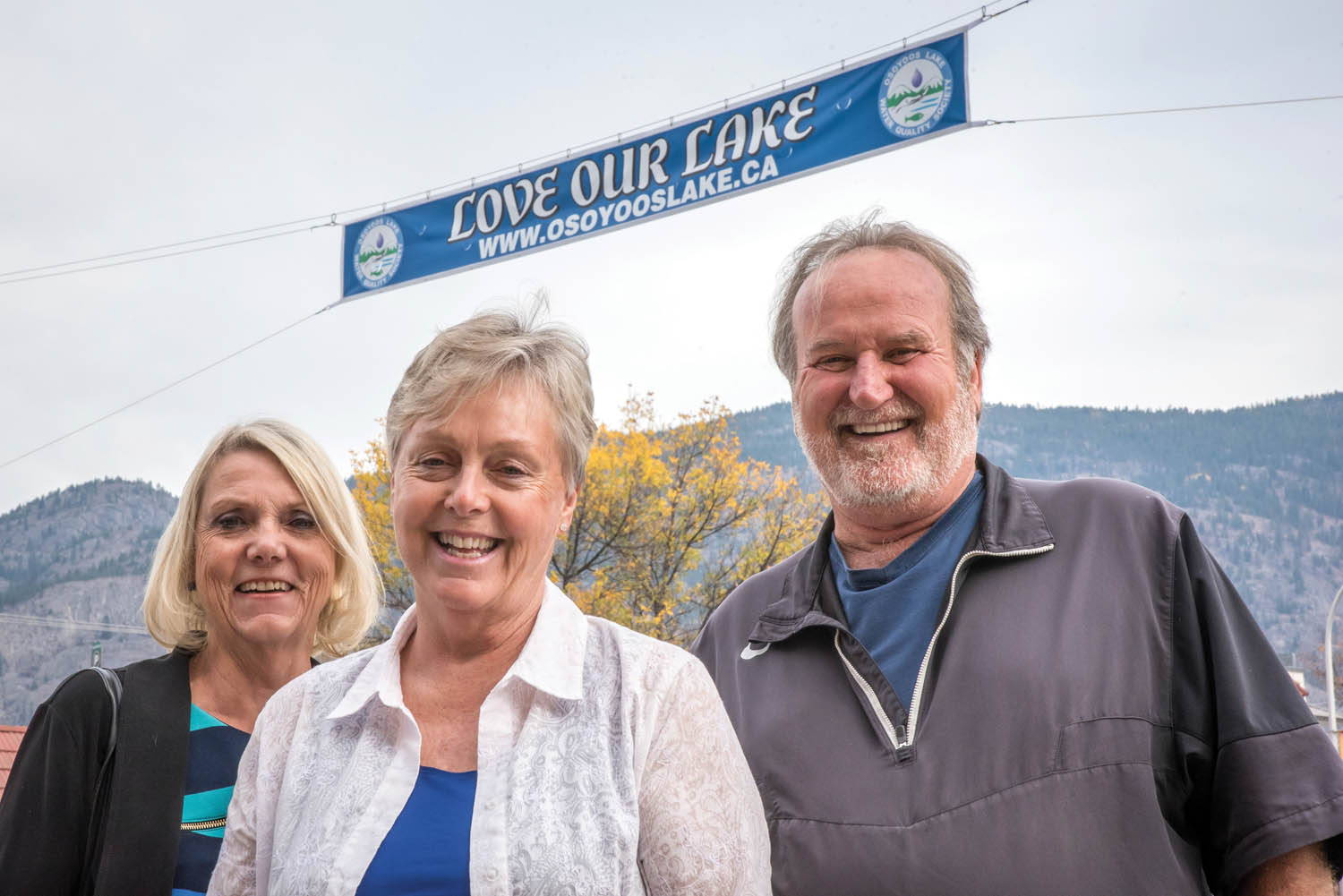
When participants in October’s Osoyoos Lake Water Science Forum drove down Main Street, they were greeted by a big banner proclaiming Love Our Lake. The banner was sponsored by the Osoyoos Lake Water Quality Society (OLWQS), a citizens’ group that monitors water quality. From left are Birgit Arnstein, president of OLWQS, and forum chairs Mayor Sue McKortoff and former mayor Stu Wells. Wells is also a director of the OLWQS. (Richard McGuire file photo)