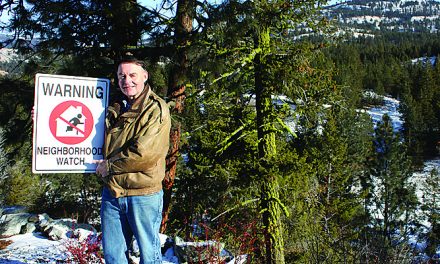
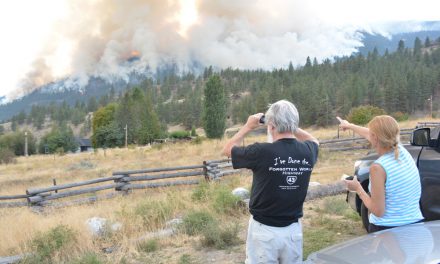
Hunters and ranchers have not changed their stance on the proposed national park. The answer is still “no.” File photo by Steve Arstad
A long-time rancher who was born in Oliver is not convinced that cattle grazing rights will be honoured in the proposed national park.
Dave Casorso reiterated this several times during a recent presentation to Oliver Town council.
Casorso, representing the Southern Interior Stockmen’s Association, said there’s a rumour that cattlemen are in favour of a national park, but this is not the case, he stressed.
“Grazing is not allowed in national parks, and I have not been told by Parks Canada that will change.”
Casorso, whose family has lived in the valley for more than 130 years, feels strongly that if grazing rights are lost, that may put the stockmen’s association in jeopardy.
Casorso pointed to the importance of the feedlot in Oliver and its benefit to the agriculture industry, and the stockyard in Okanagan Falls that markets cattle every year.
“We (cattlemen) are concerned that any change in us having the availability of affordable Crown grazing will jeopardize a lot of the economics that we generate.”
Casorso said ranchers actually create biodiversity in the region and maintain it.
Water councillor Rick Machial said he was under the impression that cattle grazing would be allowed to continue in the national park.
Casorso said there may be a phase-in period where grazing may be allowed, but the practice would be terminated at some point.
Mayor Ron Hovanes said that cattlemen have stated they don’t have anything in writing; the issue has never been finalized.
In that case, how can you endorse the park when you don’t have all of the answers? Machial stated.
The province’s “Intentions Paper” states that, “For tenure holders, tenures will continue under the same terms and conditions and be subject to existing management policies.”
In the internal engagement plan, it states that ranching families within the South Okanagan grassland component can “continue operating and grazing livestock with pre-existing tenures.”
But Similkameen rancher Mark Quaedvlieg also says he wants to see it in writing (in a legal document).
Even if ranching were permitted, Quaedvlieg worries that environmentalists and visitors would object to cattle in the park.
Cattle grazing is permitted as a special case in Grasslands National Park in Saskatchewan, but Quaedvlieg isn’t convinced that’s a permanent arrangement.
The exception for Grasslands National Park is at the discretion of the park superintendent and permits are renewed on an annual basis.
Quaedvlieg also insisted any arrangement with ranchers must not harm the economic interests of ranchers.
“The big thing is it’s fine to say you can graze in a national park, but it still has to be affordable,” he said. “There has to be a dollar in doing it. If you have to pay additional fees around permitting and everything else, it just doesn’t work.”
Jesse Zeman, representing the BC Wildlife Federation, said Parks Canada is shifting away from science-based ecosystem management to commercialization and privatization. He cited several examples of commercial operations encroaching on caribou and grizzly bear habitat, noting the caribou population is on the verge of disappearing.
Zeman said he can definitely see the province doing a better job at protecting these species than a national park would.
Zeman said the government claims that existing land users in national parks are recognized, but he pointed out that non-First Nations hunters, non-First Nations anglers, horseback riders and motorized recreationalists are excluded.
He noted that resident hunters are likely the biggest users of this area and are most affected by the national park proposal.
“People who are conserving the land are not recognized,” he stated.
Zeman said resident hunters spend $188.52 a day hunting in the Okanagan.
He stressed that the solution is conserving biodiversity through provincial tools and ensuring local control and input.
Machial said a national park is an exclusionary policy because it excludes people, which he doesn’t agree with.
“In my view it’s counterproductive in preserving the environment.”
The deadline for commenting on the province’s “intentions paper” was October 31.
By Lyonel Doherty