By Don Urquhart, Times Chronicle
Okanagan Basin Water Board (OBWB) has warned that despite cooler temperatures and recent rainfall, the Okanagan’s water supply is still experiencing the effects of last year’s extreme drought and low snowpack.
This is leading to concern about the potential for drought in the valley this summer and the heightened possibility of wildfires.
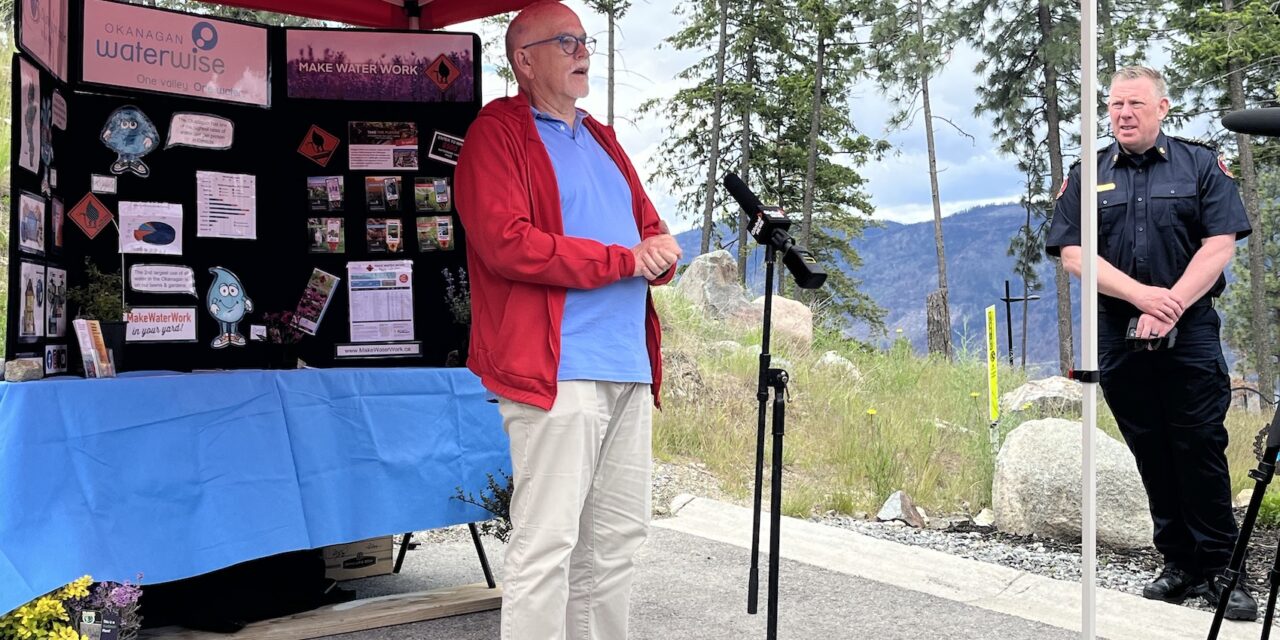
In response, local mayors, fire chiefs and those working in water came together on May 31 in Lake Country to deliver a message on wise water use during drought and wildfires.
The gathering marked the launch of the annual “Make Water Work” campaign, delivered by the OBWB’s Okanagan WaterWise program and in partnership with local governments, water utilities, garden centres and irrigation businesses throughout the valley.
“The reason we are meeting today at Lakestone Villas, is because of the story it tells and the one we need to learn from,” explained OBWB Communications Director Corinne Jackson. “This complex is a fabulous example of doing it right. It shows us how a community that follows WaterWise and FireSmart principles can save water and withstand fire, even as flames surround it.
“As we experience hotter and drier summers, and as our population increases – the importance of being WaterWise and FireSmart is becoming very clear,” Jackson added.
Lake Country Fire Chief Darren Lee echoed the message. Looking around the neighbourhood he added that by following the building code and choosing plants, such as those on the Make Water Work Plant Collection list, “you end up with this nice combination of low water use, beautiful neighbourhood, and from the get-go it’s FireSmart.”
As part of this year’s campaign, Jackson worked with FireSmart BC staff to add the FireSmart designation to plants in the Make Water Work Plant Collection.
The plant collection was initially developed in 2014, with the Okanagan Xeriscape Association, as an easy way for residents to begin the journey of transitioning to a more WaterWise landscape.
Today the collection includes 105 perennials, grasses, shrubs and trees, and is available at nine garden centres throughout the valley, from Armstrong to Osoyoos including Sandhu Greenhouses & Nursery in Osoyoos and Sagebrush Nursery in Oliver. The list of plants in the collection can be found here.
Speaking to the importance of being WaterWise, especially during a drought and with the threat of wildfires, Lake Country Fire Chief Darren Lee had advice for those with homes threatened by fire. If you have sprinklers, go ahead and put them out, or leave them at the end of your driveway, but do not turn them on and leave.
“There’s only so much volume available… It’s not a limitless supply of water,” Lee said, recalling last year’s fire in a nearby community where firefighters ran out of water, and had to have water trucked in from the other side of town.
A similar situation very nearly occurred during last year’s Eagle Bluff wildfire which threatened the Dividend Ridge subdivision of Osoyoos. With limited water supply the Osoyoos works department staff worked hand in hand with the Osoyoos Fire Department to monitor and maintain water levels/pressure during the extended firefighting activity which saved homes in the subdivision.
Lake Country Mayor and current OBWB Chair, Blair Ireland urged residents to visit the Make Water Work website, pledge to conserve this summer, and take steps to ensure their yard is WaterWise and FireSmart.
“We don’t know how the weather is going to line up this summer,” he added, acknowledging that water conditions can change quickly in the Okanagan.
Osoyoos Mayor and former OBWB Chair Sue McKortoff echoed Ireland’s sentiments saying the “Make Water Work” slogan is something everybody needs to remember. “Right now watering is three days a week and in the Regional District it’s three days as well. It definitely could be lowered like what happened last year, if we need to,” she warned.
McKortoff noted there are a number of ways to save water aside from observing the watering restrictions, such as leaving the grass a bit longer, checking that sprinkler systems are working properly, and using water within the house wisely. This includes not wasting water when brushing teeth, showering, using the dishwasher or even washing vegetables.
“Make sure that you’re saving water for the things that are really important,” she urged, pointing to the fact it takes time for the town’s aquifers to replenish. “If we don’t make sure we use our water wisely then we’re going to really be in a difficult place to have enough water for all the of the people that need it on a daily basis, which is partly why very soon we’ll have water meters,” she said.
She added that another important step homeowners can do – from both a WaterWise and FireSmart perspective – is to pull up cedar hedges and junipers as they not only consume large amounts of water but are a fire hazard that puts homes at risk.
The OBWB encourages Okanagan residents to visit MakeWaterWork.ca and find tips to maintain a beautiful yard while conserving water, find water restrictions for their neighbourhood, the Make Water Work Plant Collection, and pledge.
Pledges include:
- Water lawn between dusk and dawn.
- Water plants, not pavement.
- Never mow low. Let it grow.
- Choose plants suitable to our dry climate.
- Tune up my irrigation.
- Aerate my lawn and top dress with compost.
The campaign runs until mid-October. The community with the most pledges will be awarded the title “Make Water Work Community Champions,” and those that pledge are entered to win one of two $500 WaterWise yard upgrades.
The Make Water Work campaign was first launched in 2011 and is aimed at tackling the second largest use of water in the valley – residential outdoor use.