By Lyonel Doherty, Times-Chronicle
This is the final instalment of Fairview After Dark hosted by Rebecca Rizzo from the Oliver Museum.
There are some stories better left buried in old Fairview; better left thrown to the wind and forgotten.
But you really can’t purge them from memory once they escape someone’s lips in the dark of night.
One such vile tale occurred in 1897 concerning the McCaigs – James and his wife.
She had made an application for divorce since the couple was separated for some time. Rizzo said trouble escalated when they began to argue over who would take full custody of their son.
The child had been living with Mrs. McCaig, and without legal process, James took the boy away, bringing him as far as the Joe Dandy boarding house at the mine that he worked for.
“The enraged mother procured a revolver, followed her estranged husband to the boarding house and demanded that he give back her child,” Rizzo said.
When James refused (picture the scene in slow motion), she drew the revolver and fired, the slug hitting him in the left side of the chest. Luckily for James, she missed his heart and the bullet entered his rib cage.
“The shooting threw Fairview into quite the excitement, with Constable Hawtry arresting both of the McCaigs and conveying them to Osoyoos,” Rizzo said.
It is unclear what became of their son after that.
But in this next heart-wrenching tale, it was all too clear what happened to the three-year-old son of provincial assessor Ronald Hewat. As Rizzo explained, it was one of the most unfortunate and unexpected deaths that ever occurred in Fairview.
It was a typical day for young Richard, who was playing at the Hewat home. The boy had found some matches and crawled into a straw-filled barrel that was being used as a doghouse.
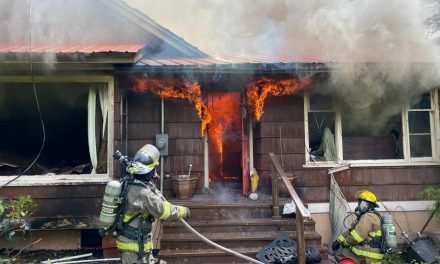
As he played with the matches, one of them ignited, engulfing the barrel in flames and trapping Richard.
“Mrs. Hewat, who was inside her home, heard his screams and rushed out to find her trapped toddler,” Rizzo said.
The mother hastily tipped the barrel over to get her son out, but the boy had suffered such horrible burns it was impossible to save his life.
Rizzo said all the doctor could do was administer an anesthetic to make the child’s last few hours easier to bear.
After four horrific hours, little Richard passed away. He was later interred at the Okanagan Falls Cemetery.
Stopping at the old Fairview lookout, Rizzo gathered her thoughts and recounted another strange death in 1918 when a young man was found starved to death beside a campfire.
A week prior, a group of men working on a nearby road noticed a man wearily plodding along.
“He was carrying a pack, and from his staggering, uncertain walk, they judged him to be intoxicated and paid him no attention, and the incident was soon forgotten,” Rizzo said.
A few days later, the road workers found the same man lying cold and stiff beside his fire. From his pack, they identified the man as William Brown, whose body was emaciated from hunger and icy from insufficient clothing.
It was later discovered that Brown was a well-educated English-born gentleman.
“It was surmised that William did not find the success he was looking for in the Fairview area, and being too proud to ask for help, he fought out his struggle alone,” Rizzo said.
Brown was a qualified civil engineer whose home had been amongst the refinement and wealth of a well-ordered English family.
He died alone beside a few charred, water-soaked logs.
The local doctor, who examined the body, said death was due to exhaustion and want of food.
“It seems strange that a man of William Brown’s education would not go into Fairview, being so close, to ask for assistance before suffering the fate that he did,” Rizzo explained.
Was it mere pride that prevented Brown from entering Fairview, or is there more to the story? Either way, the events that caused his death are now buried with him.
The conclusion
By 1906, the Fairview mines started to close and further exploration for gold was halted.
Within a few years, more townspeople began moving out of Fairview and into neighbouring communities, such as Oliver.
By 1919, Fairview had begun to vanish into the pages of history. Rizzo said some further mining was done in the 1930s, but overall, it was short-lived, and the last remaining residents moved away.
Rizzo said the souls that once resided in these hills give off an eerie energy that continues to bring life into this ghostly hamlet.