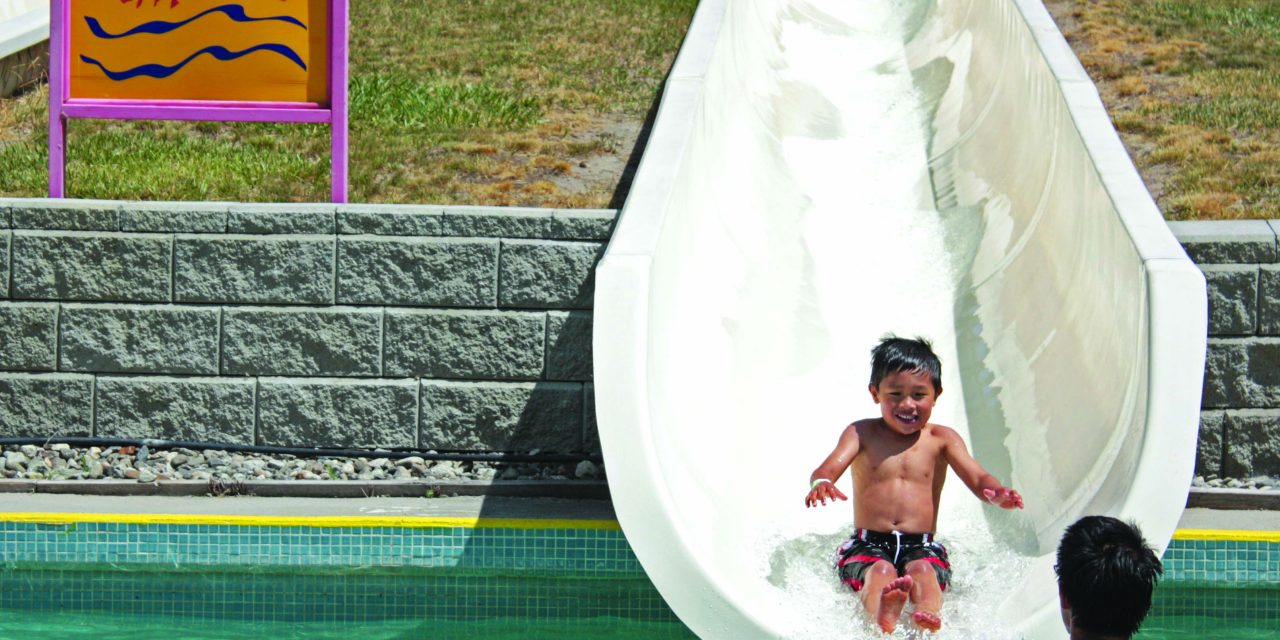
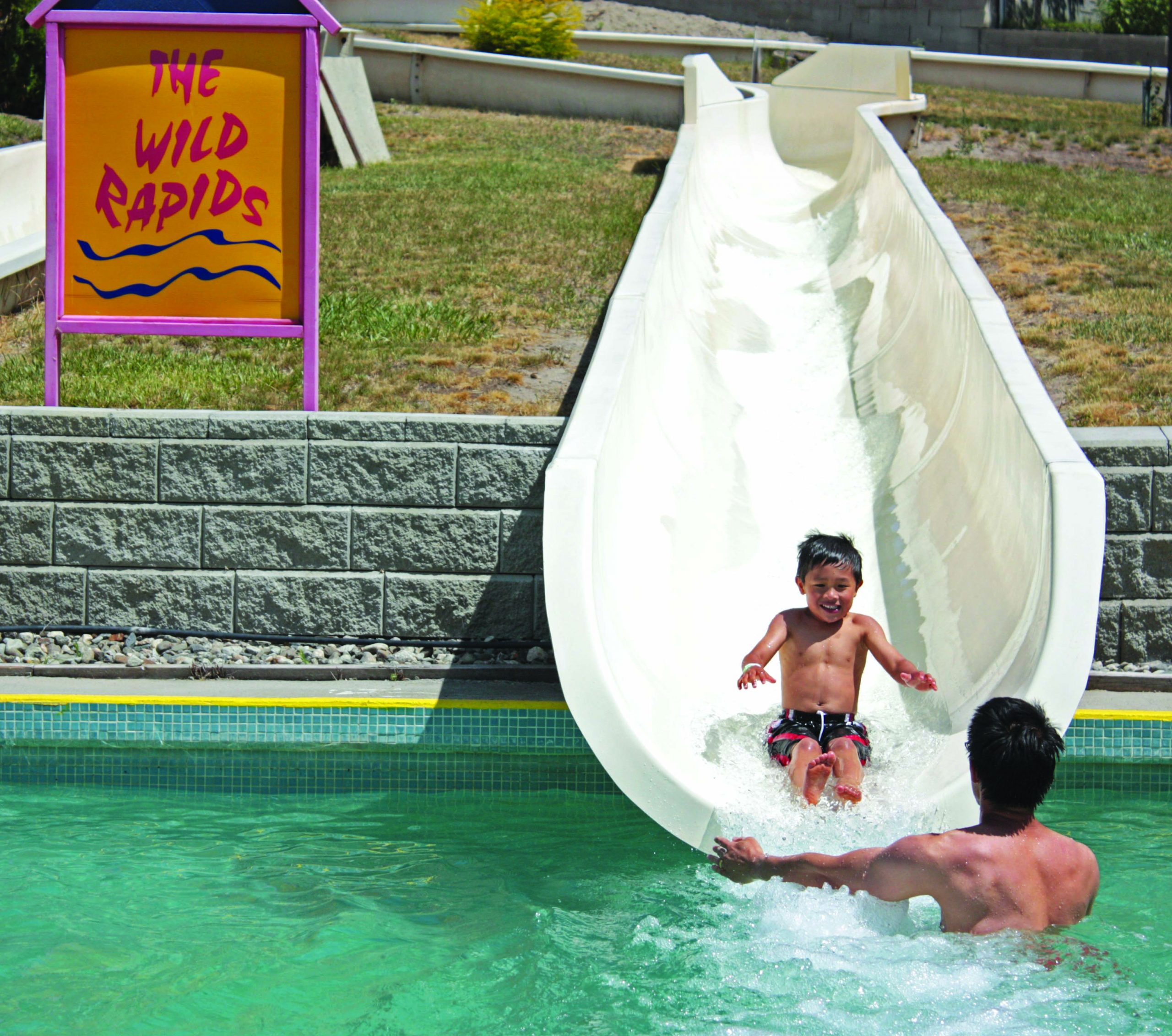
Five-year-old Ayden and his dad, Andre Eng of North Vancouver, enjoy a day at the newly reopened waterslides at the Osoyoos RV Campground and Waterslides Park on June 27. Owners Tony and Nadia Slovak opened the slides to the public that day after a two-year closure. The owners of the park have looked into ultra violet sanitation for the waterslides, but Interior Health regulations currently prohibit such a system for public aquatic parks. Photo by Erin Stodola
OSOYOOS TIMES-July 1, 2009
By Diane Zorn – Special to the Osoyoos Times
Tony Slovak said he did his homework when he was considering a new way to sanitize the water in the pools and waterslides at the Osoyoos RV Campground and Waterslides park he owns with his wife Nadia.
Concerned about water quality, he found international studies that convinced him that ultra violet (UV) sanitation was the most environmentally friendly way to go to keep the park clean.
Interior Health regulations, however, require that chlorine be used for public pools and waterslides and Tony’s idea about switching from chlorine to UV sanitation sank.
Last year, Beijing opted to go chlorine-free and rely on UV sanitation when building the Olympic Water Cube for the 2008 Olympic Summer Games.
There are also European and American health studies on children between six and 11 that show the risk of developing asthma when exposed to chlorinated water in indoor swimming pools over extended time periods.
For years UV treatment has been used in pools in the U.S. and Europe as a system that reduces the use of chemicals while providing for a safer environment for workers and bathers and also saves energy.
“Basically the water is forced to run through stainless steel and exposed to UV rays that kill 99.9 per cent of the bacteria, so you only need to use five per cent chlorine as an added precaution,” Tony said. “The water is literally safe to drink.”
Carl Wong, Interior Health’s inspector for Osoyoos, agrees that UV sanitized water is safe for drinking, but not for swimming in.
“The ultra violet sanitation process is not approved (in B.C.) and regulations here say that only chlorine can be used for disinfection purposes,” Wong said. “Chlorine is toxic and high doses can damage and even kill, but in low doses it can kill things that cause harm to people, like viruses.”
Because of the danger of sharing germs with other people using the swimming water, higher concentrations of chlorine need to be added.
When questioned about the irritation that high doses of chemical chlorine can cause to skin and eyes, Wong said “it is up to the operators of the pool to be diligent.”
“It is likely that eye irritations are due to the PH levels,” he said. “Pool operators need to track it to keep it between 7.2 and 7.4. Pool chemistry is a very complex issue.
“It is a very dynamic operation and involves proper use of chemicals, pumps and filters.”
Asked if operators need to have a licence or certificate to operate the caustic chemicals in the pool he said no.
“We rely on complaints and inspections to stay on top of it.”
Wong said the chlorine regulations were instituted in 1974.
However, those regulations still remain as the basis for obtaining a business licence for a public aquatic facility.
“Every public pool has to show a valid operator’s permit from Interior Health to remain open.”
As medical health officer for Interior Health, Dr. Paul Hasselback said “UV is not an effective mechanism, it is OK for drinking water, but not for recreational pools.
“Pools share body bacteria and public health has to be protected.”
Hasselback said that does not mean that the Interior Health Authority will not consider new technology.
“There are a variety of alternative approaches that operators can propose and make an application to Interior Health who will speak with engineers and operators to determine what keeps people healthy,” he said, adding that he was not aware of any applications that have been made from the waterslides park.
Nadia Slovak said they do not want to make an issue of it.
They want to comply with the bylaws, but she wonders if the rules are outdated and questions whether there is a need to keep up to the advances in technology.
“We are trying to seek change and have contacted the Minister of Health and the Canadian Federation of Independent Business to see if we can get some support,” she said. We want the lake clean.
“We just worry about the kids’ health and our water quality.”
[email protected]