
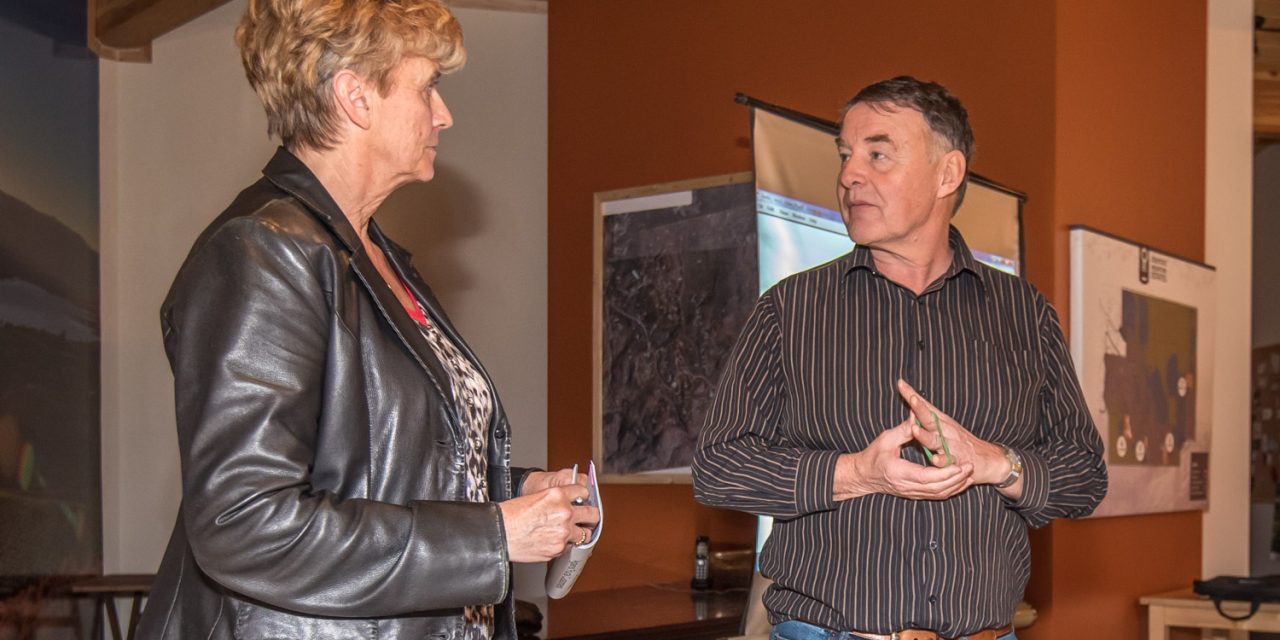
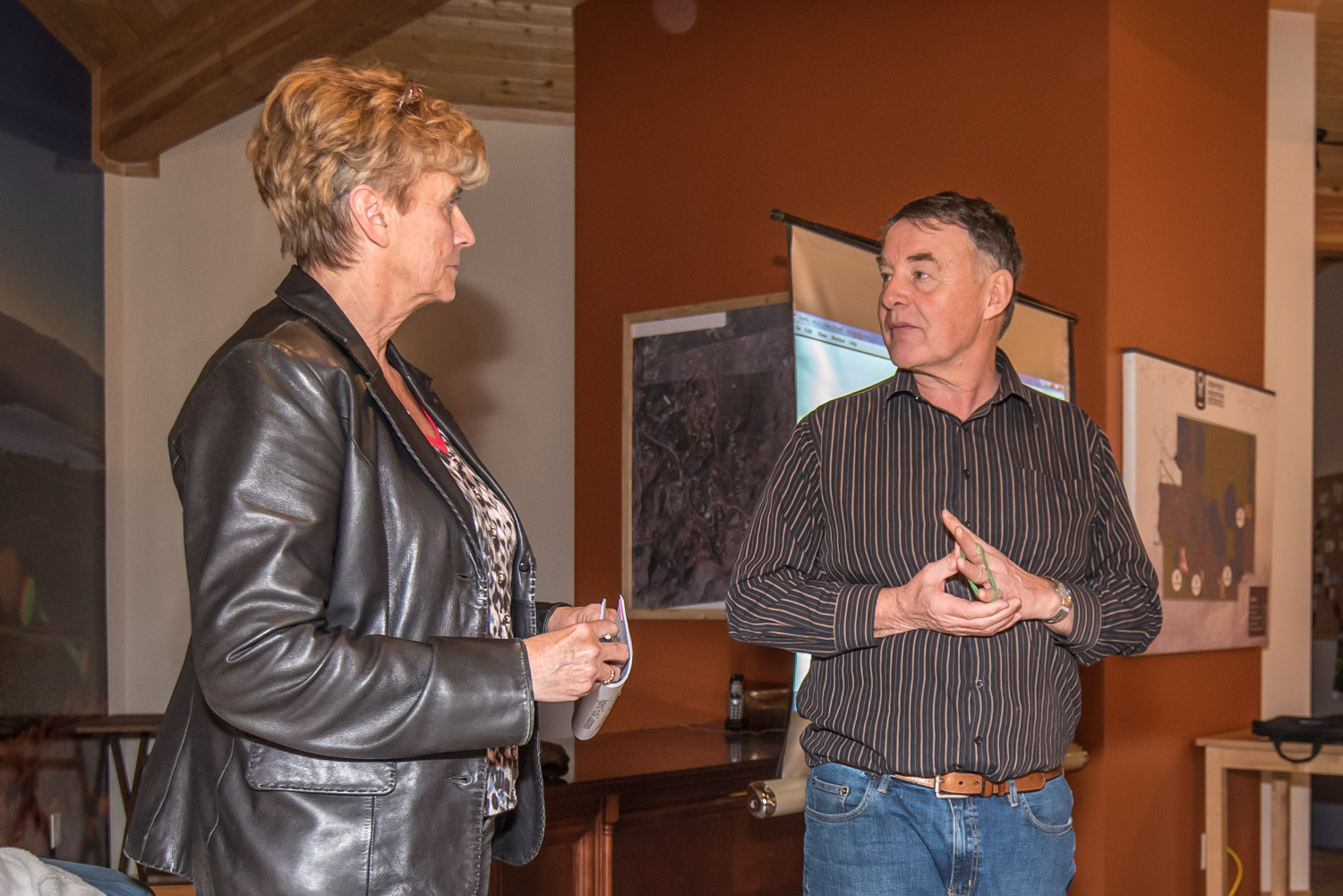
MLA Linda Larson speaks with Mark McKenney, president of the Anarchist Mountain Community Society, after hearing community concerns about two-tier electricity rates. (Richard McGuire photo)
Residents of Anarchist Mountain are angry that their electricity bills have taken a huge jump under the two-tier billing system introduced by FortisBC two years ago.
Under this system, which was imposed on FortisBC by the B.C. Utilities Commission (BCUC), residential customers get their first 1,600 kilowatt/hours (kWh) at a lower rate and anything over that at a higher rate.
It is easy to dismiss the residents’ complaints as the whining of a bunch of rich people living in oversized homes that are wasteful of energy.
Indeed, MLA Linda Larson hinted at this when she reminded the Anarchist residents that they live in large homes and that the people really suffering are those in communities like Hedley where poorly insulated houses are heated with electricity and many people have very low incomes.
But Anarchist resident Nick Marty points to more fundamental problems with the program known as the Residential Conservation Rate (RCR).
Marty isn’t just a whining resident. As a former senior official at Natural Resources Canada and the National Energy Board, he was directly involved in designing and regulating energy conservation programs.
The RCR is intended to encourage British Columbians to conserve electricity, but its design actually encourages the majority of the province’s residents to consume more.
That’s because most homes that have natural gas available to them can easily consume all or most of their electricity at the lowest rate – still priced below the old flat rate price.
As Marty points out, it’s a basic law of economics that if you lower the price, people will consume more.
Residents who don’t have access to natural gas usually have two options – use electricity for space and water heating or burn wood, which causes pollution.
Marty argues that 77 per cent of energy use in B.C. homes is for space and water heating.
That means a typical rural resident uses about four times as much electricity as an urban resident with access to natural gas.
So most electricity consumed is at the higher rate during the winter months.
As so often happens in cases of bad policy, the politicians, bureaucrats and companies dig in their heels and pass the buck.
FortisBC says only a small minority of B.C. is seeing a price hike and it was the BCUC that imposed the system on them.
The BCUC says – incredibly – that the policy is “achieving its intended results” even though FortisBC acknowledges that most residents saw a reduction in their bills “without having made any efforts towards conservation behaviour.”
And the provincial government sends “brush-off” letters to complaining residents essentially telling them to take up any complaints about their bills with FortisBC and the BCUC. Of course the politicians’ letters don’t acknowledge the policy could be flawed.
There are alternatives such as a higher threshold for residents who don’t have access to natural gas.
With the introduction of smart meters, time of use billing is also possible.
This encourages residents to shift their electricity consumption to off-peak hours, leveling out demand on the grid.
Whatever the solution, the lack of universal access to natural gas makes the RCR a seriously flawed program.
It’s time for FortisBC, the BCUC and the provincial government all to return to the drawing board to come up with a better and fairer system.


