By Don Urquhart, Times Chronicle
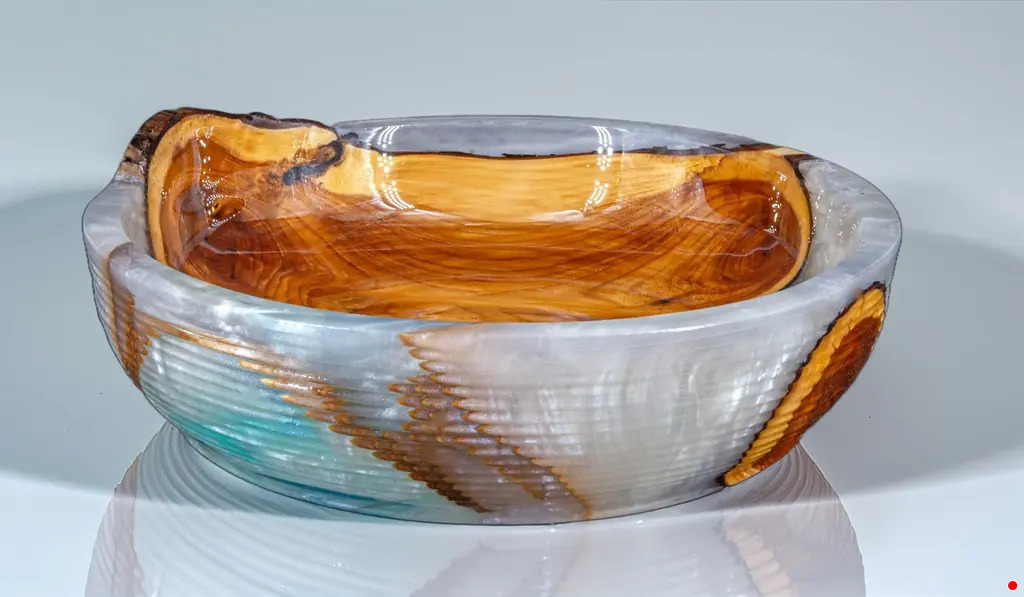
For hybrid woodturner Dave Brewin art should be both functional and aesthetically pleasing. And judging from his stunning bowls and plates, he’s hit the sweet spot in functionality meets objet d’art.
Using reclaimed materials, mostly wood, he casts them into a food-safe epoxy resin, adding different pigments, and once it’s all cured, he puts them on his lathe and turns out bowls, plates, vases – anything that can be turned on a lathe.
Each piece, completely unique, starts out as a solid chunk(s) of wood, typically. Really, the only constraints are that it needs to fit into a container filled with the resin, and it needs to fit on his lathe.
Key to his process of producing immaculate resin works is a bit of “pull and push” – vacuum to suck out the air from the tiny nooks and crannies of the wood and pressure to force resin into these very same tiny cracks and crevices.
“For that reason, I like the really ugly wood, because it just has more character,” he says.
While the wood and resin are in the pressure pot, it’s actually curing at the same time, a process that usually takes three to four days, he says.
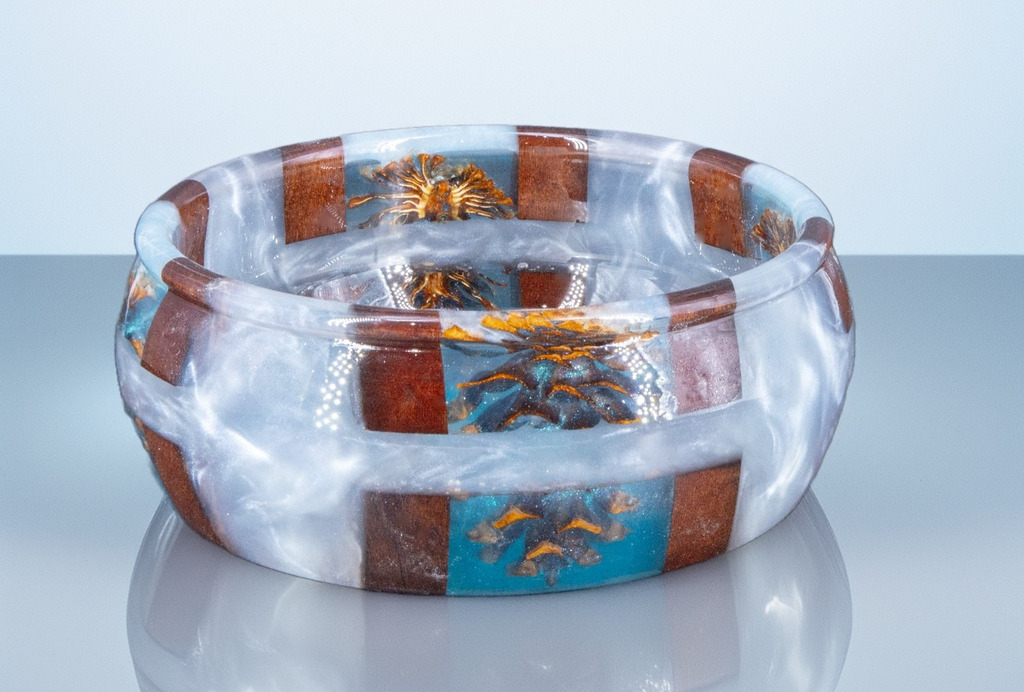
A Mahogany & Cones Bowl.
Dave Brewin photo
For anyone who has ever worked with resin, the trials and tribulations of air bubbles will strike a chord. “When I started this, I did have an idea of how epoxy worked.” Prior to his artistic path, Brewin used to work in Quebec back in the 1980s making fiberglass and epoxy boats. “We used to lay the glass in there and then roll all the air out,” he says of his earlier industrial days.
Another aspect of working with resin that will surely resonate with those who have dabbled is the smell. That deeply penetrating, dangerously hallucinogenic odour is simply overpowering. But this is actually a thing of the past, at least for Brewin.
He’s chosen the environmentally friendly route with Canadian-made epoxy that’s biodegradable. “It has no smell at all when you’re working with it. I do wear a mask when I’m turning it, of course, but it’s a great product to work with, and the fact that it’s made in Canada, all the chemistry, everything is done right here,” he says.
One thing he discovered two or three years ago is that his use of traditional turning tools was leading to more sharpening than actual work on the lathe, so he went to carbide tools, which made a “huge difference,” he says.
The hybrid woodturning came about more by accident than anything else, he notes. “I saw somebody online doing something similar about two and a half years ago, and I thought, you know, I worked on a lathe in high school in the ‘70s, so I have an idea how a lathe works, and I just went out and got a lathe and went to town.
“I always jump in with both feet when I do stuff,” he chuckles. “Before I was doing this, I was painting, and now the paint and the canvas is all gone into the closet, and the lathe has taken over.” He adds that he’s now on his fourth lathe and awaiting delivery of number five, which will allow him to work on bigger pieces around 43 cm in diameter.
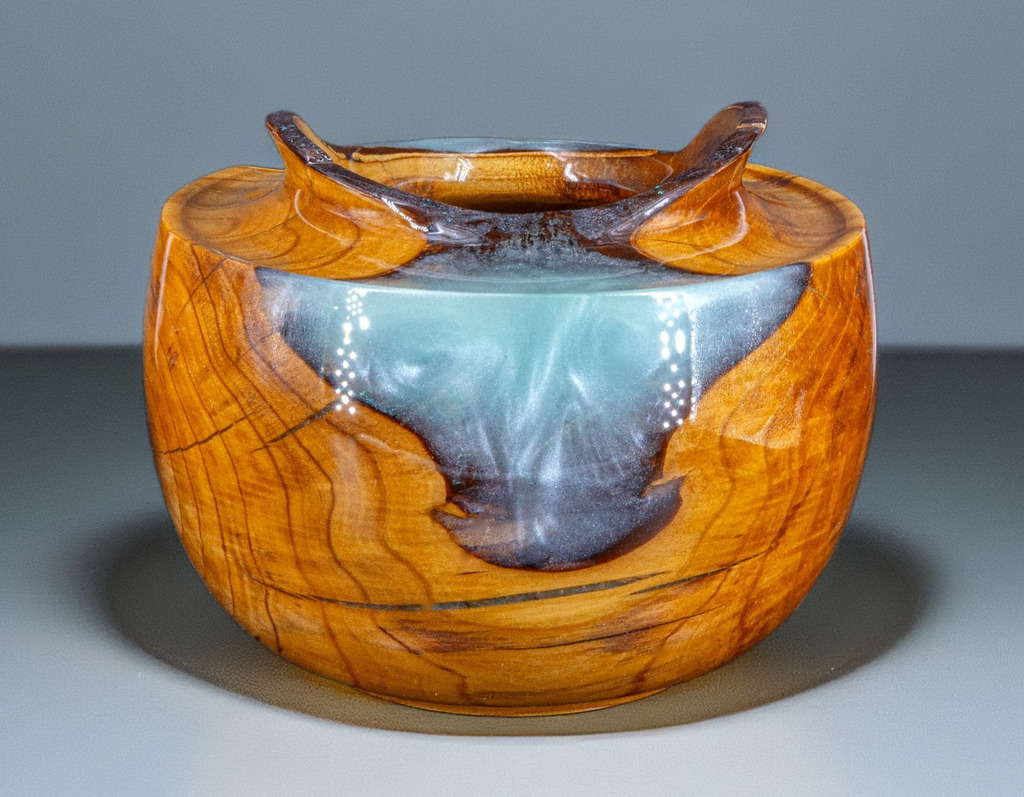
Plum Wood Bowl.
Dave Brewin photo
Looking at the selection of pieces at the Okanagan Art Gallery, which Brewin has recently joined, bringing yet another unique addition, is a bit like looking through Alice’s looking glass. Small flowers, sparkly bits, pigment designs, pine cones, and fantasy landscapes he’s crafted out of construction paper that, in one case, looks like a miniature coral reef. A feast for the eyes and a spark for the imagination wouldn’t be an overstatement.
“You’re limited only by the imagination of what you do,” he observes. “Like on this piece here, this was a maple burl, and I actually painted all of what I wanted to remain, so that when you see through it you can see all the colours.”
An interesting aspect of this art form is that there’s also a bit of science involved due to the chemical reaction of the epoxy. Each colour must be poured separately and allowed to dry, and not too much resin can be poured at one time or the piece can develop “thermal cracking”, he says.
In the beginning, he would spend a significant amount of time hunting for wood, but now he has a legion of friends who always have their eyes open for wood. He gets interesting pieces from his arborist friends, he adds.
Once he’s done cutting on the lathe, it’s time to polish. “Most of the time is spent sanding and polishing,” he says, adding that it includes hand polishing. “People will come up to me and say, ‘How do you get the wood inside the glass?’” He laughs that it’s “not a little ship in the bottle thing,” but acknowledges it’s the look he’s going for – an uber shiny surface like glass.
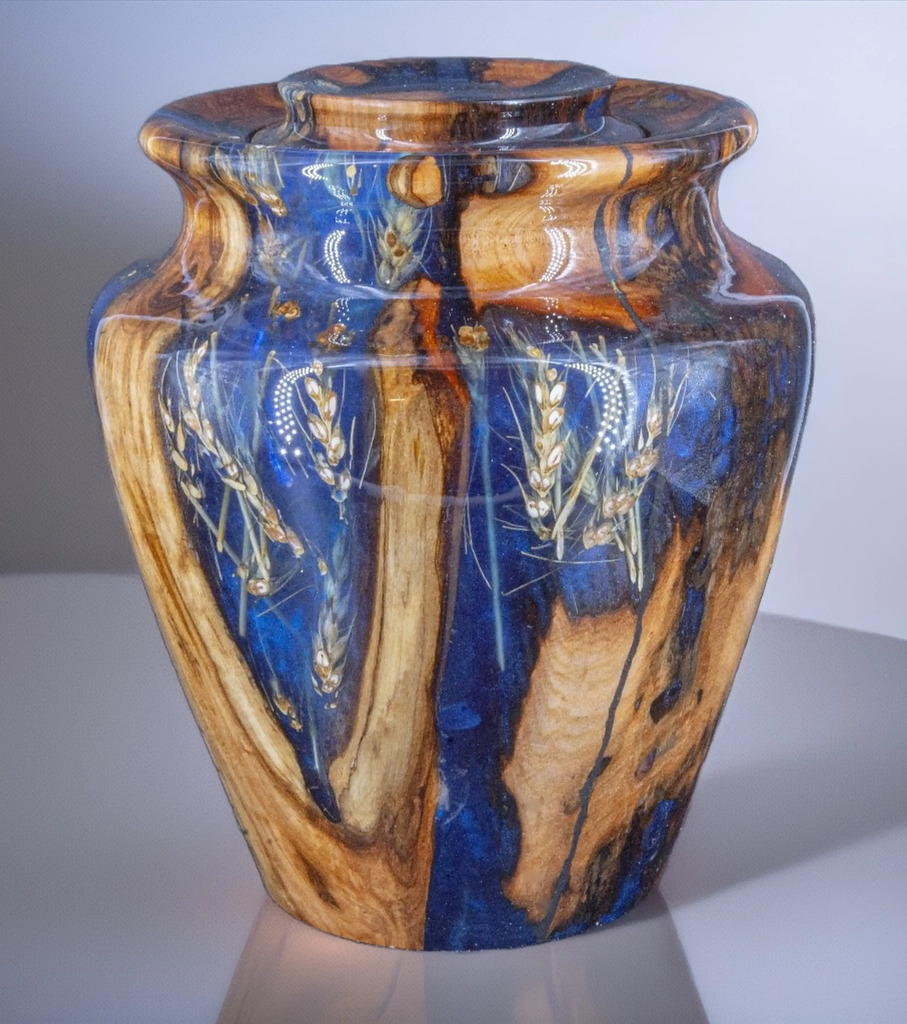
Dave Brewin’s Sapphire Blue Wheat Willow Urn.
Dave Brewin photo
He’s been asked to make table tops, but just lacks the space to do it. “If I had a nice 400 or 500 sqft shop with a lot of space or larger, then I could do something like that,” he says. Another limitation is the requirement for it to be dust-free.
But he does do commission work. ”I do a lot of urns personalized for pets and older people,” he says. “I recently did an urn that featured wheat. This person was from Saskatchewan, and so I got my brother-in-law in Saskatchewan to send me some wheat, and I made an urn out of it,” he says.
Limited only by imagination, indeed. One self-imposed limitation, however, is that he doesn’t like making smaller pieces. “When it gets too little tiny, it’s a little too finicky for me. I’ll do them if somebody wants one, like somebody wanted a honey pot. I made them a honey pot with a little stick and whatnot. But I prefer doing the larger pieces, which is why I’m getting the bigger lathe.”
He’s also used grape vines in his pieces and, in fact, used some from Seven Stones Estate Winery in Cawston. My friend who owned it, George Hanson – he passed away, and I wanted to keep him alive, so it’s my way of keeping his vines alive”.
Brewin laughs when asked if his house is filled with his pieces and adds that some of the pieces are hard to get out of the house because his wife likes them too much.
Brewin’s functional pieces of art can be found at various farmers’ markets, art walks around the region, and now in the Okanagan Art Gallery. For more information, visit his website at artisbrewin.com.