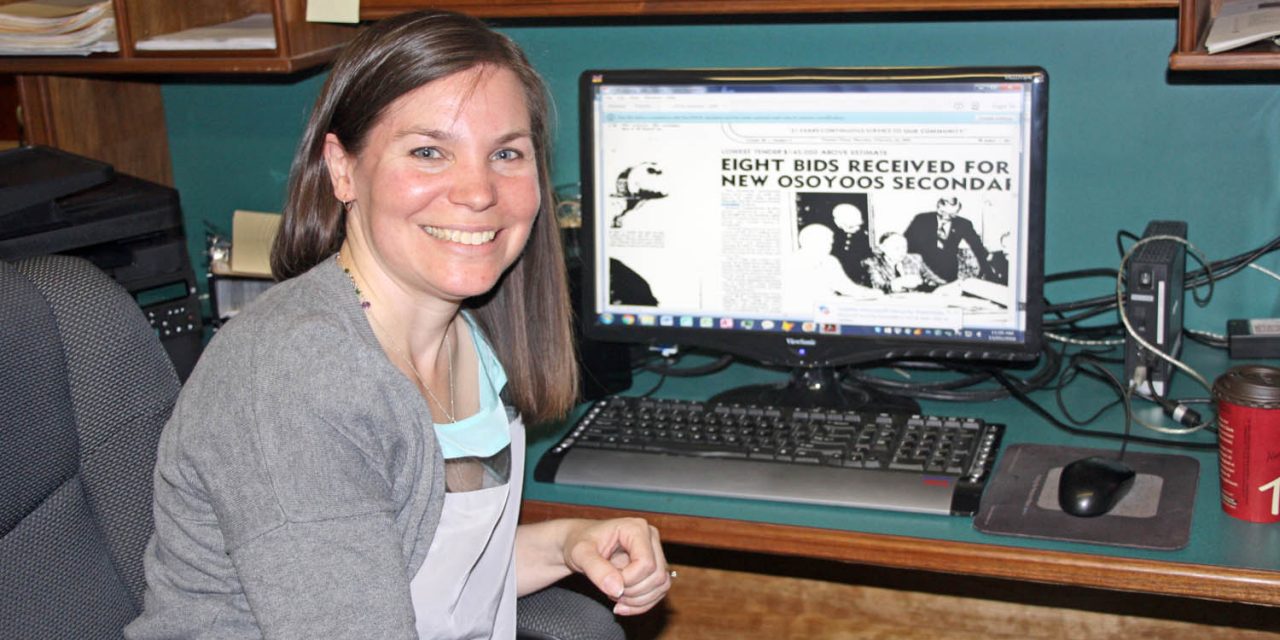
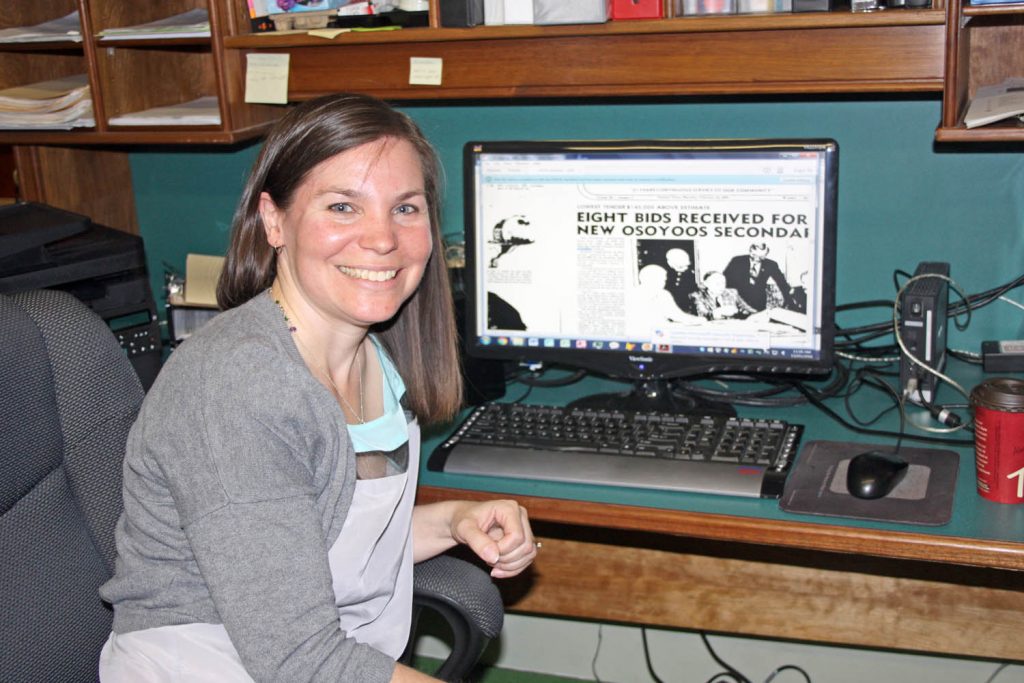
Kara Burton, executive director of the Osoyoos Museum, researched the controversy surrounding the decision to build Osoyoos Secondary School. The tension and hostility on school board suggest history has repeated itself. (Keith Lacey photo)
The same tension, enmity, frustration, anger and hostility that has surfaced over the past four months since it was announced that local school board trustees would be closing Osoyoos Secondary School (OSS) is nothing new for this community.
Those same emotions were shared almost 40 years ago when a group of strong-willed and determined local citizens – and some very determined local school board trustees – pushed to have a high school built in Osoyoos.
Kara Burton, the executive director of the Osoyoos Museum, said she had received numerous inquiries from local citizens over the past several weeks who wanted to inquire about museum archives detailing the history of OSS.
With her own children affected by the recent announcement that trustees with School District 53 had voted to close OSS effective June 30, Burton said her own interest was piqued about the proud history of OSS.
So she decided to sit down and spent several hours gathering information – almost exclusively from articles that appeared in the pages of the Osoyoos Times – that detailed the prolonged and bitter battle to get OSS built in the first place.
Then, as now, there was an obvious and pronounced divide between local trustees and trustees from Oliver and Okanagan Falls, many who battled for years against the idea of having a high school built in Osoyoos, said Burton.
“It’s a little bit unbelievable that there are so many similarities between what happened back in 1977 and 1978 and what has happened over the past few months,” said Burton, who was born and raised in Osoyoos and is a proud graduate of OSS. “Just like what has happened over the past few months, the parents and trustees in this community had to fight so hard to try and get a high school built and they were opposed every step of the way from the citizens and trustees in Oliver.
“Just like back then, I don’t think the people of this community are going to give up until a decision is made to keep our high school open.”
What started as opposition to the idea of a new high school for Osoyoos in 1976 and 1977, resulted in a compromise to build a new school for students up to Grade 10.
The battle to include Grade 11 and 12 students lasted literally until weeks before OSS officially opened in September of 1979.
Then, as now, there were threats of legal action and pleas for the government to intervene.
The chair of the board of trustees actually resigned months before OSS opened due to the constant and continual bickering between trustees on either side of the issue.
A thorough perusal of the museum archives shows that the first discussions amongst community leaders and the local school board – which was then called School District 14 and was in control of all schools only in Osoyoos, Oliver and Okanagan Falls – to build a high school in Osoyoos dates back to 1969, said Burton.
“At the time, the only school in Osoyoos was the school called Osoyoos Elementary Junior Secondary School … and it went up to Grade 10,” she said. “Only the Grade 11 and 12 students were sent by bus to the high school in Oliver.”
In 1977, the local school district was made up of three trustees from Osoyoos, three from Oliver and one from Okanagan Falls.
An article in the Osoyoos Times in 1975 indicated that enrolment at Southern Okanagan Secondary School (SOSS) was reaching its capacity and several editorials in the Osoyoos Times suggested it might be time for Osoyoos to have its own high school, said Burton.
Stan Stodola, the founder and longtime owner of the Osoyoos Times, was a strong supporter of the concept of a high school for Osoyoos and he eventually became a local trustee around the time OSS finally began construction, she said.
“There were lots of editorials in the paper strongly in favour of a high school for Osoyoos,” she said. “A lot of the people who were on the front lines of trying to get the high school built in Osoyoos still live here today.”
A headline from the Oct. 9, 1975 edition of the Osoyoos Times read, “New School Wanted for Osoyoos.”
It’s clear from several other articles around that time that trustees from Oliver and Okanagan Falls wanted nothing to do with a new high school being built in Osoyoos.
The push for a new high school in Osoyoos was heating up in 1976. One headline read, “School Board Now Favours Secondary School for Osoyoos.
“There was a full reversal from the trustees … what happened, I simply don’t know,” said Burton.
In June of 1976, a huge front-page headline read, “High School Approved.” The opening paragraph read, “The dramatic approval has been met with widespread surprise and pleasure. As late as last December, the school board was opposed to even making a proposal to the Department of Education for a senior secondary school in Osoyoos.”
In December of 1976, preliminary drawings for the new high school were brought before trustees and the current site on the West Bench of Osoyoos was approved.
In early 1977, the idea to build a community theatre as part of the new high school was discussed for the first time.
The initial concept to have taxpayers from across the School District contribute to paying for the community theatre became a hot button topic and Osoyoos community leaders eventually decided to hold a referendum. The vast majority of local residents agreed to foot the bill on their own without support from Oliver and OK Falls residents, said Burton.
“The provincial government announced there would be no provincial funding for the theatre … so ultimately, Osoyoos held a referendum … and it passed with flying colours,” she said.
That referendum was held in September of 1977 and town council announced on Nov. 19 that it would provide $150,000 for the community theatre to be repaid by local residents over several years.
The road to build the high school also began in September of 1977.
Just months before construction on OSS was set to begin, controversy erupted as the B.C. Land Commission (now the Agricultural Land Commission) released a report saying it would not release the land at the proposed school site from the Agricultural Land Reserve (ALR).
An appeal from the school board to the land commission was eventually successful and tenders to build the school were sent out in January of 1978 – the original amount was roughly $1.78 million.
Eight bids to build the school were presented to the board office a month later, with the two lowest bids being in the $1.8 million range from two Penticton contractors.
Once it was announced that construction on the new high school was moving ahead, that’s when the enmity and divisiveness between Osoyoos and Oliver trustees became even more glaringly apparent.
In late April, a headline appeared stating, “School Board Undecided About Grade 11 and 12 in Osoyoos” as Oliver trustees voiced their concerns over the quality of education for senior secondary students who were still being bused to Oliver.
A petition quickly surfaced in Osoyoos supporting a full secondary school in Osoyoos with Grade 11 and 12 students included. Thousands signed the petition.
The tension between the trustees was so tense over this issue that Minister of Education Dr. Pat McGeer had to write a public letter.
He stated, “The Ministry is satisfied that the school … will accommodate 360 students (including Grade 11 and 12) and will provide a high quality of education in Osoyoos.”
Gordon Armstrong was hired as the new superintendent of education for School District 14 in August of 1978.
Only weeks later, more headlines appeared stating, “Grades up in the Air” as Oliver and OK Falls trustees continued to battle against the new school including Grade 12.
In late November, all three Osoyoos trustees tabled a motion that Grade 11 and 12 be included in the new high school.
Even after construction had started on the school, the battle over whether to include Grade 11 and 12 at OSS continued.
A headline in the Jan. 4, 1979 Osoyoos Times read, “Grave Conflicts Erupt at Meeting of School Trustees.”
With construction almost complete on the school, Osoyoos trustees were still sending letters to the Minister of Education asking him to confirm Grade 11 and 12 would be included when OSS officially opened in September of 1979.
“The appeal by trustee (Virginia) Cook fell on deaf ears,” read another headline.
On March 1 of 1979, six months before OSS opened, school board chair Bernice Scott from OK Falls, announced her resignation, stating that “internal squabbling among local trustees over the issue of the new Osoyoos school” was at the heart of her decision.
Scott’s decision obviously shook up the squabbling trustees as days later it was announced they had voted unanimously to include Grade 11 when the school opened in the fall of 1979 and Grade 12 a year later.
“One week after the board chair’s resignation, they finally decided to include Grade 11 and 12,” said Burton.
After that decision was made, Oliver trustee Tish Pike, who vehemently opposed the idea of OSS being built in the first place, announced her resignation.
Only days before the school opened, the board selected to call the school Osoyoos Secondary School and changed the name of Osoyoos Junior Senior Secondary School to Osoyoos Elementary School.
Osoyoos Secondary School officially opened its doors after Labour Day in 1979.
The official opening ceremony took place three weeks later with Cook cutting the ribbon along with Principal Roger Tait and Jim Hewitte, the Minister of Energy Mines and Resources.
McGeer, who was still Minister of Education, didn’t attend.
KEITH LACEY
Osoyoos Times