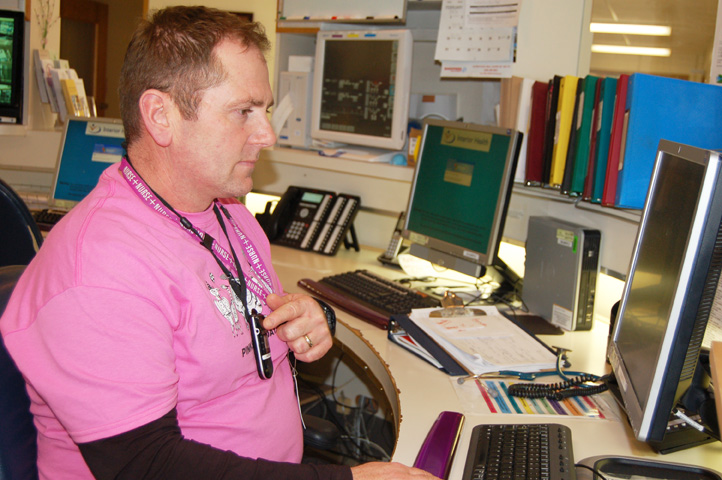

LPN Paul Brunner at South Okanagan General Hospital receives a call on his Vocera communicator. The “Star Trek” device allows staff to connect with anyone in the designated facility.
Erin Christie photo
When it comes to health care, communication is critical. And with the advent of high-tech response devices like the Vocera, better patient care is just a click away.
South Okanagan General Hospital introduced the wireless “Star Trek” communication system on October 13.
Acute services manager Genevieve Nice said using these pocket-sized communicators boost hospital safety, improves communication between health care professionals and increases response time and productivity significantly.
“If a staff member is working with a patient and a message comes through they don’t have to stop and find a phone, the device is hands free so they can continue helping their patient,” she explained.
So how does it work? Much like the communicators worn on the 1950’s sci-fi series, the Vocera devices are clipped to the staff member’s collar or a lanyard and understands spoken voice commands in natural language.
With one-button access, it allows users to connect with anyone in the designated facility through the Vocera Messaging Interface (VMI). It can also be used to connect patient monitoring systems, scheduling software, bed management applications and other systems, as well as outside phones.
Acute services director Calum Hughes said the implementation of the devices was initially triggered by safety concerns. One of the highest priority functions was an alarm system that would allow staff members to initiate a “code white” if they were concerned for their safety.
Under the old system, a health care worker who needed help would have to get to a phone in a patient room or nurse station. That call would then be routed through to security. In an emergency situation, seconds count, and each step in that process took time. Though safety concerns are common among Canada’s health care providers, use of the Vocera system is not.
Hughes said SOGH is one of “very few” hospitals in the country to implement this technology, and they were one of the first to go completely electronic.
“We’re very fortunate to have this facility. It’s basically a micro-version of the larger hospitals so we get to be kind of a pilot site for different initiatives. We thought Vocera would be beneficial, and the improvement to our communication so far has been phenomenal.”
With a catchment area of nearly 21,000, efficiency is everything, Nice added. “We’re a very busy place and we use these everyday 24/7. We want to provide a holistic approach to patient care and this helps make that possible.”
Nice, who oversaw the implementation of the Vocera system, said she hopes to usher in more high tech tools to SOGH this summer. Her latest project is to install a SMARTBoard for the staff, which she said will further enhance the “team approach” to patient care by streamlining communication.
Nice and Hughes commended the South Okanagan Health Care Auxiliary for committing the $100,000 toward the purchase of the Vocera system. The remainder of the funds came from the South Okanagan Similkameen Medical Foundation.
“It’s really a community effort,” noted Hughes. “People from the community participated in the fundraisers and shopped at the thrift store, and that’s where the money to purchase this system came from, and it’s something that will benefit everyone. We are so grateful for the generosity in this community.”
Erin Christie
Oliver Chronicle