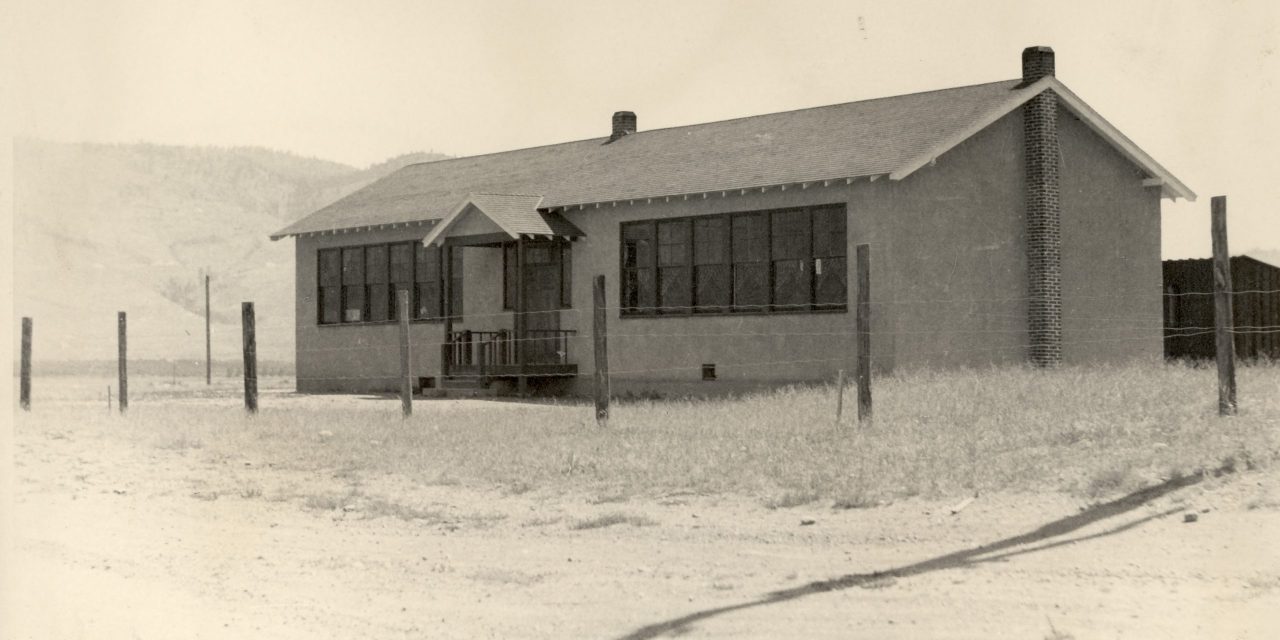

The Osoyoos school house was built on the site of today’s town hall in 1932 and part of it is incorporated into the present building, which is a mish-mash of additions added over the years. A second room was added to the original one-room school in 1934, and later a third and fourth room were added. In 1944, the old Testalinda School was moved to the Osoyoos site, becoming the fifth and sixth rooms. (Osoyoos and District Museum and Archives)
If the present town hall is demolished due to its deteriorating state and the costs of renovating it, a piece of the town’s history will be gone.
The building contains parts of two different schools, possibly lumber from a Fairview hotel once called the Bucket of Blood Hotel and Saloon, and various additions added over the years.
But despite its interesting history, it can’t really qualify as a heritage building, said Kara Burton, executive director of the Osoyoos and District Museum and Archives.
“Definitely the property and building have been there for some time,” said Burton. “As a heritage building, it’s difficult to say. It’s been added on so many times and renovated that I don’t think it’s really true. I don’t know how much of the original structure is there.”
A consultant’s report received by council at its March 5 meeting expresses the view that it’s not feasible to do a major renovation to the existing building, which would require extensive work to address structural and fire safety issues.
“It is likely that a new building could be constructed at a lower cost than initiating repairs and renovations to the existing building,” the report concludes.
The report was vague on the building’s history, simply saying: “Although the construction history of the town hall is not clear, it is understood that the building is over 50 years old and was constructed in sections over time.”
As several old-timers have pointed out, the building is considerably older than 50 years, with part of it built on the present location as a one-room schoolhouse in 1932, making it close to 86 years old.
But part of it includes a portion of the old Testalinda School, built in 1926 between Osoyoos and Oliver. That school contained lumber salvaged from the Golden Gate Hotel in Fairview, previously known as the Bucket of Blood Hotel and Saloon.
Whether or not any of that old saloon wood is contained in the present town hall, and if so how much, is unknown.
Even the more recent history, gleaned from notes at the museum, old issues of the Osoyoos Times, and recollections of seniors who were children at the time, are sometimes contradictory and may not always be accurate.
An earlier log school, built in 1892 as a government building, became the town’s first school in 1917 when there were enough children. It was located on the bench south of the present Osoyoos Elementary School, but was eventually moved to Main Street in 1963 to become part of the town’s first museum behind the cenotaph.
The log building ceased to be the school in 1932 when the one-room school was built at the site of the current town hall.
As the town’s population grew, a second room was added in 1934 and later a third and fourth room were added to the school.
Meanwhile, up the road, a second room was added to the 1926 Testalinda School sometime between 1932 and 1934 when the number of students exceeded 30.
But, a decade later in 1943, the Testalinda school was closed after the school districts of Oliver, Testalinda Creek, Osoyoos and Okanagan Falls were amalgamated into the South Okanagan United Rural School District.
The following year, the Testalinda School was moved to Osoyoos and added onto the existing four-room school to make it six rooms. This was cheaper than transporting Osoyoos children 12 kilometres to Testalinda.
George Fraser, a local history buff who has vague memories of attending school where the town hall is from grades 2 to 6 in the early 1940s, said he thinks the Testalinda School was put at the back of the existing school, to the south of the main building.
“I don’t have a terribly good memory despite rumour,” he said.
Former long-time Osoyoos resident Dorothy Fairbairn remembers going to the one room school. Her memory is also a little unclear, but she remembers her schoolroom being included in the present town hall where Mayor Sue McKortoff’s office is now.
She also remembers when the second room was
added end-to-end with the first room. By the time the Testalinda School was moved, she was going to school in Oliver.
Fairbairn recalls her first day at the one-room school.
“My brother took me to school on the back of his bike,” she said. “He told me, ‘If you talk, you’ll get the strap, and if you get the strap, you’ll get it again at home.’ Corporal punishment was very alive and active at that time.”
Others, however, say the portion of the town hall where the mayor’s office is was one half of the Testalinda School. But a report in the Feb. 21, 1950 Osoyoos Times, appears to confirm the recollections of Fraser and Fairbairn, saying the portion of the school retained by the village was the four original rooms, while the south wings were purchased by Ben Izaak and moved. One of these buildings, apparently part of the old Testalinda School, was moved to become a meeting place for the Jehovah’s Witnesses.
This building is now located next to Sunshine Ridge Retirement Residence off Nighthawk Drive and still exists.
The town’s planning office could not locate any records confirming which portions of the building were constructed in which years.
In the mid-1940s, the residents of Osoyoos were talking about incorporation as a village, and in 1946, the board of trade – the forerunner to the chamber of commerce – sent a petition to the provincial government seeking village status.
Osoyoos had no newspaper until the Osoyoos Times was started at the beginning of 1947, so residents were notified of an organizational meeting in early 1946 by knocking on doors.
The first village commissioners were appointed, but in 1947 they were elected, and the first meeting was held in the rear of the old post office on Main Street. It subsequently moved to the business of Les Topliss, who took over as village clerk in 1948 from postmaster Harry Hesketh.
By the late 1940s, the six-room school at the site of the present town hall had outgrown itself.
In September 1949, a new 13-room elementary school opened in the building that is now the Sonora Community Centre – close to where the original log school had been. The village acquired the old school and some of the buildings were moved elsewhere, purchased by Glen Tweedy.
Then on May 1, 1950, according to the Osoyoos Times that year, the village office moved from rented premises to a “home of its own” at the old school. It assumed the name “Municipal Hall.”
Renovations were done to the building several times in the 1970s, starting with the conversion of a former workshop into a 24 by 24-foot space.
The building received a cosmetic facelift when it adopted a Spanish theme in 1975 as part of a campaign to give the town a Spanish look. At that time, the town aimed to mimic Spain, with white stucco, red tile roofs, decorative brick and wrought iron balconies. In later years, the architectural style of other buildings imitated the adobe style of the American Southwest.
In the early 1980s, a two-storey addition was added.
Fraser said he was saddened when his old home, the Haynes homestead on Lakeshore Drive was demolished in 2016. But he won’t have the same sadness if his old school, the town hall is demolished.
“I don’t feel the same way,” he said. “If it had remained as a school, I think I would have more empathy towards it, but because it has been altered into the village hall and the fire hall connected to it, etc. etc., it’s not the same building.”
Burton at the museum said she’s always sad when a piece of local history is lost, and like Fraser, she too was sad when the old Haynes homestead was demolished.
“But we also have to understand that not everything can [be saved],” she said. “You can only fix things up so much and if it can’t serve the purpose any longer, then we have to move forward.”
RICHARD McGUIRE
Osoyoos Times

This photo taken in 1953 shows the town hall with the fire hall in the background. Firefighters pictured are (back) Walt Abel, Jack Patt, John Litowski, Stan Stodola, Russell Lutz, Howard Compeau, (front) Fire Chief Percy Bates, Don Bates, Don Koenig, Royd Fenwick-Wilson and Vern Hills. Stodola was the founder of the Osoyoos Times. (Osoyoos and District Museum and Archives)

This building next to Sunshine Ridge Retirement Home was once one room of the Testalinda School. It was added to the school that is now the town hall building in 1944, but it was relocated here in 1950 when the school became the village office. This building for a while was a Jehovah’s Witness hall. (Richard McGuire photo)