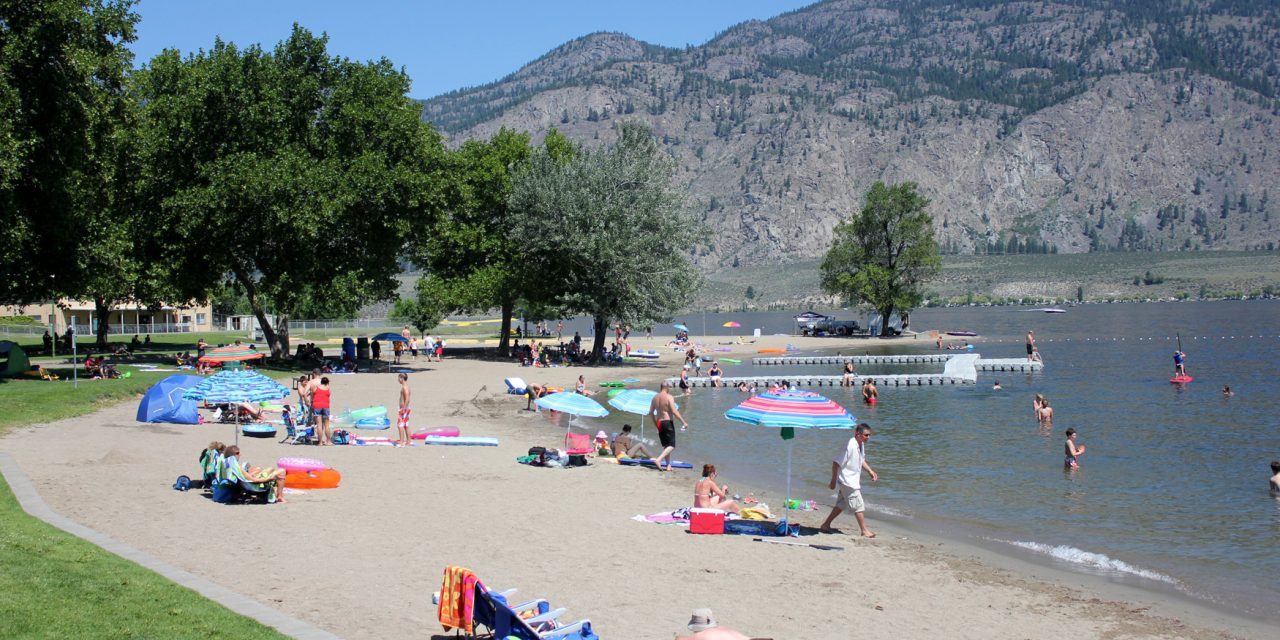
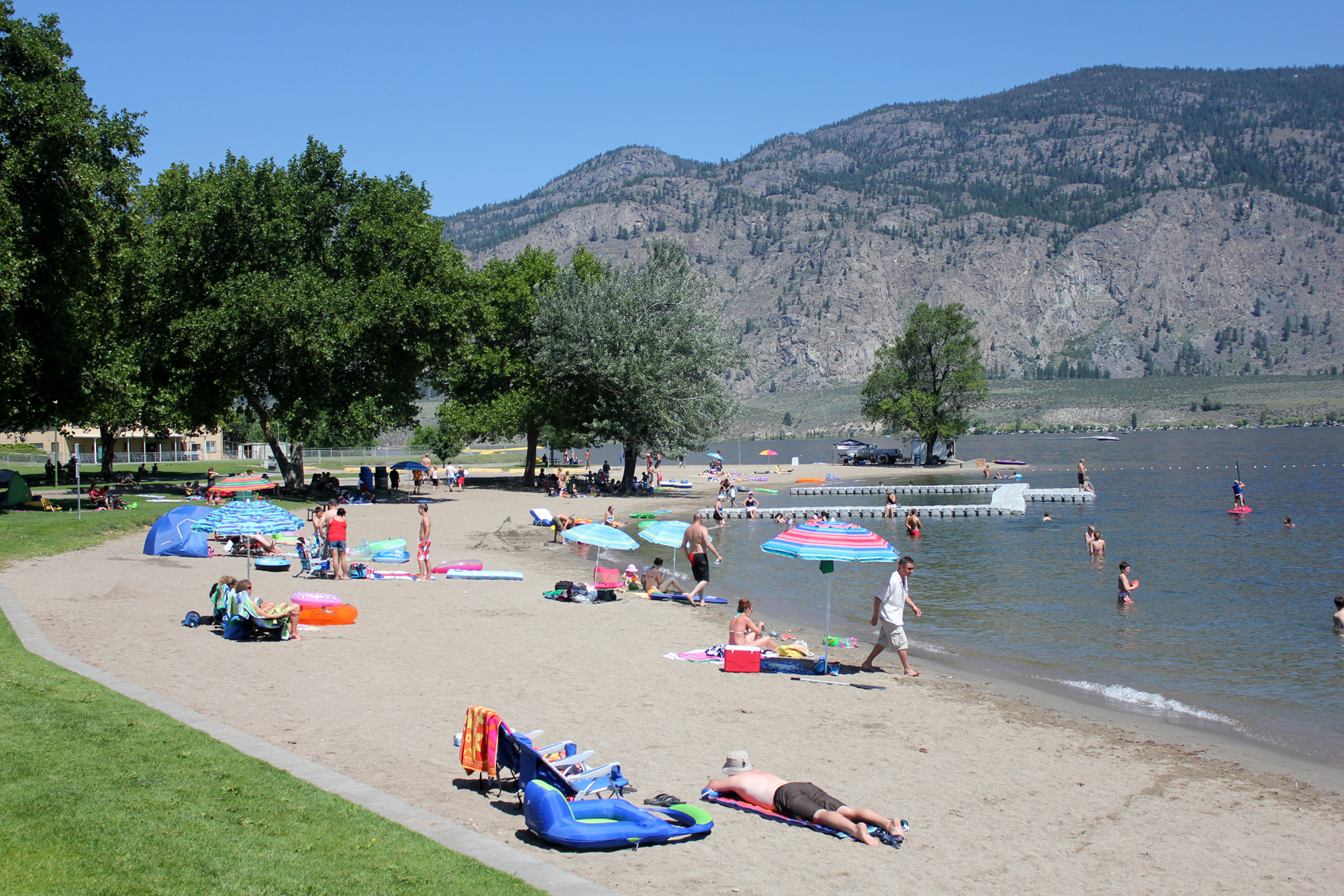
Hundreds of residents and tourists flocked to Gyro Beach this past Friday, July 27, as the temperature in Osoyoos soared above 30 degrees Celsius. Both the Town of Osoyoos and the Osoyoos RCMP have each taken additional steps recently in dealing with the ongoing issue of illegal and distributive behaviour on town property. Photo by Mathew White.
If you’ve spent any time in Osoyoos this summer, you’ve no doubt noticed the problem the town has been having with distributive and illegal behaviour in its public parks and on its beaches.
The issue has resulted in countless investigations with the Osoyoos RCMP, forcing them to seek alternative methods to deal with the ongoing problem.
Sgt. Kevin Schur said the Osoyoos RCMP recently approached the Town of Osoyoos, about three weeks ago, and worked with the Chief Administrative Officer, Barry Romanko, to have RCMP officers approved to hand out expulsion letters to those who won’t obey town bylaws.
“Because of the issues we’ve been having with a number of non-residents in the parks … I saw that as an opportunity for us to enhance the powers and abilities that we have to deal with different people in these areas,” said Schur.
“So we ran it by the town, about them delegating that authority to the police officers here to issue those expulsion letters, (and) they did.”
Temporary Park Expulsion Letters are essentially just what they sound like. They are a legal document that effectively bans a person from the town’s parks and beaches for a pre-determined amount of time. Common violations which would constitute an expulsion letter include, possessing liquor in a park, creating a nuisance, damaging park property, being in the parks after hours, interfering with workers or enforcement officers, etc.
Schur said this method of police enforcement is so new they’ve literally had to hunt for carbon paper. The bylaw which allows these letters (Bylaw #1278) was only passed last year, which is why they have not done this until now.
Before the RCMP were given the ability to hand out these letters, Schur said it was very hard to deal with the ongoing issues at the town’s parks and beaches. He said through the Liquor Control and Licensing Act they are able to hand out hundreds of tickets, but that does not mean those people are not allowed to return to the area.
“We can give them a ticket, but we can’t tell them you’re not allowed back here,” said Schur. “So we were really kind of hampered by that. We can give out a lot of tickets and we can dump hundreds of gallons of alcohol, which we’ve done, but it really doesn’t address the bigger problem, whereas the bylaw expulsion letters kind of does.”
The expulsion letters the Osoyoos RCMP have been issuing this summer have been marked to ban the offender until the end of September.
Schur said banning a person for a couple of months sends a clear message and it’s not too drastic, whereas banning a person for an entire year might be “highly intrusive.”
And because the letters stem from a town bylaw, anyone who has been issued an expulsion letter has the right to contest it with the town and have it amended or revoked.
Schur said the first letter that was given out this year was issued through a bylaw officer and was actually given to a local resident. Of the four expulsion letters issued by the RCMP specifically, he said all were given to transient workers.
For those who fail to comply with the letters, Schur said there are a number of options the police can take.
“We can give them a ticket, because they are in contravention of the bylaw again,” he said. “So we can give them another ticket. I think it’s a couple hundred dollars and then they have to leave. If they refuse to leave, then this is where it’s going to start getting into the criminal side.”
If an offender refuses to leave the area they’ve been banned from or continues to break the law, under the act, Schur said the RCMP can issue a provincial appearance notice.
“So now instead of the ticket … we give them a court date,” he said. “And now instead of just $200, they’re subject to six months (in provincial jail) and/or a $10,000 fine.”
“Basically it’s all in response to their behavior. If they abide by the letters and rules, none of this will ever take place. If they continually breach these conditions, then it’s going to escalate to the point where they’re likely going to get arrested and thrown in jail and brought to court. And it makes no difference who it is. It doesn’t matter if it’s a transient, local, anybody. If you contravene this stuff, there are consequences”
But as much of a step forward as this is, Schur will be the first to tell you it is not the final solution. He said a joint effort needs to be made between the town, the RCMP, the business community, the farmers in the area and the residents themselves.
And that’s exactly what started this past Thursday, as town council had a closed door meeting with members of the RCMP and local bylaw officers in regards to this issue.
“Council is extremely concerned with the decreased quality of the visitor experience that is occurring at the Gyro and Lions Beach areas,” said Romanko. “Council has received several written and verbal complaints that users of the beach are committing flagrant bylaw and criminal violations that are negatively impacting the family beach environment in these areas.”
During the meeting, council was given an update on the expulsion letters and how they’re working within the community. Besides that, Romanko said another result of the closed door meeting is additional funds have been allocated to increase the RCMP and bylaw officer presence in these areas as well as increased water safety patrols.
Effective immediately until the end of Aug., the following actions will take place:
• A bylaw officer will be present in the Gyro Beach and Lions Park area every day from noon until 10:30 p.m.
• Additional bylaw hours will be spread around other parks.
• Osoyoos RCMP will increase foot, bike and water patrols with the potential use of plain clothes officers.
Mayor Stu Wells said this has been a particularly tough year in dealing with the distributive behaviour on the town’s parks and beaches and he hopes these measures will make all the difference.
“There’s a different tone out there,” he said. “With the people that are congregating on the beaches, they’re quite defiant.”
Wells said the actions taken by the town and the local RCMP is a great step forward in dealing with the issue.
Town leaders realized there needs to be more action taken on this problem and that is exactly what they have done by increasing the funding for a higher RCMP and bylaw officer presence, he said.
“I happened to see it personally over the weekend, on both Friday and Saturday night there was certainly a high presence of both bylaw and RCMP working together,” he said.
Wells agrees with Schur that this is not going to be the final solution, although he did say the expulsion letters have been working much better than he expected.
While these solutions will most likely make a great difference for the rest of this season, he said in the future more money needs to be designated towards this problem.
“With this increased enforcement I’m feeling comfortable for this year,” said Wells. “And we just have to spend more money. We’re a resort municipality; we pride ourselves so much and work so darn hard to get to the level we’re at, we can’t afford to have that tarnished with the kind of actions that have been going on.”