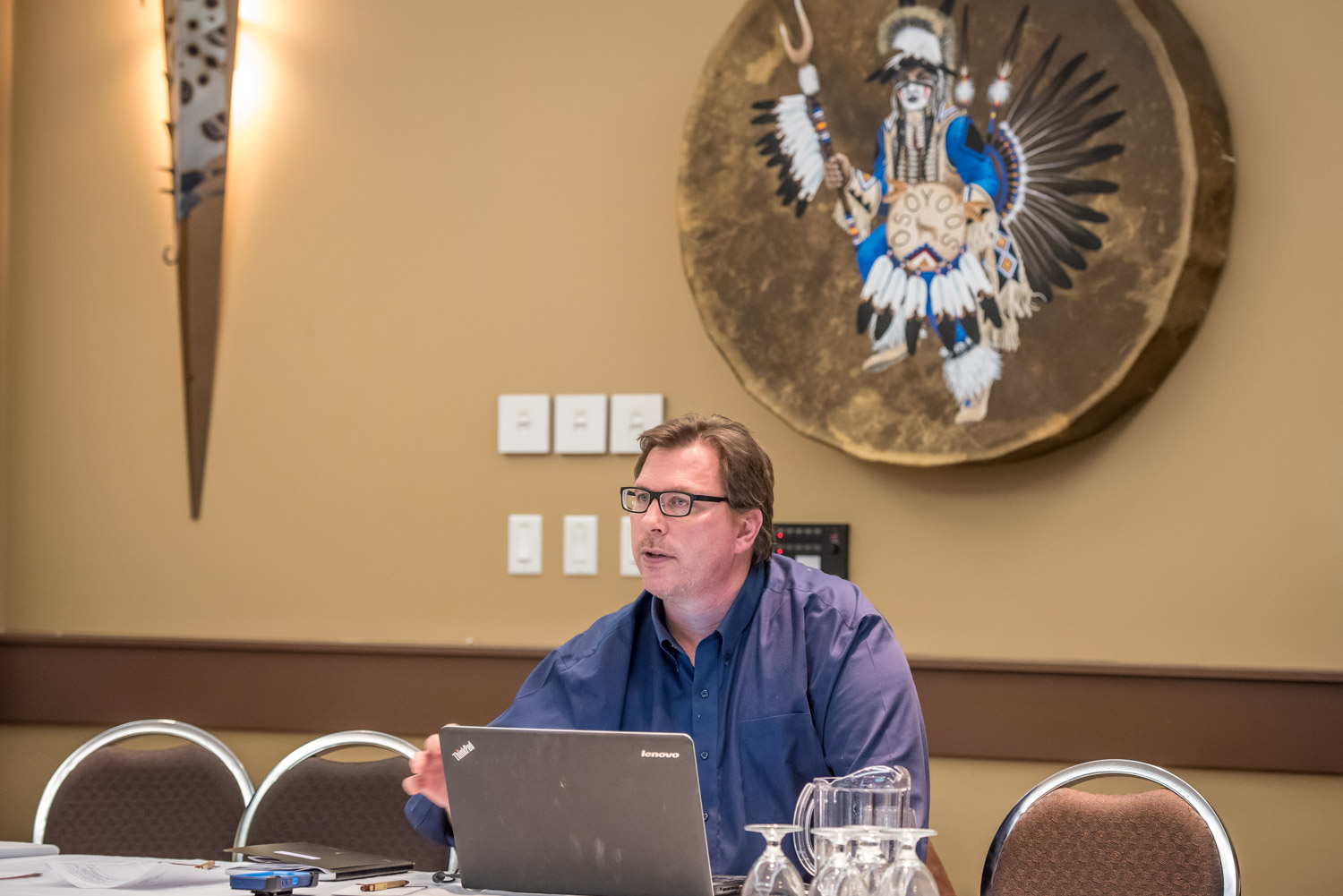
Okanagan Nation Alliance fisheries biologist Richard Bussanich spoke about the status of the Okanagan sockeye salmon fishery in a meeting at Spirt Ridge recently. (Richard McGuire photo)
This year’s sockeye salmon run in Osoyoos Lake could be as big as last year’s and fish are also moving further upriver, suggesting new fisheries could open in future years.
As well, other salmonid species such as Chinook, steelhead and coho have begun returning to the Okanagan.
That’s the word from Richard Bussanich, a fisheries biologist with the Okanagan Nation Alliance (ONA), who provided a salmon update recently at Spirit Ridge Conference Centre.
The projection is for 330,000 Okanagan sockeye to reach the mouth of the Columbia River this year with about 225,000 making it as far as Wells Dam near the confluence of the Okanogan and Columbia rivers in Washington State, Bussanich said.
This would allow the minimum escapement goal of 100,000 fish to be met and allow for food, economic and recreational fishing like last year.
Escapement refers to the number of fish that leave from Osoyoos Lake and go to spawning grounds further upstream. The minimum escapement is required in order to sustain the fishery in future years.
The update on March 25 was provided at the Osoyoos Lake Sockeye Salmon Fisheries Planning Meeting, which informed local stakeholders of the planning for the 2015 sockeye salmon season currently underway by the ONA, ONA Fishery Division, Osoyoos Indian Band (OIB) and the Nk’Mip Desert Cultural Centre.
A pilot program initiated last year allowing volunteer fishers to catch fish for the ONA’s commercial fishery was considered successful. This means it will be expanded this year if more volunteer fishers can be recruited, Bussanich said.
Last year the program began with 10 vessels per day, but this year it could increase to 30. Volunteer fishers are registered and receive an orientation. They turn their catch over to the ONA for sale at Nk’Mip in Osoyoos and Codfathers in Kelowna with partial proceeds being put back into the fishery and fish recovery.
Bussanich also pointed in an interview to several key developments that could affect the fishery in future years:
• The return of salmon to Skaha Lake;
• The arrival in Osoyoos Lake of other salmonid varieties such as Chinook, coho and steelhead;
• Changes to survival rates on the Pacific Ocean as a result of the El Niño effect.
With increasing numbers of sockeye making it past the modified dam at Okanagan Falls and into Skaha Lake, a fishery there could be developed in the future.
Last year an estimated 20,000 to 30,000 sockeye made it into Skaha Lake, Bussanich said.
“We might be pulling the trigger on a food fishery in Skaha Lake, if not this year then in ensuing years so we can take what we’re learning in Osoyoos Lake and apply it,” he said.
In the Osoyoos model, when fish numbers started to increase in 2008, a very small-scale food fishery was introduced, catching fish for consumption and ceremonial purposes by the OIB.
From there, as numbers increased, commercial and recreational fishing was introduced.
The result, said Bussanich, is that fishing on Osoyoos Lake is now done by a very mixed user group with minimal or no disputes.
“I’m very proud of that,” he said. “If we can continue that, it’s a perfect example of a fishery.”
Bussanich hopes this model can be replicated on Skaha and eventually on Okanagan Lake.
An additional benefit of more fish migrating further upstream is that it could extend the fishing season.
Because the fish migrate further, they start earlier, replicating the pattern of their ancestors. Sockeye were coming into Osoyoos Lake starting in July, but last year they were observed starting around June 20, Bussanich said.
With the recent rise in numbers of Chinook from almost nothing to more than 1,000 adults in the last three years, there could be some exploratory fishing of Chinook this year, he said.
“We’d like to propose exploratory fishing this year where we go out and collect samples and learn from that in anticipation of kick starting the Chinook population here,” said Bussanich.
For the first time in more than 75 years, more than 100 coho were estimated to have crossed the Zosel Dam at Oroville last year, signaling a possible return of that fish to the Okanagan.
“I have no idea where they spawned,” said Bussanich. “It’s like looking for a needle in a haystack when you’re talking hundreds of thousands of sockeye, but there’s the beginning stages of coho.”
If positive trends continue, there could be a small Chinook fishery in the next 10 years, he said.
It will probably take more than 25 years until coho start making a significant contribution because the return of that species is still at the beginning stage, he said.
Steelhead, an ocean-going salmonid related to the rainbow trout, are also beginning to return.
“We don’t have a really good grasp of numbers on steelhead, but there’s a couple thousand steelhead that make it into the basin,” said Bussanich. “So we’ve gone from one predominant to now four potential salmonids.”
There could, however, be challenges in coming years as a result of the El Niño effect on the Pacific Ocean.
In the past 10 years, the sockeye have had a good survival rate both at the freshwater stage and on the ocean. For every adult that spawns, between seven and 15 fish return in the three-year migration cycle, Bussanich explained.
If there is a marine shift with changed weather patterns, survival on the ocean could be reduced so that as few as three adults return for every spawning adult.
“This year it shouldn’t be too bad,” Bussanich said. “But next year and the following years we’ll be a little more conservative in our estimates and the way we manage the fishery to ensure that the stock keeps producing and maintaining itself and potentially growing.”
RICHARD McGUIRE
Osoyoos Times

Sockeye salmon attempt to swim up one of the gates at the Zosel Dam in Oroville, Washington. The salmon migrate up the Okanogan River to Osoyoos Lake, where they wait before proceeding up tributaries in the late summer to spawn. (Richard McGuire file photo)