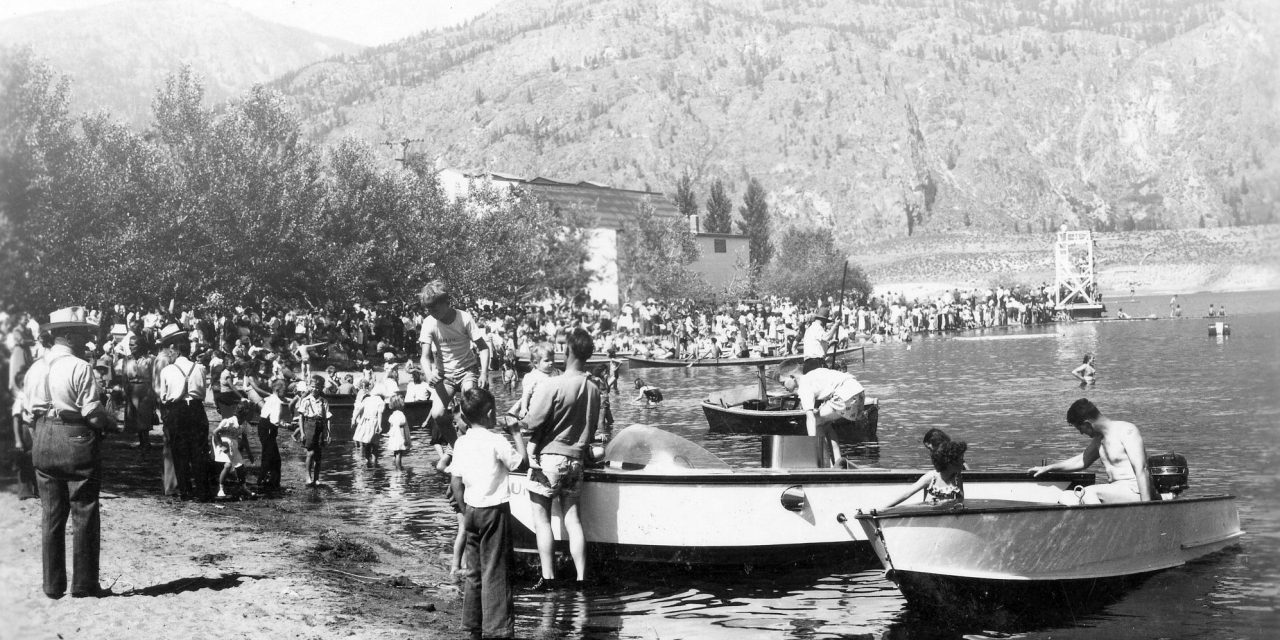

The community beach was crowded with people at the first Cherry Carnival in 1949 featuring aquatic events. (Osoyoos and District Museum and Archives)
When a group of Osoyoos residents got together in the spring of 1949 to plan the community’s first Cherry Carnival, the idea was to hold an aquatic sports day to raise money for park development.
This year marks the 70th time the festival has been held, though its name was changed to Cherry Fiesta after the town adopted a Spanish theme in the 1970s.
The first carnival featured the election of the first Cherry Carnival Queen, Louise Waddell, or Weddell as the name was spelled in the Osoyoos Times.
There was fierce competition between Waddell, representing the Legion, Joan Pelkey, sponsored by the Gyros and Sylvia Oliver, the Kiwanis candidate. Residents could watch the progress of the race on thermometers in the drug store window.
On the clear day of the first carnival on July 1, there was barely a ripple on the waters of Osoyoos Lake as thousands of people gathered at the waterfront to watch power boats, water skiers, war canoe races, diving and log rolling contests, according to the Osoyoos Times the following week.
The parade included a colourful array of bicycles, tricycles, baby carriages, covered wagons and little clowns. The children’s section also featured Girl Guides and Brownies.
A pet parade brought up the rear, including dogs and even a goat.
There were floats representing the service clubs, organizations and businesses of Osoyoos.
One float, on old vehicle that was “highly bedecked” and called “Garbageman’s Dream,” brought laughter from the crowd, said the paper.
“The first annual Osoyoos Cherry Carnival has been acclaimed as the biggest event this district has ever staged,” wrote the Osoyoos Times. “With hard work, and the perfect prevailing weather, the Carnival has gone down in the records as an overwhelming success.”
That view was shared by George J. Fraser in his book, The Story of Osoyoos.
“The celebration proved a decided success from all angles and resulted in a net profit of $1,176.08,” he wrote.
That’s equivalent to nearly $13,000 in today’s money, according to the Bank of Canada inflation calculator.
In the first four years of the carnival, a total profit of $4,423.58 was raised, which would be nearly $50,000 in today’s money.
In the 1952 carnival, a new event was a barbecue. Ted Pendergraft donated a prime beef, stipulating that the meat would be given away at lunch time to anyone who wanted a slice.
“A big crowd lined up for the treat and all pronounced the meat delicious,” wrote Fraser.
Do you have a memory from one of the early carnivals? Were you in the parade?
Please share your memories by contacting Editor Richard McGuire by email at editor@osoyoostimes.com or by phone at 250-495-7225.
RICHARD McGUIRE
Osoyoos Times

In the 1952 Cherry Carnival, a new event was a community barbecue. Ted Pendergraft donated a prime beef, stipulating that the meat would be given away at lunch time to anyone wanting a slice. Pictured here, Pendergraft gives Bea Pendergraft the first bite of beef. A big crowd lined up for the treat, and as historian George J. Fraser wrote, “All pronounced the meat delicious.” (Osoyoos and District Museum and Archives)

Children on tricycles and bicycles and in prams proceed down Main Street during the 1949 Cherry Carnival parade. (Osoyoos and District Museum and Archives)

The Cherry Carnival Royalty are pictured at the 1952 event. From left are Princess Alice Siva, Queen Wilhemina Long and Princess Elaine Long. They are wearing silver bracelets that were gifts to the reigning royalty. (Osoyoos and District Museum and Archives)

The 1952 Cherry Carnival parade makes its way down Main Street. (Osoyoos and District Museum and Archives)