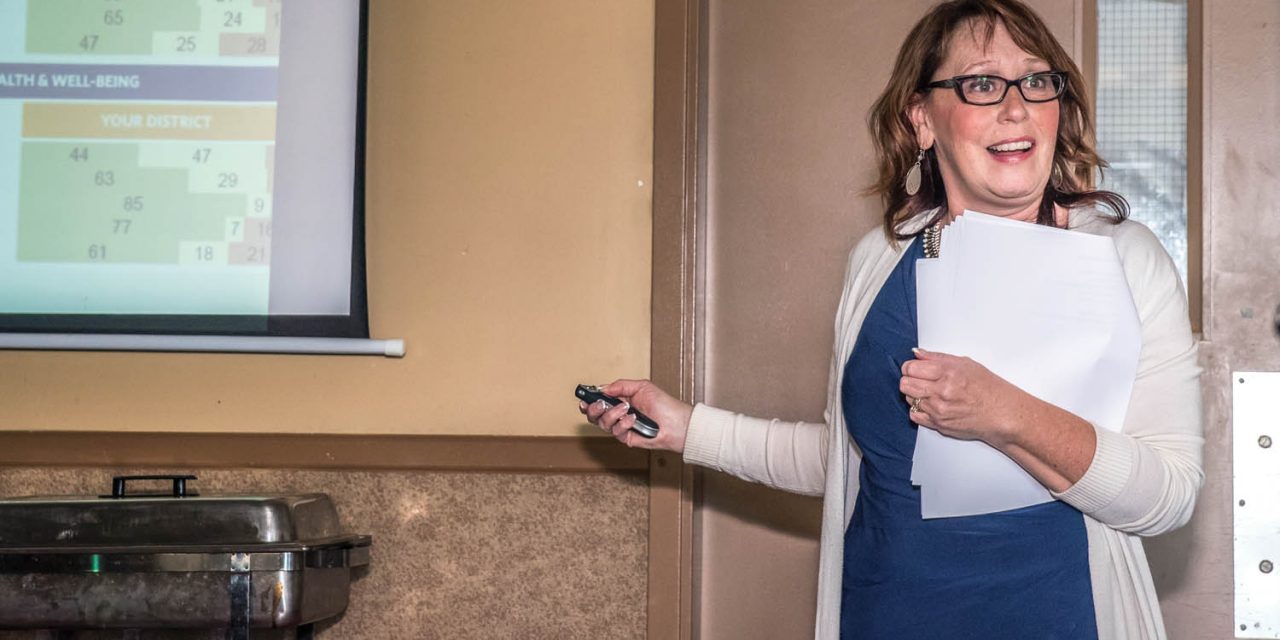
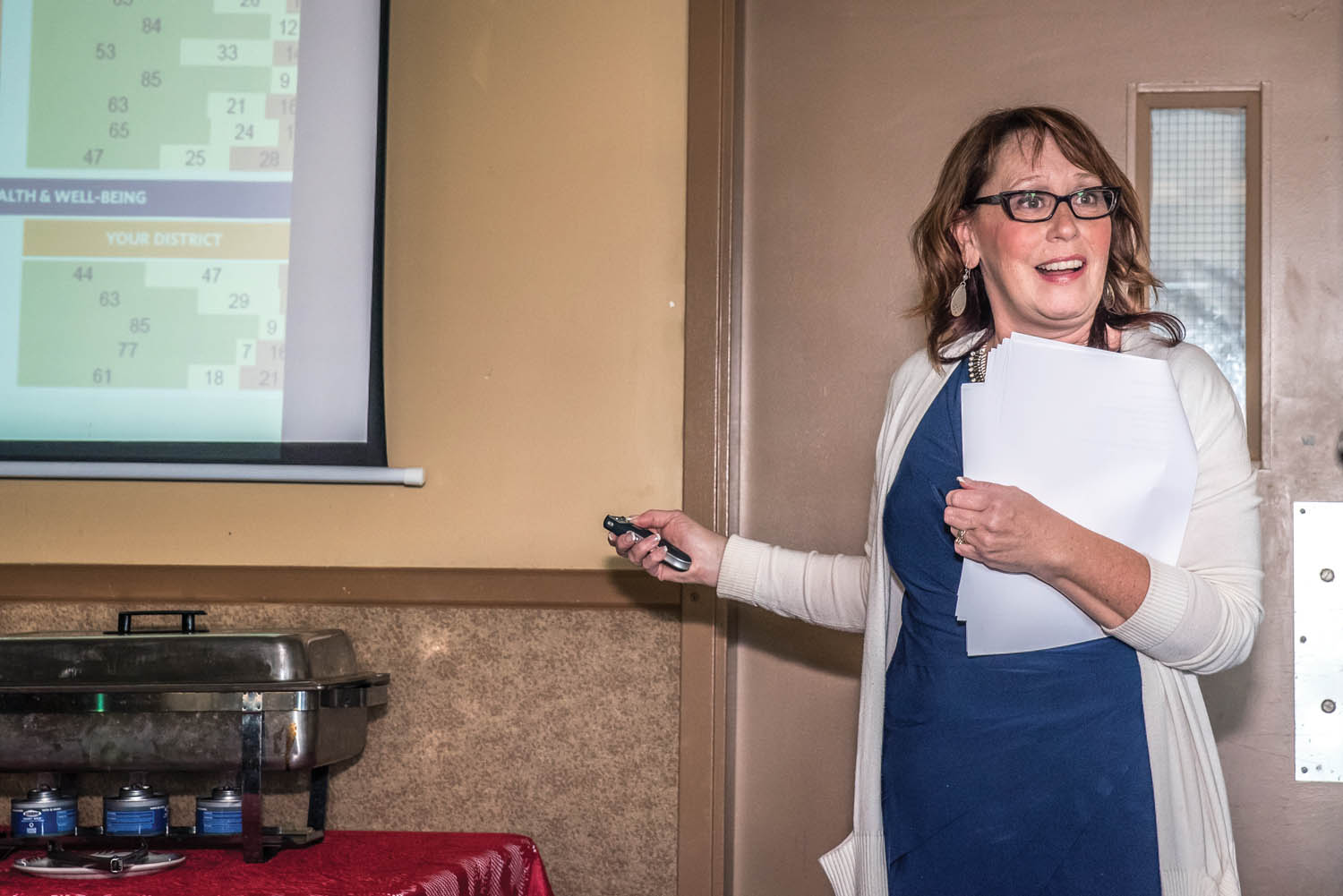
Bev Young, superintendent of School District 53, was guest speaker at the Rotary Club of Osoyoos recently where she presented findings about student wellbeing. Some of the figures relating to teenage girls were especially disturbing. (Richard McGuire photo)
High school aged girls are considerably more troubled and stressed than boys and this is an issue that education officials want the community to be engaged in.
Bev Young, the superintendent for School District 53, raised this and other concerns at a recent speech to the Rotary Club of Osoyoos.
One particularly disturbing statistic is that 21 per cent of high school aged girls have considered suicide and 12 per cent have attempted it, some on more than one occasion. Roughly a fifth have cut or injured themselves in the previous year as a way of dealing with mental health issues without intending to kill themselves.
Among boys, however, eight per cent have considered suicide and four per cent have attempted it.
This figures were brought to light in the 2013 McCreary Adolescent Health Survey, which was one of three reports assessing the health and development of students that Young spoke about. Most of the McCreary figures she cited are from the entire South Okanagan.
She also spoke about the Early Development Indicators (EDI), which assess students coming into Kindergarten and the Middle Years Development Indicators (MDI), which is newer and only Grade 4 results are available from last year.
The EDI results come from assessments made by Kindergarten teachers, but the MDI and McCreary reports come from questionnaires completed by students.
Although many indicators Young cited suggest most children are well adjusted, some of the figures surrounding adolescent girls were the most alarming and provoked discussion among Rotarians.
The figures showed that adolescent girls are more than three times likely than boys to experience depression (19 per cent compared to six per cent) and are nearly four times as likely to experience anxiety disorder or panic attacks (11 per cent compared to three per cent for boys).
As many as 16 per cent of girls said they had experienced “extreme stress” in the previous month, compared to only five per cent of boys.
In an interview following her talk, Young said she didn’t want to try to interpret these results, but she did point to some links uncovered in the McCreary tests.
A major link is that students reporting mental health problems often were the same students reporting they are getting insufficient sleep.
One graph, said Young, shows that adolescents need between 8.5 and 9.2 hours of sleep each night, but only a little over half are getting that.
“I can’t comment on why they’re not getting it and I don’t want to infer,” she said. “What the survey did show is that older students slept less than younger ones and when they do go to bed, 61 per cent reported using their phones after they went to bed to phone or chat and 57 per cent search the internet.”
Young acknowledged that it isn’t easy for parents to control teenagers’ sleep and use of social media, but she said bringing this to the attention of parents may help to highlight the importance of good nutrition, good sleep, a stable family and supervision at home.
Body image is another factor affecting girls, Young noted. Among girls, 24 per cent who were of a healthy weight thought they were overweight. More than half of healthy weight females were trying to lose weight.
Marieze Tarr, school board chair, is also a Rotarian and she introduced Young at the meeting and several times commented on points the superintendent made.
Tarr also was disturbed by some of the findings of the McCreary report pertaining to adolescent girls. She also noted the connections between lack of sleep and body image and how these affect mental health.
“A lot of our girls are not sleeping enough and that makes them anxious and causes a lot of mental health issues,” said Tarr. “It’s hard to speculate exactly what it is, but if you think of society, girls are supposed to be perfect and their bodies are supposed to be perfect. It may be because of the pressures that are on girls. That’s why I think that if we can have some progress in the schools to teach kids to be more confident and accepting of themselves and who they are, that might make a difference.”
Tarr noted that the internet and social media can mean adolescents experience bullying around the clock.
“In the past when you and I were in school, when we went home that was our safe place,” said Tarr. “Nobody was going to be able to bully us. It wasn’t following us home. Now, with the internet, they are never away from bullying. If they feel threatened, if they have some bad relationships with other kids, it’s always with them because it’s as far as their cell phone, which is in their pocket.”
Tarr said the school board wants to raise awareness of these issues in the broader community.
“We want people to talk about it,” she said. “The more people talk about something, the greater the chances of finding a solution.”
Another finding of the McCreary report was that 19 per cent of females and five per cent of males don’t access mental health services when they need them. The main reasons are that they don’t want their parents to know and they think or hope the problems will go away.
Young also spoke about declining school enrolments, noting that in Osoyoos, school enrolment has dropped from about 700 full-time equivalent students in 2005 to about 565 in 2014. The biggest drop recently has been at Osoyoos Secondary School. Numbers at Osoyoos Elementary School fell sharply between 2005 and 2006, but have been more stable since then.
This is a concern because the school district receives roughly $7,000 in funding from the province for every student enrolled.
Young noted that larger classes are graduating than are coming up through elementary school.
People are leaving for economic reasons and fewer families are staying in the district, she said.
“We’re noticing each year that families are moving for employment,” Young said, adding that some stay until the students have finished. “The majority of families are moving for work. Many moved to Alberta a few years ago. In Osoyoos in particular, we seem to have Alberta families coming and part way through the year, they’re not making a go of it and they go back.”
RICHARD McGUIRE
Osoyoos Times