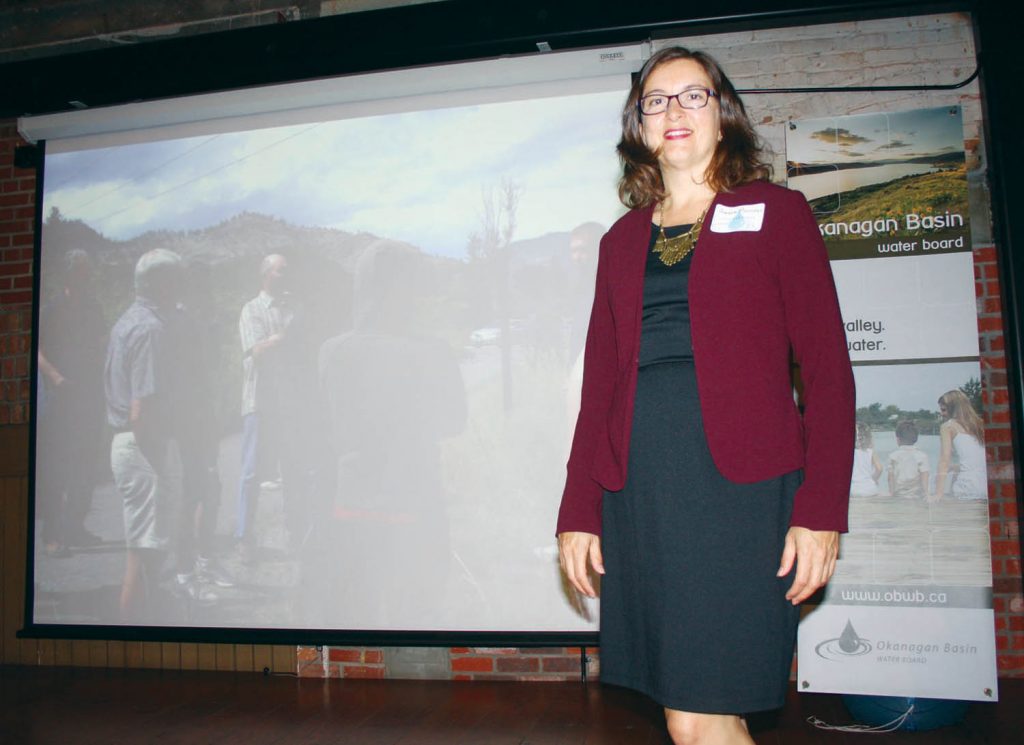
Dr. Amber Manfree, a water researcher at the University of California, Davis, was the keynote speaker at the Okanagan Basin Water Board’s annual general meeting held last Friday at the Laurel Packinghouse in downtown Kelowna. Manfree talked about what water management experts in Northern California have done to deal with a prolonged drought that has now reached into its fifth consecutive year. (Keith Lacey photo)
Residents and farmers in Northern California have managed to survive one of the worst extended droughts in that state’s history, but only because proper infrastructure is in place and government leaders have allowed experts like herself to formulate long-term plans to deal with all issues related to prolonged drought.
Dr. Amber Manfree, a researcher at the Center for Watershed Sciences at the University of California, Davis, was the keynote speaker at this year’s Okanagan Basin Water Board (OBWB) annual general meeting held last Friday at the Laurel Packinghouse in downtown Kelowna.
Manfree spoke for an hour about the many lessons learned in water and environmental management from the front lines of California’s prolonged drought, which has now extended to five years and counting.
The Okanagan Valley is fortunate to have an agency like the OBWB that is working on a scale that allows flexibility and organizational structure that encourages strong dialogue on water issues with government, farmers and residents, said Manfree.
While change is sometimes difficult, tough choices like choosing to move out of a floodplain or not develop in fire prone areas or changing crops to suit the water available in an area, there are many examples of people acknowledging the need to do things differently in areas like the Okanagan Valley that are often exposed to drought, she said.
In the wine growing region of the Napa Valley in California, wine growers removed 20 acres of vines worth millions of dollars to help re-establish wetlands and aquatic function in the area, understanding that a healthy ecosystem benefits everyone, she said.
The entire State of California has massively altered water systems and this has caused a cascade of problems, while global warming is also affecting weather patterns resulting in the longest prolonged drought in Northern California in 40 years, said Manfree.
“We’ve been avoiding looking at things, the impacts of our (human) actions,” said Manfree. “We must reorganize how we approach problem solving. There’s going to be unexpected events, but the level of damage they cause is something we can control.”
The reality in Northern California is that 80 per cent of people live in the southern part of the region, while 80 per cent of groundwater is located in the northern part, she said.
Thankfully, the government has supported spending hundreds of millions of dollars on long-term infrastructure, including dams, tunnels, reservoirs and aquaducts, to transport water miles to the most populous regions of Northern California, she said.
“That’s the reason we have all of this infrastructure happening,” she said. “We can move water 700 miles a day. It’s an incredible system.”
Researchers like her provide information to government to deal with issues like removing salt, heavy metals, fertilizers and pesticides from groundwater so residents can have access to quality drinking water during prolonged periods of drought, she said.
“Basically, we have issues all over our water system,” she said. “When you make a lot of changes to water systems, it has tremendous impact.”
California has a series of 1,400 dams spread across the state and most of those dams are impassable to the majority of fish species, which has resulted in action to establish spawning areas for these species on waterways not impacted by dams, she said.
There is no doubt climate change and global warming has a direct role in the prolonged drought that has enveloped all of Northern California over the past five years, she said.
There has been more rain in 2016 than the previous four years, “but one year of average rainfall doesn’t make up for the deficiencies” in the water system caused by four years of virtually no precipitation, she said.
State legislators in California have allowed experts to come up with solutions to ensure safe drinking water and groundwater for agricultural purposes will be maintained despite the drought and there have been positive results, she said.
“It takes a lot for Californians to do something about groundwater,” she said. “The state … basically told us (regional water experts) to do a good job or they would do it for us.
“We’re finally working together to come up with regional solutions that are working.’
The fact less water has been needed for agricultural purposes than it has in many decades has also helped during the prolonged drought, said Manfree.
“The economy depends less on water abundance,” she said. “It has definitely helped.”
There were worse prolonged droughts in Northern California in the 1930s and 1980s and the residents managed to survive without any serious water shortages, she said.
The key to solid water management practices during periods of prolonged drought is recognizing weaknesses in systems and encouraging preparedness when prolonged drought does happen, she said.
Places like Northern California and the Okanagan Valley have been battling the repercussions of prolonged drought for hundreds of years and it’s really important to look back in time and learn lessons to ensure water systems are protected when drought returns, she said.
“You have to see the bigger picture and incorporate what you’re learned in your plans,” she said. “Making room for processes can make extreme environmental events less frequent and less damaging.”
Dr. Anna Warwick Sears, the executive director of the OBWB, also gave her annual state of address over what the organization has accomplished over the past 12 months.
She also congratulated the success of the Okanagan Water Stewardship Committee, which is celebrating its 10th anniversary in 2016.
KEITH LACEY
Osoyoos Times