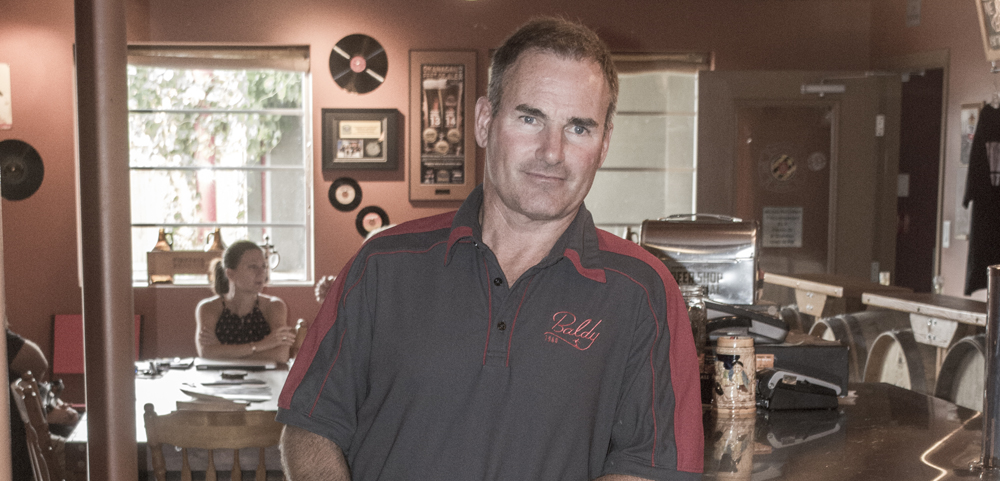

‘Snowy Joey’ O’Brien met with local media at the Firehall Brewery recently to discuss the new business plan for Mount Baldy. Photo by Dan Walton
A phoenix is rising out of the ashes at Mount Baldy.
The ski resort’s new managing director ‘Snowy Joey’ O’Brien doesn’t have any doubts about his plan.
“This is my third ski resort resurrection, so hopefully I continue to have a good batting streak,” he said last week during a roundtable discussion with local media.
After going bankrupt at the end of the 2012-2013 season, the ski area struggled to find a new buyer, and since then has only been in operation for a portion of the 2014-2015 season.
The days of sporadic operations are over. As long as weather co-operates, the new team at Baldy will be opening the hill to the public on Dec. 1 and then continue operations for seven days a week until the end of March. Afterwards, Baldy will explore staying open daily from the start of April until the Easter long weekend, but can only guarantee weekends at this point.
After the resort was taken out of receivership over the summer, O’Brien was hired to help restructure the business for what was supposed to be a few months, though circumstances led him to continue with the ski resort permanently as the managing director.
For skiers and boarders who have ridden Baldy in the past, O’Brien said the biggest differences they’ll notice since its revival will be less brush on the runs, better housekeeping and a “standardized” level of service.
“We can’t affect the snow that falls, but in terms of all the other pieces of the puzzle, we’re going to standardize it; make it consistent so you’ll begin to be able to go, ‘I know it’s going to be good.’”
As an example of the consistency he plans to deliver, O’Brien said during rapid temperature shifts in the late winter, it’s difficult to prevent snow surfaces from becoming unpleasantly stiff when a sunny day is followed by a flash freeze.
“Unless you have the experience to know how to deal with it,” he said.
And compared to most ski resorts, the snow endures much gentler lifecycle at Baldy.
“We have the highest base elevation in Canada, therefore usually the driest, softest snow. Locals tell me almost universally that we sit above the fog belt that sometimes sits in the valley bottom; we’re on top of it and get to look down on the clouds.”
O’Brien said volume measurements of snow at the resort have varied, but there’s “a heck of a lot.” Because there’s a low ratio of traffic versus terrain, the snow faces less abrasion.
“Our snow retains its soft textures longer than traditional resorts that have greater capacity; more people traffic wears out the snow faster.”
While he’s optimistic about turning the ski resort around, there’s still a heavy load of work that needs to be done.
“When we arrived we knew this,” he said. “The resort has essentially been operating maintenance free for almost a decade. The lifts were meeting minimum code … but the mountain itself had two-metre high bushes everywhere, and the buildings all look like they were abandoned. The equipment – there wasn’t a wrench to be found – somebody helped themselves to all of that stuff.”
In the midst of a months-long inventory-taking process, his team is deciding which assets are salvageable and which ones need to be replaced. The work that’s underway was prescribed by a two-year master plan, which was a requirement for the property to be taken out of receivership.
O’Brien shared a brief post mortem of why Baldy struggled through the first half of the decade. The previous vision, he said, came from a master plan that focused on real estate development without much consideration for the customer experience.
“Well that no longer works. In fact it never really worked in many places,” he said. “Many small ski resorts that are not run by professionals don’t know how to make it work.”
He says there are two components that need to be balanced when operating a ski hill: skilled craftsmen who know how to make sure guests enjoy their experience, and a solid business plan that turns a profit.
“Most people aren’t good at both.”
He said the success of a ski resorts doesn’t depend as much on high volumes of traffic to come through on during peak periods and long weekends – rather it’s about maintaining a healthy ridership through the slow times.
As initiatives to get skiers on the hill outside of peak hours, the team at Baldy will be reaching out to local schools and offering weekly programming.
Also, he said Baldy’s shorter lift lines makes it an attractive venue for competitive skiers. At resort’s that require a lengthy chairlift ride, athlete’s bodies begin to relax and lose muscle memory, and residual fatigue will often set in before the proper volume of training has been attained.
“I’m standing there at the t-bar,” he recalled. “I go down one particular slope we just cleaned and I get thrilled, because it’s the perfect length for a slalom training hill, and it’s three minutes up and we have the capacity on this slope for about 60 athletes.”
O’Brien mentioned Baldy’s value as a training facility to his friends in the industry and said immediately there was strong interest. The average board of directors doesn’t have those connections, he said.
“That’s just one piece. Imagine that times a thousand.”
In the first five weeks after season passes went on sale, 1,300 were sold out of their inventory of 5,000.
Currently, passes cost between $149 and $249, and O’Brien said the pricing model is adapting to a shift in demographics. He said the average baby boomer will take their passes to the hill 12.9 times each season, while the average millennial only uses a pass 5.6 times per year.
“The old model of pricing season passes at today’s world price is no longer appropriate.”
Baldy will be operating with three or four lifts. That depends on the functionality of the t-bar, which hasn’t run in six-to-seven years.
“We have to look at budget to see if it’ll happen.”
The target for the first season is to draw 42,000 guests. Next season, the team hopes to bring in 56,000, which is the average attendance for small ski resorts in the region.
But to O’Biren, quality is more important than quantity.
“Our primary focus in the beginning is on guest satisfaction.”
On a scale of one-to-10, O’Brien said it’s crucial that guests feel the Baldy experience to be at least an eight.
“When guests rank it eight-out-of10, their chance of referral is 88 per cent… compared to a score of seven-out-of-10 there’s only 21 per cent chance they’re going to recommend it.”
O’Brien said there’s also vast opportunity for summer programming that the team is exploring.
Although O’Brien plans on reopening the resort on Dec. 1, he said there needs to be 75 centimetres of snow to fall beforehand.
“If we get 75 centimetres of snow by Dec. 1 we’ll be open, but we may have to wait until we have that volume.”
His hard work thankfully wasn’t undone by nature last weekend, as there could have been a major hiccup in the resort’s resurrection when Mount Baldy was the epicentre of a 4.0 magnitude earthquake on Sept. 10.
On Baldy’s blog, they said seismologists don’t expect any damage; some staffers inspected the lifts and their foundations as a precaution and found no damage; further inspection could be due when the resort completes its maintenance, though that’s at the discretion of the inspector; and there were no serious concerns, “just lots to talk about on the mountain today.”
By Dan Walton