By Don Urquhart, Times Chronicle
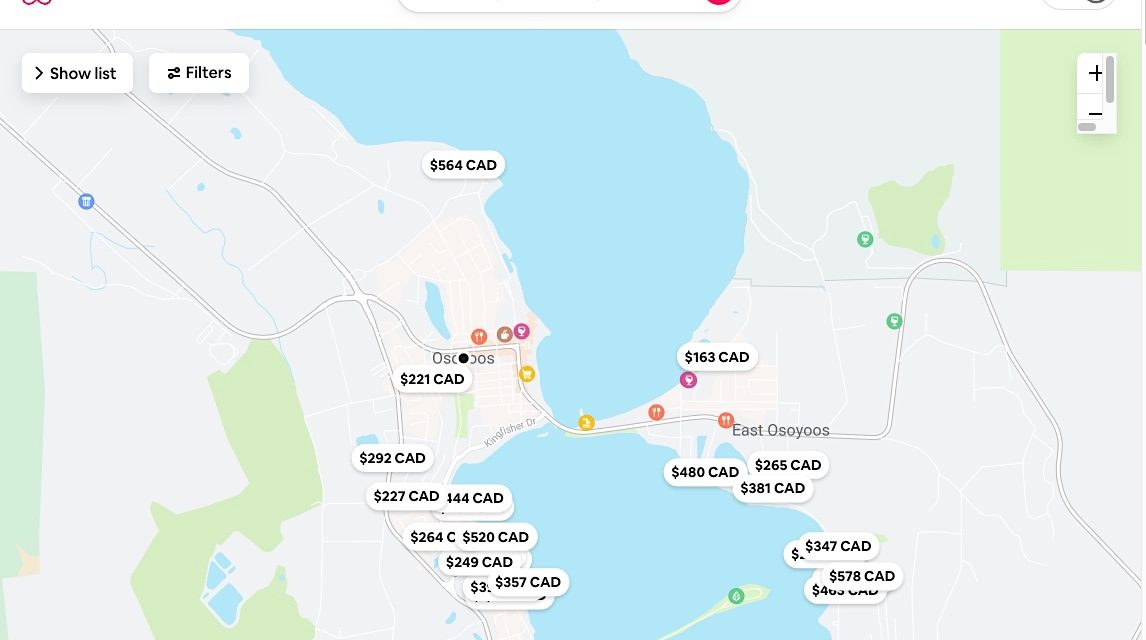
For Osoyoos Mayoral candidate Dustin Sikora homeowners who break town bylaws prohibiting short-term rentals like Airbnbs are harming the town and its ability to have a stable supply of labour.
“The only ones who are rewarded are those who break the bylaw and this is an injustice and it’s working against the good of this town. We rely on a healthy and stable labour class and they need stable housing whether that’s rented or owned,” Sikora said at the Times Chronicle All Candidates Town Hall Forum on Monday.
He noted that the pressure on housing prices is intensified because “people are buying houses and not intending to live in them or rent them at reasonable prices to year-round workers.” These people buy them to rent out for “boutique money” in the summers, he said.
“This is solved by bylaws that we already have on the books,” Sikora said, adding it’s about leadership. “How do you have a bylaw on the books if you don’t enforce it?” he asked.
Sikora says the town is making the problem worse “when we allow people to disregard the law, while we turn a cheek and let them get away with making profits and driving up prices further and continue to keep property values out of reach for the labour force.”
He notes this “catch 22” can be solved by having “strong leadership that enforces the bylaws, or by strong leadership that takes a stand and takes the bylaws off the books if they’re not going to be enforced.”.
“The bottom line is the communication needs to be clear what we’re doing in this community and right now it’s mixed signals at best,” he said.
Council candidate Sy Murseli is unequivocal on the issue: “the laws have to change.” Key concerns for him are safety and noise. “With Airbnb’s we don’t know what kind of people these are… we don’t know let’s face it. And the neighbours of course they’re upset about the parties, so the laws have to change.”
For incumbent councillor Myers Bennett, part of the problem is that many people are buying into the market but they are not renting long-term because of the Residential Tenancy Act.
He claims that, “as soon as you get a renter in there it’s gonna take you a year or two or three years to get them out of there. Meanwhile they wreck your place. Short term rentals you don’t have a problem,” Bennett added.
While acknowledging that short term rentals like Airbnb take rental stock out of the local market, he underscored it’s a B.C.-wide problem and one that bylaws appear unable to solve.
Agreeing that it is more of a provincial issue, and a national issue as well, Cheong suggested looking at other models such as what Hawaii and Toronto are doing for instance. While these are bigger areas with far greater resources he says they have successfully subpoenaed Airbnb for booking information with which owners can be held accountable.
But the bigger issue for Cheong is safety. “How do we know if the suites are up to code, are they fire safe?” he asks.
“The last thing we need is to have a family of tourists and God forbid a fire breaks out because this Airbnb unit was not inspected. And from there I think we need to be a bit more diligent with amending the bylaw so it is a little more realistic, or look at other solutions.”
King noted it’s easy to comment on the need for enforcement and new bylaws but the solution is more difficult partly because of the problem enforcing. He also underscored that it’s easy enough to identify the Airbnbs by simply going to the company’s website.
“I know another Town that actually hired a student that identifies all the Airbnb’s in the town then you’re not losing the bylaw officer’s time and then they can go out and do some enforcement,” he said.
He also added that Osoyoos is in the process of looking at a new policy around B&B’s including AirBnbs to write a new bylaw “that will actually give some teeth.”
“It’s very clear we need a bylaw that has some teeth to it and with teeth comes enforcement,” agrees Council candidate Zach Poturica. “Sending letters out isn’t enforcement and it certainly isn’t fixing the issue.”
He added that people move here because they want to live and remain here but this lack of long term rental stock, “we know it’s chasing away young families, it’s chasing away longtime residents and they’re frustrated they’ve got no place to go, they need to be out they need to find a place.”
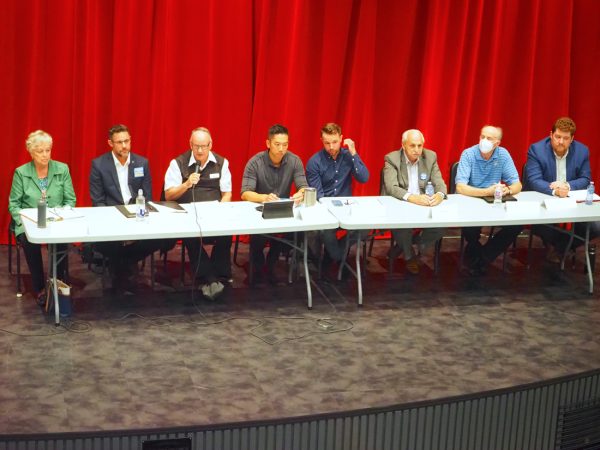
From left to right: Sue McKortoff, Dustin Sikora, Myers Bennett, Dr. Johnny Cheong, Wes Greve, Jim King, Sy Murseli, and Zach Poturica. Victor Ady photo
Poturica notes that part of the opportunity lies in the fact other municipalities have grappled with this situation already and have put into place bylaws, registration processes and safety inspections.
There is an opportunity for us to have some regulation within the byelaw to address the situation such as Johnny [Cheong] brought up. We don’t want to discover there’s loss of life or property because we had a unit that was unsafe and used for profit,” he added.
“We know there’s issues and we know there’s solutions and with the right approach and the right players in the game we know there’s an opportunity for us to move forward and develop the housing to service the needs of the community,” Poturica added.
McKortoff noted that delegates to the UBCM conference spent a great deal of time discussing the problem of short term rentals as the regional district has. “One of the things that you can do is suggest – you can’t force – for people to get a license.”
“And when you get a license to operate a B&B or Airbnb that means that Interior Health will check to make sure it’s up to code on washrooms and sewer and that type of thing and you can also get the fire department to come and check.”
All of this takes place before a license to operate is given. “That would be the ideal because our bylaw officer spent a great deal of time with complaints about Airbnb’s and so we do need to find a different way to make sure they are not spending all the time dealing with that when it’s very hard to monitor,” she added.
Sikora feels the issue warrants more public feedback to determine whether and how much short term rental will be “tolerated in this community”.
“We’ve gotta figure out what the balance is, how much the community wants to tolerate, is there zoning involved, do we wanna do it in one area not another? So these are all factors we have to figure out.”
“Once we figure out the vision and direction then we execute it,” he said.