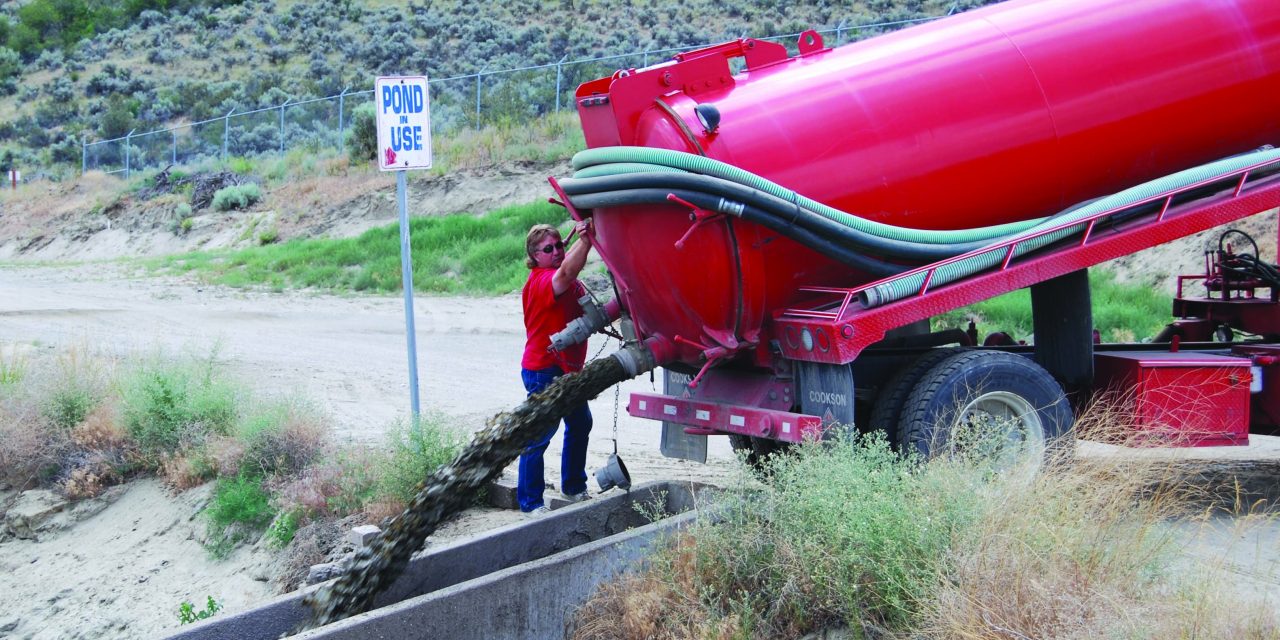
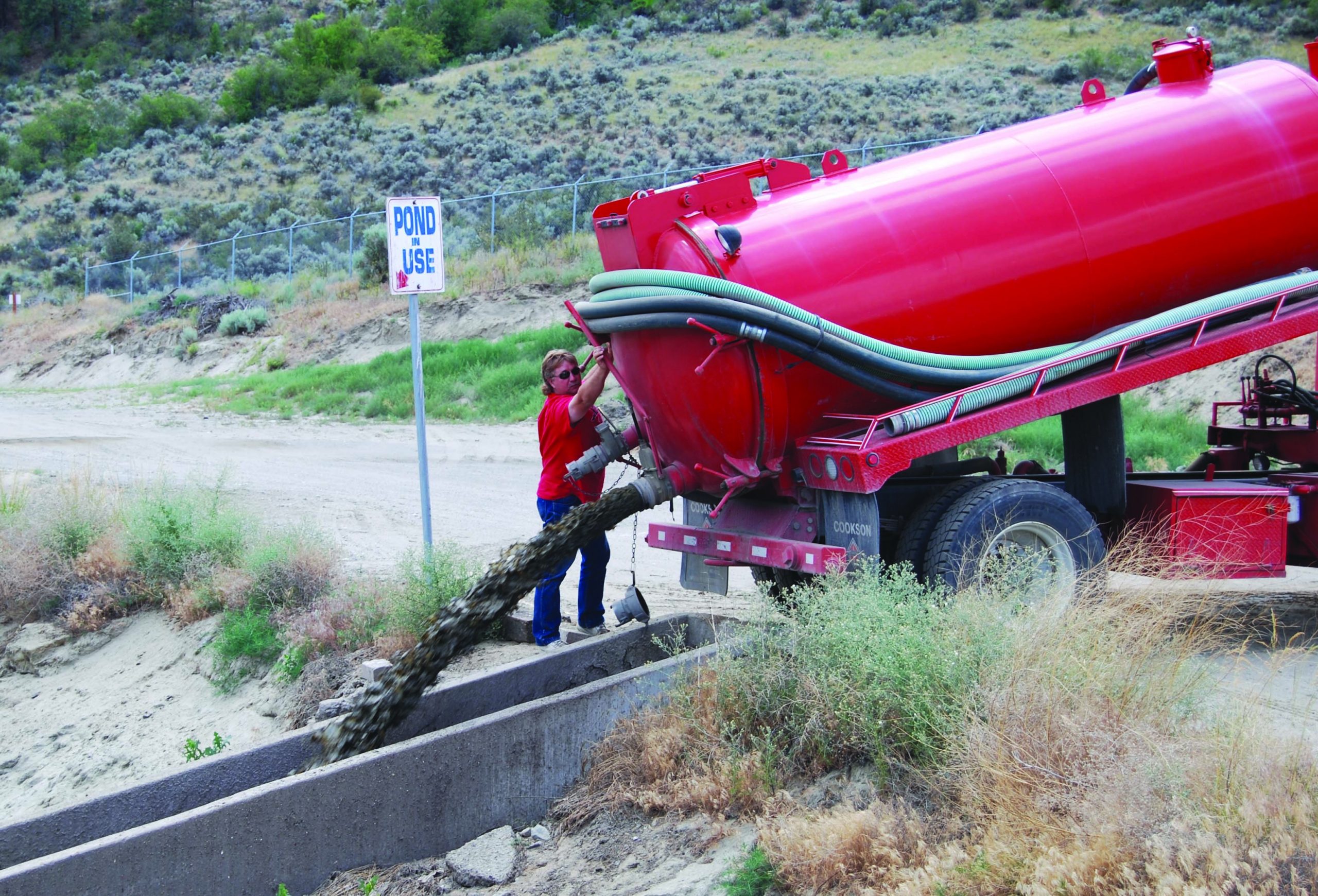
Dennis Bucher, from Osoyoos’s Darlorn Septic Service, pulls the lever on the back of the company’s truck to release the waste into a septic pond at the Osoyoos Landfill. As of September, the landfill will only accept liquid waste from within town boundaries. Photo by Laurena Weninger - Click on picture for larger image
OSOYOOS TIMES-July 1, 2009
By Laurena Weninger – Osoyoos Times
If you live in the Osoyoos area, it’s soon going to be a lot more expensive to have your septic tank pumped.
“We do 1,000 septic tanks a year,” said John Mills, owner of Osoyoos’s Darlorn Septic Service.
Right now, it costs about $360 to have your septic tank pumped out and hauled away.
That’s already a jump from the 2008 rate.
As of February this year, the Town upped the fee for the dumping of liquid waste at the Osoyoos Landfill from $10 per tonne to $33.50 per tonne.
“It went up 335 per cent, overnight,” Mills said.
That cost has been directly reflected in the bills he gives his customers.
Last year, it only cost $260 for the pumping service.
But if those were the only changes on the horizon, it might be an easier pill to swallow.
As of September, the Town will only allow liquid waste from within town boundaries to be dumped at the landfill.
That seems absurd to Darlorn truck operator Dennis Bucher.
“The Town of Osoyoos sent us that map,” he said, pointing to a giant map of Osoyoos. “Anything in that black line, we are able to pump (and dispose of at the landfill). But there’s no septic within that black line.”
Osoyoos finance director Jim Zakall said the change in the area where liquid waste is accepted from is primarily because the smell that comes off the landfill’s septic ponds – which are right across the road from the Osoyoos Desert Centre – is offensive to visitors.
This fall, any company that comes to dump at the landfill will have to prove that the waste came from within town limits by means of a signed document from the property owner.
Delivery must also be within the landfill’s hours of operation so it can be monitored.
It is a change that will affect more than just home owners.
All of the wineries in the South Okanagan are on septic and they all use the portable toilets rented out by companies like Darlorn for their orchard and vineyard workers.
Those toilets are also used at construction sites, sports events and concerts.
Darlorn also services campsites and RV parks.
Many homes along Osoyoos Lake are on septic and newer ones have holding tanks that are pumped regularly.
None of these are within the town limits.
Mills said this is going to have a huge impact.
He doesn’t see how he can feasibly continue to provide the portable-toilet service and is considering pulling the 150 he has distributed in the area, including the one that sits behind the scale at the Osoyoos Landfill.
“There isn’t a place to dump from here to Penticton, Grand Forks to Princeton,” he said.
The closest possibility for dumping is the Penticton landfill, and they aren’t even accepting the Osoyoos waste – yet.
Andrew Reeder, engineering services manager for the Regional District Okanagan-Similkameen (RDOS), confirmed that for now, Penticton won’t take liquid waste from the area, but the RDOS is working to remedy that.
“We are seeking permission to allow wastes to go up to the Penticton facility,” he said.
The RDOS has also applied for grants that will allow it to continue to look at other options.
Mills is glad to hear that, because he doesn’t consider trucking waste to Penticton an option.
His truck only holds the equivalent of two septic tanks and that means customers are going to bear an even heavier load when it comes to cost – as much as $600 or $700 to have their waste taken away.
Coun. Michael Ryan said he knows this will be a tough change, but it isn’t a Town matter.
“When you are talking vineyard owners, you aren’t talking Osoyoos proper,” he said, suggesting this is an RDOS rural Area A matter. “I think they need to take some leadership.”
Area A Director Mark Pendergraft said people are just going to have to pay more for now.
He said the RDOS plans to study the situation and find other options, including outfitting the Oliver Landfill – or a new site entirely – to accept the waste.
But that might not be easy.
“It’s going to be difficult to locate it because of the issue of smell,” Pendergraft said. “There are very few possibilities.”
[email protected]