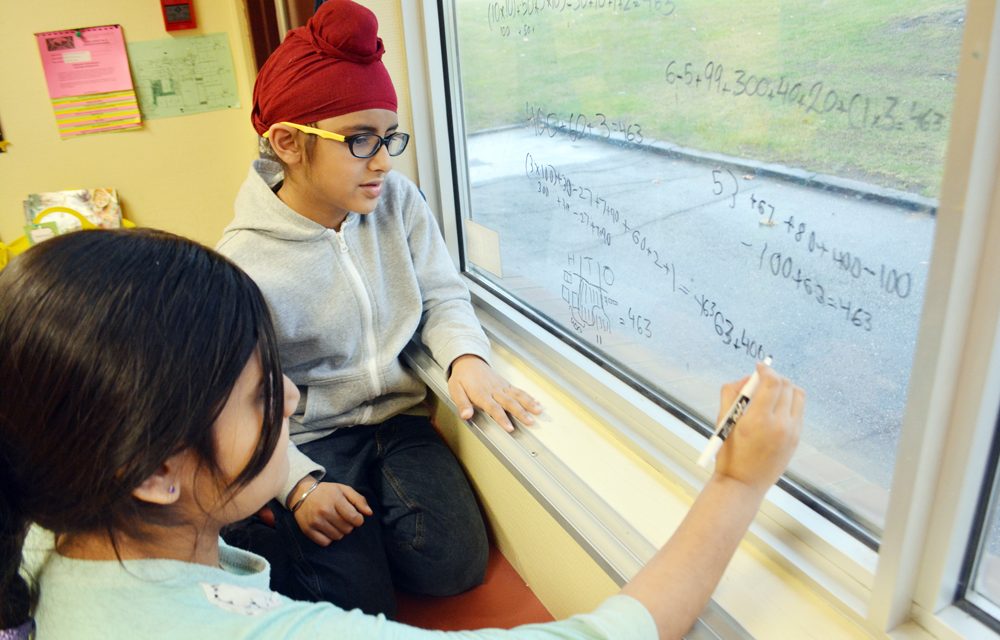

The revised curriculum is shifting away from memorization and focusing more on critical thinking and problem solving. File photo
To catch up with the age of information, public schools across the province have initiated a revised curriculum.
“Students now have limitless access to information and need the skills to navigate, interpret, analyze and apply the information they need in their work and personal lives,” said School District 53 superintendent Bev Young.
“(This year’s) curriculum is not brand new. There is much that is the same as far as rigorous learning standards and the foundation of the revised curriculum remains literacy and numeracy.”
The curriculum was revised as a strategy to improve learning outcomes. It aims to focus clearer on the essential elements of learning and reduce the monotonous elements. Teachers and students now have more flexibility to customize the learning experience depending on individual strengths and needs. It will also help students conceptualize their big ideas, helping them learn how to balance the foundational skills that are important for success in school and life.
The reduction of “prescriptiveness” in the new curriculum is being welcomed by teachers and school staff, Young said, as the previous expectations pressured teachers with a “daunting amount of content and teaching to a final test.”
To address the world’s ever-increasing interconnectivity, the revised curriculum is drifting away from memorization, now with greater emphasis on the development of critical thinking, collaboration and problem solving skills – which are referred to as core competencies.
“The inclusion of these core competencies and a focus on the big ideas affects all courses,” she said. “The degree to which learning outcomes were combined, moved, or reduced may vary.”
The end goal is to better prepare students for life after school, and that intertwines with greater academic outcomes.
“We hope this means a higher graduation rate, increased relevance for students, and students who are more skilled and equipped to contribute and be successful in our complex world.”
The revised curriculum became mandatory at the start of the 2016-2017 school year for students in kindergarten to Grade 9. Teachers of Grades 10, 11 and 12 have the option to use this year as a pilot run at the revised curriculum before it becomes mandatory next year. In a parallel fashion, some teachers experimented with the revised curriculum for kindergarten to Grade 9 before it became mandatory.
Young said teachers who tried out the curriculum last year collaborated to analyze changes and investigate resources, and they identified the instruction of core competencies and the assessment of student success as areas of the curriculum that can still improve.
“While change is always stressful, much of the feedback I have heard is that the changes are welcomed,” Young said. “Particularly the changes to reduce the learning outcomes to make room for project and place based learning, to provide more time working with students to apply the content and skills they are learning. The reduction of provincial exams was also welcomed.”
When asked why it took until 2016 for the Ministry of Education to adopt such basic ideas, Young said it requires years of planning to revise a curriculum.
“Change is often slow … a system change including curriculum, assessment, reporting, assessments and exams, legislation, ministerial orders, university requirements takes time and perseverance.”
Young believes the most valuable components of the previous curriculum carried over, such as rigorous standards and a foundational understanding of literacy and numeracy.
“It is an improvement as we are not preparing our students for the same world my grandparents, my parents, or myself went to school to prepare for.”
By Dan Walton