By James Rose, Special to the Times Chronicle
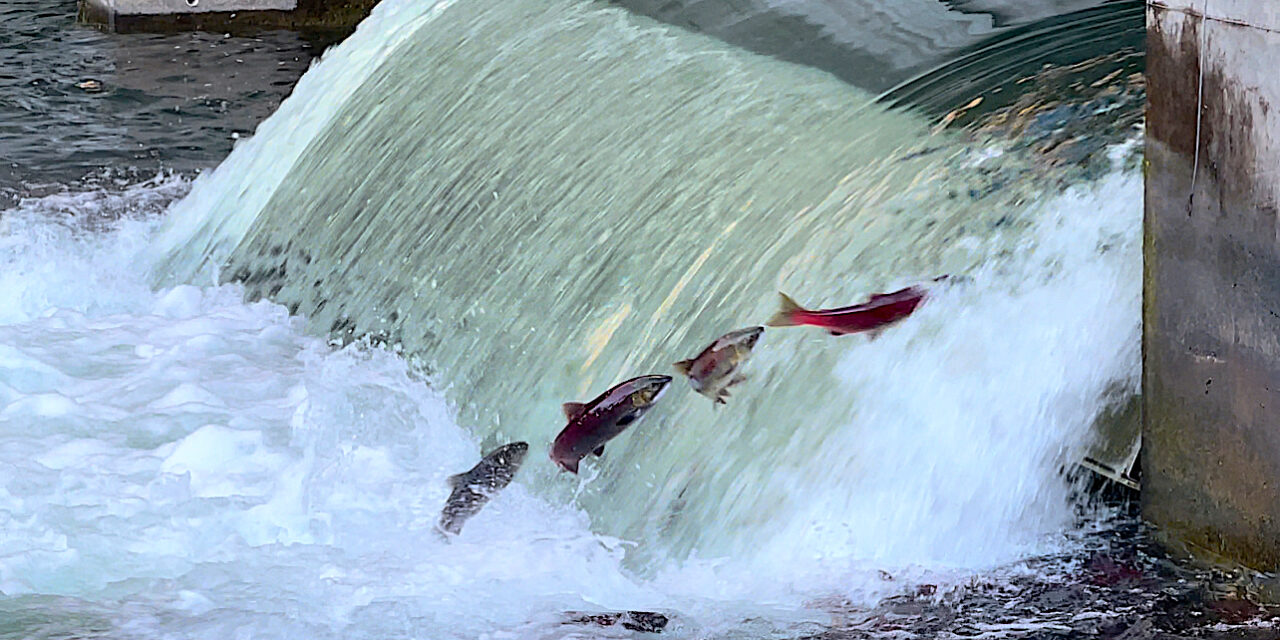
Encouraging efforts are underway to improve the Okanagan River system’s beleaguered salmon population, including the opening August 18 of the Okanagan Lake Dam Fish Passage.
On July 31, 14 adult summer chinook salmon were transferred from the Colville Tribes’ Chief Joseph Hatchery (132 kilometres south of Osoyoos), to the Okanagan Nation Alliance (ONA) Penticton Hatchery.
The salmon, shared by the Colville Tribes, mostly originated as eggs in the Chief Joseph Hatchery in Washington. After a five-year journey to the ocean and back, the fish were captured at multiple locations, including the Wells Hatchery (located on the Columbia River) and the Chief Joseph Hatchery.
“Salmon do not recognize countries or boundaries,” said Jarred-Michael Erickson, chairman of the Colville Confederated Tribes in a press release. “And neither should we as we seek to restore them fully in their natural habitat. The Colville Tribes stands ready to work with anyone who can help us fill our rivers with salmon once again.”
The transfer is part of an international effort to improve chinook salmon stock in the transboundary Okanagan River. At least 10 pairs of adult salmon are expected to be spawned and raised at the Penticton Hatchery, yielding more than 40,000 eggs for the hatchery supplementation program.
Over the last nine years, the Colville Tribes have provided approximately 117,000 chinook eggs to the Penticton hatchery. Unique this year is the transfer of adult salmon rather than the typical transfer of salmon eggs.
The Colville Tribes and the Okanagan Nation Alliance together belong to an international workgroup associated with the Pacific Salmon Commission. The goal of the workgroup is to develop a long-term plan for an expanded hatchery supplementation program.
In conjunction with the salmon transfer, on August 18, the ONA opened its highly anticipated and historic Okanagan Lake Dam fish passage.
At 10 a.m., the water was released providing salmon unimpeded access from Okanagan River into Okanagan Lake for the first time in nearly 100 years. The project, which began in February, received $5 million in funding and was a collaboration between the ONA, Penticton Indian Band, City of Penticton, Province of British Columbia, and Fisheries and Oceans Canada.
“Around 200 people were in attendance and there was definitely a sentiment of joy and excitement,” said Tara Montgomery, ONA’s communication lead.
The passage is located between the river and the lake at the east side of the Penticton-Okanagan Lake Dam. A naturalized fishway was developed around the dam on its east side consisting of a series of shallow, fast-moving sections and pools made with natural rock. The passage is its own separate structure, functioning independently from the dam with no impact on the dam itself. It includes adjustable barriers to prevent the passage of invasive species.
The project improves access to various habitats within the lake and its tributaries, including cool waters for spawning. The Penticton-Okanagan Lake Dam, built in the 1950s, restricted fish passage which severely impacted salmon populations. Compounding the population decline was the channelization of the Okanagan River.
For many years the ONA advocated for salmon restoration. Completing the project represents a major step toward achieving that goal and a cultural reconnection with the salmon they consider relatives.
The opening of the passage and the salmon transfer represent welcome relief to a year marked by a low salmon return. In 2024, 491,000 sockeye salmon passed through the Wells Dam on the Columbia River.
This year, the ONA forecasts between 60,000 – 80,000 salmon will pass through. Most are destined for the Okanagan River system. As of July 14, 50,000 sockeye had already passed.
The low return is the result of warming river water. The Columbia River’s temperature in Washington state exceeded 22°C early this summer — too warm for salmon to migrate through. If water temperatures exceed 18°C, fish slow down and seek cooler water where they hold until cooler temperatures prevail. As the end of summer nears, the river’s temperature will fall, and the fish start to move upstream to Osoyoos Lake through August and September.