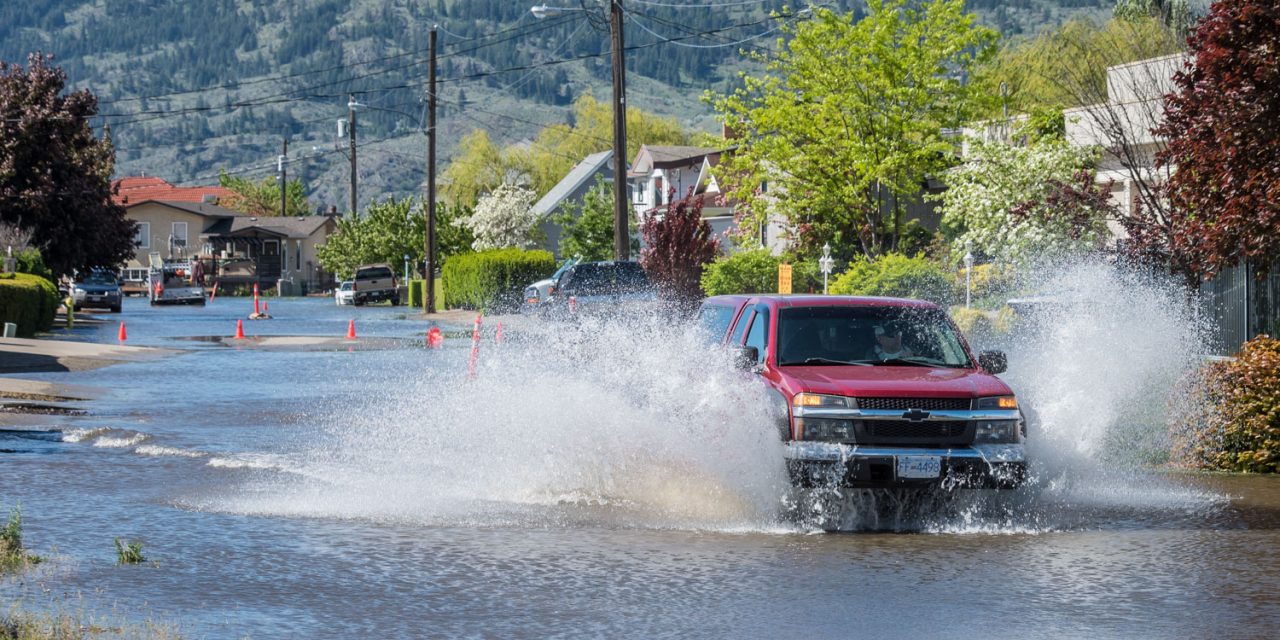

A truck makes a splash as it drives out of Solana Key. A number of homes on Solana Key and Harbour Key were put under evacuation order Thursday night. (Richard McGuire photo)
Residents of 23 homes on Harbour Key and Solana Key were ordered to evacuate Thursday evening under the local state of emergency.
The level of Osoyoos Lake is continuing to rise and as of 8:30 a.m. Friday, it was at 916.32 feet above sea level – approaching the 1972 peak of 917.06 feet.
Meanwhile, the Town of Osoyoos has ordered the use of sump pumps to be stopped immediately because the sewer system is overloading.
“The Town of Osoyoos is ordering that the act of directing basement flood or ground water directly into the town’s sewer system through the use of sump pumps or other infrastructure stop immediately,” the town said in a bulletin issued Thursday night.
“The town is also ordering that all homes or businesses with basement flood water cover their floor drains and use other methods of draining their flood water outside the home,” the bulletin continued.
“The act of causing this water to enter the sewer system in current conditions is causing pump infrastructure to function beyond capacity, which may result in a breakdown of the town sewer management system,” the town warned.
“Persons found to be continuing with the practice of directing basement and ground water into the town sewer system may be subject to penalty,” said the notice issued by Barry Romanko, Osoyoos chief administrative officer.
Meanwhile, there’s a glimmer of hope in that the Similkameen River discharge has dropped off slightly from its peak of 32,300 cubic feet per second (cfs) Thursday night.
As of 8:30 a.m. Friday, it was down to 31,100 cfs.
While the Similkameen doesn’t drain into Osoyoos Lake, it joins the Okanogan River just south of Oroville, Washington and high flows from the Similkameen are impeding the drainage from Osoyoos Lake.
The slight drop in the Similkameen could be short lived as temperatures are forecasted to climb into the weekend, which could cause more higher-elevation snow to melt.
The flood situation is the result of record-high snowpacks, which are more than double the normal amounts for this time of year, combined with warmer weather causing that snow to melt.
RICHARD McGUIRE
Osoyoos Times