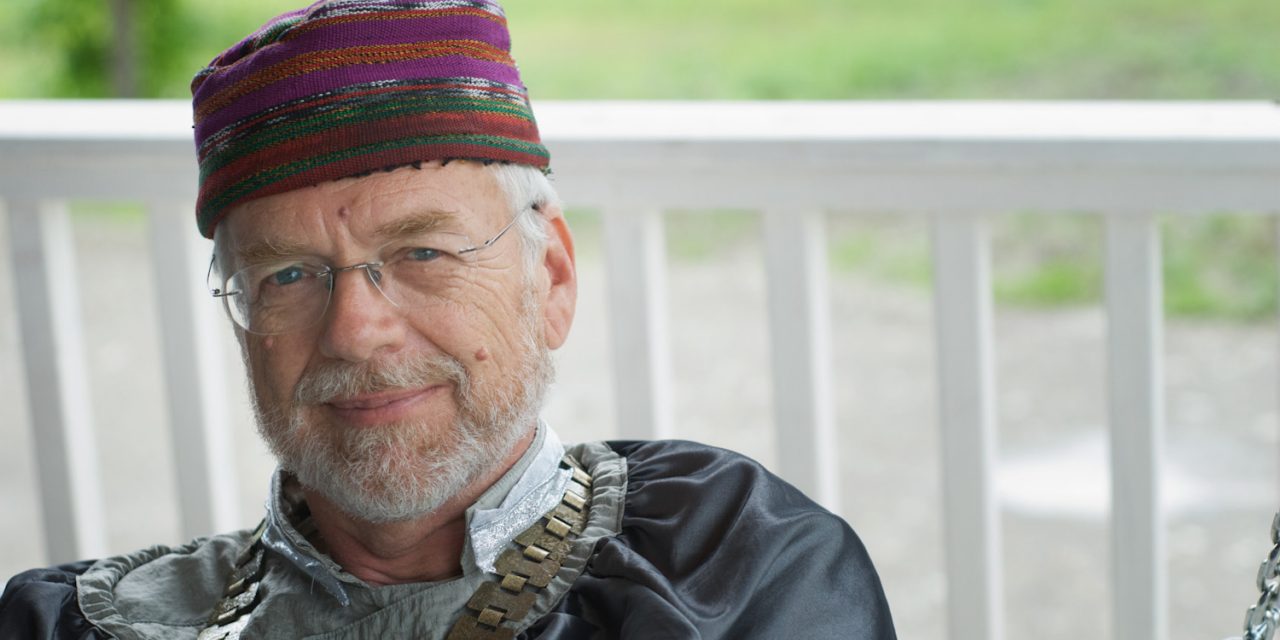

No one will forget Michael Newman’s wry smile and his knack for making everything right after a bad situation. His words prevented wars, and sometimes started them, but he was always steadfast in his beliefs.
Surrounded by loved ones, the long-time newsman lost his battle with pancreatic cancer on February 23. He was 68. A week before he passed, Michael joked that he would make sure it didn’t hinder the Chronicle’s Tuesday noon deadline. That’s okay, Michael, we survived.
Many people will remember this man for his undeniable wit and tenacity for the news; he was publisher of the Oliver Chronicle for 22 years.
Long-time employee Richard Schaffrick has fond memories of his fearless, outspoken boss.
“The staff was allowed to make their own decisions with little supervision. We appreciated that immensely.”
In 1986 Michael gave no better explanation for purchasing the Chronicle than one offered by Victor Kiam in his Remington razor ads: “I liked the product so much I bought the company.”
Michael always loved newspapers. He read them voraciously and took great pleasure in participating in the letters to the editor column. He once wrote that a decent newspaper is a civilized necessity in life.
Michael and family arrived in Oliver in 1980, buying a 10-acre orchard south of town. He became active in the local fruit industry, the concert society, the irrigation district and the regional district as rural director.
Michael arrived at the Chronicle with no training in running a newspaper, just an understanding of bookkeeping and his father’s stern instructions to avoid negative numbers on the balance sheet.
He was a stickler for fairness and accuracy, and didn’t feel the need to crack the whip as long as his staff met the deadline. His pet peeve was lateness; if you wanted a job at the Chronicle, you showed up on time or you didn’t show up at all. It was that simple.
Michael never shied away from controversy, often running stories that ruffled the feathers of those who deserved to be scrutinized. He schooled himself in matters of criminal court, which he covered religiously. On occasion he challenged the court when it imposed publication bans or other rules that kept the public in the dark. The public had a right to know and he fought for that right tooth and nail.
All of the lawyers and judges knew him by name and respected his knowledge.
Michael answered the call for advice from editors and other writers who wanted to make sure they got it right without getting into hot water.
He was known for listening to people no matter how strange they sounded, and provided them a venue to rant and rave about community issues. His grin and dry humour were almost famous, and his steel nerves served him well when others would have “lost it” in the face of harsh criticism. For example, Michael stood by his controversial decisions as president of the Oliver and District Heritage Society. His passion for heritage and rebuilding the museum was unbreakable.
His other passion was being an active member of the Oliver Rotary Club and doing humanitarian work for World Neighbours.
Schaffrick also recalled Michael’s passion for cooking.
“One year at a staff pre-Christmas dinner he tried out his new lamb recipe on us. Since I had never eaten lamb in my life, I was apprehensive. But he added plenty of spices and I survived the ordeal.”
When Michael sold the Chronicle to Robert Doull in 2008, he reflected on the newspaper business, saying it was the most enjoyable job he ever had. But he was looking forward to no longer living by a press deadline.
In an editorial that year, Michael wrote it would be nice not to carry the responsibility for someone’s opinion when he allowed him to vent on the letters page.
“I still firmly believe in running letters from the town idiots because I think the town needs to know who the idiots are.”
Retired from newspaper life, Michael found himself back where he started: being a simple subscriber eagerly awaiting the Chronicle’s arrival in Wednesday’s mail to see whether there was a delicious response to the idiot who wrote a letter the previous week.
As Michael would say to his staff as he left the office for the day, “Faster . . . more . . .”
Clarence Louie, chief of the Osoyoos Indian Band, recalled working with Michael on a historical housing project as a summer student.
“I remember him being a good boss – very helpful and respectful, and we got into some good educational discussions.”
Louie said Michael could talk and debate on most anything, and he always did it in a nice way.
“He brought me to his house a number of times and would always have his wife make us lunch. He had a nice educated demeanor about him.”
Dale Dodge, one of Michael’s many friends, worked with him on the board of World Neighbours Canada for six years.
“I had worked previously with him on the community health project about 15 years ago as well, and in both cases Michael impressed me with his knowledge, his wisdom and his ability to argue even the most contentious points with a smile on his face and a twinkle in his eye.”
Dodge said Michael’s dedication to World Neighbours Canada and the people of Honduras was impressive, to say the least.
“The Chorti people of Honduras and the townspeople of Oliver have both lost a passionate champion.”
Former Chronicle editor Frank Stariha said Michael clearly had newspapers in his blood.
“One of his favourite photographs, proudly displayed in his office, was of his grandfather at work on his typewriter, working on a news story. The acorn, indeed, didn’t fall far from the tree.”
Another attribute which stands out about Michael was the courage of his convictions, Stariha said.
“How many people would have put their very lives on the line by taking part in the freedom marches in the American South in the early 1960s as Michael did?”
Stariha said he and Michael didn’t always agree on everything, but “I never lost my respect for Michael, his innate intelligence, his sometimes scathing sense of humour, and his keen interest in virtually everything around him, a trait which served him well . . . you gave it a good run, Michael.”
Long-time friend and former employee Sue Morhun said Oliver has lost a man who was central to making many things happen for the betterment of the people of this community.
He was a thoughtful and responsible elected official both at the RDOS and Town council tables, and a dedicated volunteer, Morhun said.
“Most recently, Michael led a team of volunteers through the difficult task of revitalizing the Oliver and District Heritage Society and rejuvenating the 1924 BC police station (museum). His skilled leadership, his vision for a successful future in the face of opposition and his plain hard, physical work in this particular endeavour has created an enduring legacy for which we are grateful.”
Morhun said Oliver will miss him in many different ways.
“We will also be thankful for his courage in terms of tackling difficult tasks head on and his conviction that we all need to make this world a better place. That was always his motivation.”