By Don Urquhart, Times Chronicle
A record-setting half a million sockeye salmon are expected to return to Okanagan waterways this month to spawn, testament to years of work to rescue the devastated salmon ecosystem by the Okanagan Nation Alliance and its partners.
Last weekend saw the Okanagan Similkameen Conservation Alliance (OSCA) hold two open houses at the Okanagan River Restoration Initiative spawning beds just north of Oliver as well as at the Okanagan River Restoration Initiative spawning beds in Okanagan Lake in Penticton.
The Okanagan Nation Alliance (ONA) fishery department is anticipating 670,000 sockeye will return to the Columbia River with 80 per cent of those heading to the Okanagan waters from Osoyoos Lake northwards, according to Richard Bussanich, ONA’s head fish biologist.
This equates to over 530,000 sockeye, the highest number on record since the destructive channelizing of the Okanagan River in the early 1950s.
Speaking to Lee McFadyen who has been working with the ONA and OSCA for nearly two decades, this is a dramatic turnaround from the low point following channelization in which the number plummeted to only a couple of thousand virtually signalling the eventual total collapse should nothing be done.
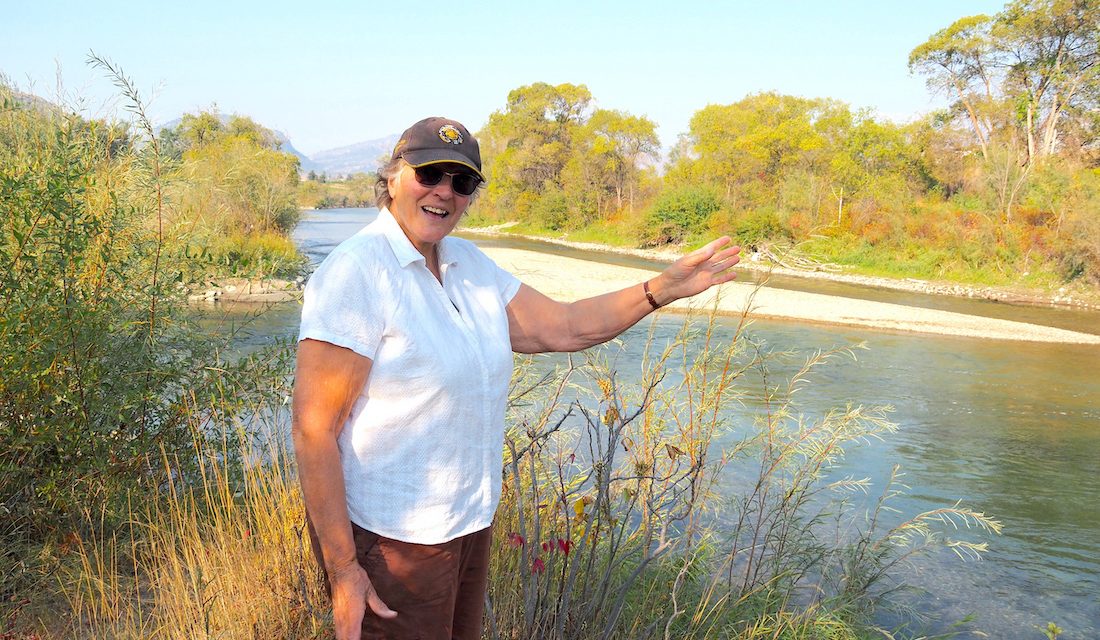
Peak spawning time is from the beginning of October to about the third week of the month, she noted. The bright red salmon can be seen spawning in the “re-wilded” section of the Okanagan channel just north of Oliver and from the pedestrian bridges crossing the channels.
The channelizing back in the day reflected conventional wisdom which lacked the scientific knowledge of what it would do to the salmon population. Colonial mentality also meant that First Nations peoples were not consulted.
With salmon numbers struggling for decades the Penticton Indian Band and some of the elders in particular began the groundwork for re-establishing the salmon.
McFadyen explains that this bumper year is the result of many factors including the large number of salmon fry that were released into Okanagan Lake four years ago. A large snow pack from last winter and a wet spring filled Okanagan Lake to its maximum point and that enabled a steady releasing of water that kept water levels high and water temperatures cool, both important factors for spawning salmon.
The salmon go through a four year cycle, she explains. One year as a fry in the local waters before they head for the ocean, only to return three years later to spawn. The salmon return thousands of miles to where they were hatched in a navigation process scientists believe is based on the earth’s magnetic field like a compass.
This has important consequences because as efforts are now underway to re-establish sockeye salmon in the Kootenays (fish ladders enable the salmon to surmount the numerous dams) fry will have to be taken from other areas such as the Okanagan, McFadyen says.
Whether one year in the local waters of the Kootenays will be enough to “reset” the salmon’s guidance mechanism remains to be seen. It is possible that fry taken from the Okanagan and transplanted to the Kootenays for instance, will ultimately come back to the Okanagan, McFadyen acknowledges.
The Okanagan Nation Alliance’s goal is to have the salmon return to all of their traditional territory which includes many of the streams that flow into Okanagan Lake.
McFadyen highlights that while the Okanagan waterways are part of the much vaster Columbia River system that stretches nearly 2,000 km from the Pacific Ocean just north of Portland Oregon all the way up beyond Golden and Revelstoke, it is not doing as well.
Numerous hydro-electric dams were built throughout the Columbia River watershed in both the US and in B.C.’s Kootenay region during the 1950s.
“When those dams were put in the sockeye were blocked so there are no sockeye in the Kootenays,” she said, adding that there are kokanee which are landlocked salmon.
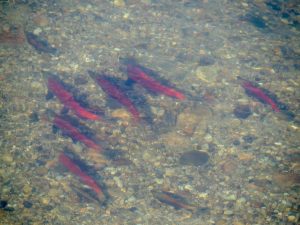
Spawning salmon with their distinctive colour on the Okanagan River just outside of Oliver.
Don Urquhart photo
McFadyen notes that in the entire Columbia River system there are only three rivers that support salmon any longer and the Okanagan is the main one.
“There is the Wenatchee in Washington State which is a reasonable run and there is also the Snake River which is barely holding on.”
“So this is extremely important and much more important than people realize because when you think of fish you think of eating the fish.
For First Nations peoples the salmon hold great cultural importance and in fact represent one of their four Food Chiefs – skemxist (Black Bear), siya (Saskatoon Berry), spitlem (Bitter Root), ntyxtix (salmon).
Return of salmon part of Columbia River Treaty negotiations
But on a wider scale McFadyen says that while most tend to think about the salmon in human terms, and not of the bears, coyotes, eagles, osprey, orcas, seals who all absolutely depend on these runs.
“So this makes the Okanagan River an extremely valuable river.”
She adds that it disturbs her to see people who thoughtlessly throw sticks in the river for their dogs to fetch or horse riders riding through the river, both of which directly impact the spawning salmon. This is simply a lack of awareness she feels, something remedied by more public education and signage at the river.
Work on re-establishing the salmon population began back in the 2000s with the renewal of a section of the Okanagan channel to reconnect part of the original river to the main channel. Work on this started in 2006 after a section of land along the river was purchased by Nature Trust of B.C. This was completed in 2009.
“We had to put a new dike in and concurrent with the reconnection, lots of gravel,” she says. An artificial island was created and since that time it has been shaped by the river and a new island has also formed. Gravel spawning beds were also created.
In 2014 the Penticton Indian Band opened its 2,322 sqm hatchery which has the capacity to rear eight million eggs. New salmon ladders at the MacIntyre Dam and the Okanagan Lake dam at Penticton were also key.
Buoyed by this success the projects will continue to create the necessary conditions for salmon to once again thrive throughout the entire Okanagan waterway.
“The First Nations are really working on that and it requires two things: will and energy, and it requires money and technology,” McFadyen said.
“If there is unlimited money available it could be done over a five-year period but there isn’t so it’s going to be maybe a 30 year period.”
Today there is the technology to put effective fish ladders on all the dams and there is technology to rebuild spawning beds. “We know how to do that and we’ve become very good at it so then it requires the will and the Sylix certainly have the will – they want the salmon back.”