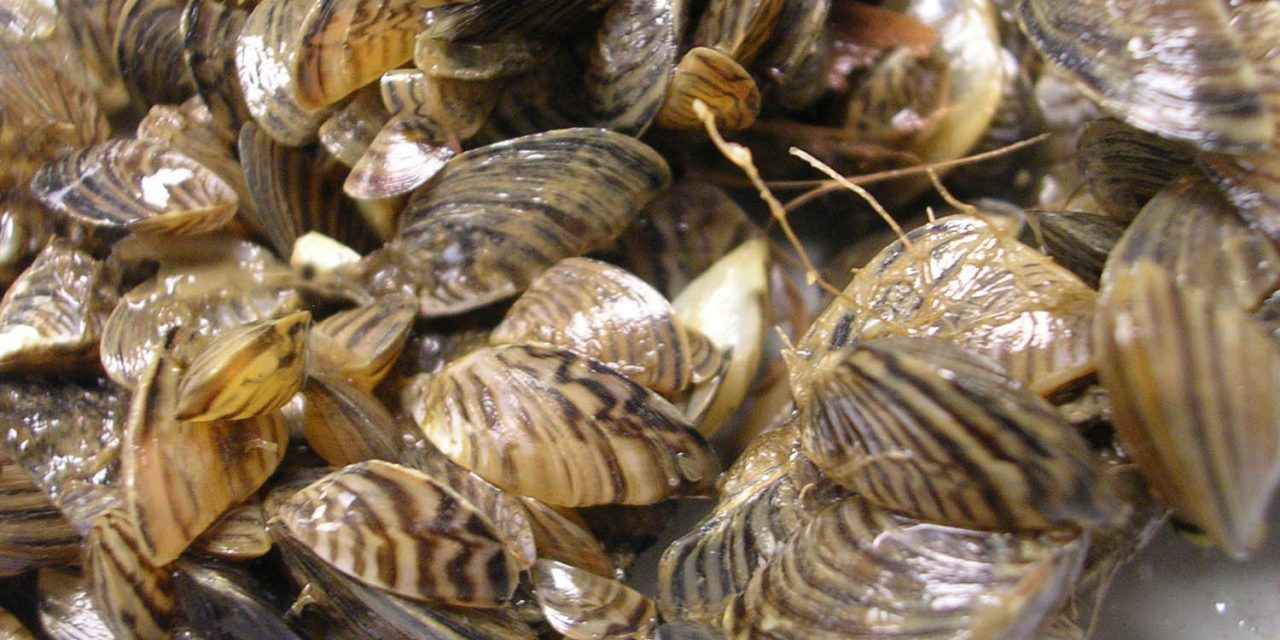
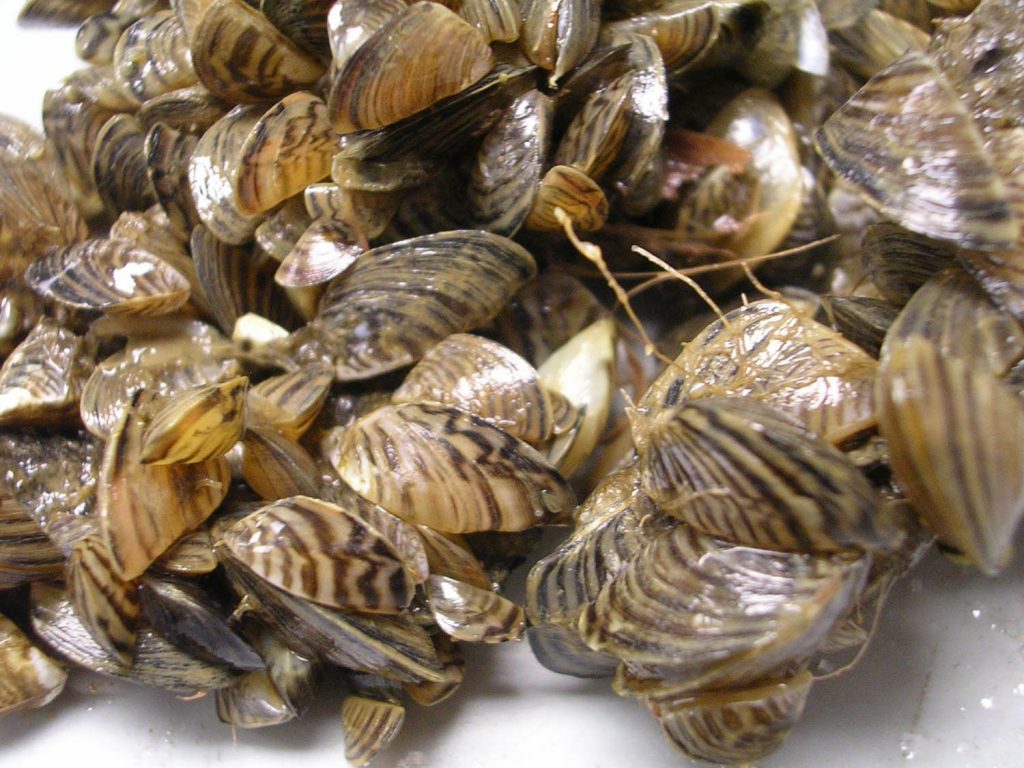
Zebra mussels (pictured here) have spread to Manitoba and quagga mussels have reached the Southwest United States. Now mussel larvae have been detected on reservoirs in Montana, the first time invasive mussels are known to have reached waterways in the Pacific Northwest. (U.S. Fish and Wildlife Service photo)
The so-called “perimeter defence” strategy intended to keep invasive mussels out of B.C. waterways has been called into question with the recent discovery of mussels in Montana.
This marks the first time that invasive zebra or quagga mussels have been detected in waterways of the Pacific Northwest.
The Okanagan Basin Water Board (OBWB ) is again calling on the federal and B.C. governments to step up zebra and quagga mussel defences in this province.
“We wish to again express our deep concern that not enough action is being taken to prevent invasive mussels from spreading within the Pacific Northwest,” OBWB Chair Doug Findlater said in a letter to Prime Minister Justin Trudeau and several federal ministers.
This year the B.C. government stepped up its mussel inspection program, which is largely funded by FortisBC, BC Hydro, Columbia Power and the Columbia Basin Trust.
But the eight inspection stations only operate for eight to 10 hours a day from April to October, and the OBWB says that’s not enough.
“We are pleased to see this, but there are still gaps in our defence, with inconsistent enforcement at our borders and inspection hours that are not long enough,” said Findlater. “This and more needs to be fixed now, before next year’s boating season.”
Under the perimeter defence strategy, there’s been an emphasis on stopping mussels from entering states and provinces on the perimeter of the Pacific Northwest before they reach B.C.
In early November, Montana Fish, Wildlife and Parks Department announced that water samples taken at Tiber Reservoir near Shelby tested positive for mussel larvae. Suspect results were also reported at Canyon Ferry Reservoir near the state capital of Helena.
No adult mussels have been found.
Invasive zebra and quagga mussels are typically spread by recreational boaters, who fail to properly clean, drain and dry their boats before transporting them from infested waterways.
Once established, these mussels proliferate and cover water intakes, bridges, docks, boats and anything else in the water.
Their razor-sharp shells cover beaches, making it dangerous for swimmers to go barefoot, impacting tourism.
The OBWB has estimated the annual cost to mitigate a mussel invasion in the Okanagan at $43 million.
Until now, most of the infestation has been in the eastern half of North America, but in recent years mussels have spread to waterways in the U.S. Southwest and to Manitoba.
Montana spends roughly $1 million U.S. annually to defend against aquatic invasive species, while Idaho, with a more comprehensive program, spends about $10 million.
The B.C. program for 2016 cost $2 million Canadian, with most of that funding coming from the hydro utilities and Columbia Basin Trust. OBWB wants to see stable funding.
The program identified 683 watercraft as coming from a “high-risk” province or state.
Of those, 17 were confirmed to be carrying adult invasive mussels. Of these, 14 came from Ontario and the other three were from Manitoba, Michigan and Nevada.
Crews also issued 92 decontamination orders as well as 46 tickets and 36 warnings to motorists with watercraft who failed to stop at the inspection stations as required by B.C. law.
In May, the OBWB wrote to the province calling for expanding inspections to at least daylight hours. They also called for more conservation officers including full-time officers with authority to pursue people who fail to stop for inspection.
The OBWB also called on the B.C. government to revise its legislation to require all watercraft entering B.C. to report to an inspection centre before launching in provincial waters.
Findlater is calling on the federal government to increase training and funding for the Canada Border Services Agency (CBSA) as well as to provide increased funding for infested provinces to contain the problem and mussel-free provinces to prevent it.
The OBWB also wants senior federal public servants assigned for forums such as the Pacific Northwest Economic Region Invasive Species Working Group “to demonstrate that the federal government takes this issue seriously.”
RICHARD McGUIRE
Osoyoos Times