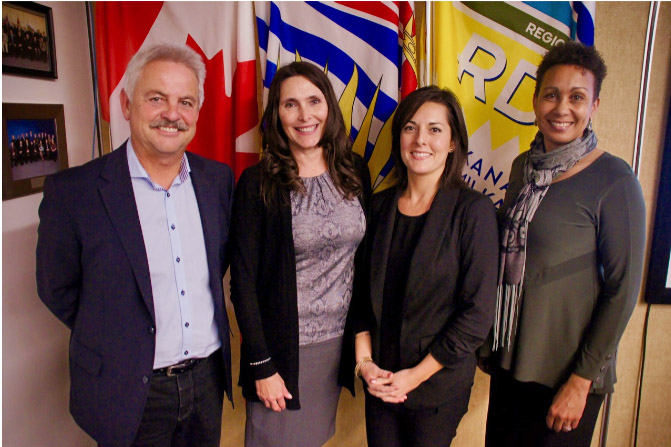
Dale Boyd/Osoyoos Times
By Dale Boyd
Osoyoos Times
Residents of the Regional District Okanagan-Similkameen (RDOS) could see their taxes go up roughly $1.11 a year as directors seek to equalize their pay following federal tax exemption changes.
At the Dec. 5 meeting the board directors voted 16-3 to accept the recommendation from the citizens’ committee to raise their pay by 11.9 per cent.
Starting on Jan. 1, 2019 one-third of board director’s income was no longer tax-free due to changes in the federal budget.
Should the board pass the recommendation at their Dec. 19 meeting, a total of $60,000 split in varying amounts across all board directors would need to be budgeted.
The RDOS joins many regional governments across the province in adjusting their pay rates in response to the federal changes, said board chair Karla Kozakevich.
“Many councils and regional districts made a decision to make an increase to offset the loss, the loss you would have on your take-home pay, so many made that decision prior to the October 2018 election. Others said let’s leave it to the new boards to decide how they want to proceed. So that’s what the previous RDOS board did,” Kozakevich said.
The recommendation was put forward by a five-member committee appointed to investigate the changes. The committee recommended the 11.9 per cent increase. The increase would see a $3,943 increase to a total of $37,079 a year for the board chair, an increase of $718 to a total of $6,756 a year for the vice chair, a $760 increase to a total of $7,148 a year for a municipal director and electoral area directors increasing by $2,629 to a total of $24,724 a year.
Read more: Kozakevich remains board chair, Holmes elected vice chair
Kozakevich noted the last time the RDOS directors had a pay increase was 2012, and the new measures are “not a pay increase in the sense of actually getting a raise, but just to equalize our pay so that we weren’t actually taking home less pay. So for me, I worked seven years as a politician, and then in my eighth year I actually earned less money because of this federal change,” she said.
The move was led by RDOS residents who applied to join the committee, Kozakevich noted.
“Then you have citizens reviewing and making recommendations instead of the politicians reviewing their own pay. So the citizen volunteer group came back and said they compared to other regional districts, they looked at and we haven’t had a pay increase in, I think, eight years,” Kozakevich said.
Lionel Trudel, a member of the Elected Officials Compensation Committee, said they researched the issue by comparing directors’ stipends in other similar-sized districts. He noted that these districts were also moving ahead to increase the pay of their board members to offset the tax change.
“These directors are glorified volunteers who work for very low wages (for the amount of time they spend on the job).”
Trudel said local directors have not had a pay increase since 2012. He added that it would be hard to attract people to serve on the board if their stipends kept decreasing.
Trudel stated he is all in favour of fiscal conservatism, but he truly believes directors on the board deserve to be fairly compensated.
He said this issue was only brought forward due to the impact of the tax changes. However, there may still be some discussion as the board brings the decision to their regular agenda on Dec. 19.
“It has to come back on December 19, to the formal board agenda meeting to be to be finally adopted, so it may garner some more discussion. It could get voted down for all we know,” Kozakevich said.